- IDP in insurance automates data extraction from unstructured forms, reducing claims processing time compared to manual entry.
- AI-driven validation minimizes human error and allows insurance teams to handle massive document spikes without increasing operational headcount.
- Modern IDP platforms connect directly with legacy policy systems via APIs, transforming messy paperwork into structured, actionable data.
Insurance operations are predominantly document-centric workflows, making Intelligent Document Processing in Insurance increasingly essential for handling growing document volumes efficiently. Today, instead of paper alone, teams manage PDFs, scanned forms, handwritten claims, digital attachments, and a wide range of document types arriving in multiple formats. Each document must be processed accurately, quickly, and at scale.
This document volume introduces measurable operational costs. Policies, claims, applications, loss runs, certificates, and inspection reports all require data to be extracted, validated, and routed into downstream systems. When handled manually, this process increases the risk of errors and extends turnaround times. When automated effectively, it significantly improves efficiency and accuracy while maintaining operational bandwidth.
This guide explains what Intelligent Document Processing in Insurance is, how it works in insurance workflows, where it delivers the most impact, and how to implement it without disrupting existing operations.
What Is Intelligent Document Processing in Insurance?
Intelligent Document Processing (IDP) uses AI technologies such as OCR, NLP, and machine learning to automatically extract, classify, and validate data from documents without manual effort. In insurance, it converts unstructured inputs like handwritten FNOLs, medical reports, and multi-page applications into structured, actionable data that can directly flow into policy management, claims, and underwriting systems.
IDP vs. OCR vs. RPA in Insurance: What's the Difference?
Insurers often already use OCR or RPA somewhere in their operations, which raises a fair question: why isn't that enough? Each technology solves a different part of the document problem, and understanding where they stop is what makes the case for IDP.
OCR converts scanned or image-based text into machine-readable characters. It reads a page but doesn't understand it; a loss run and a lease agreement look identical to OCR once the text is extracted.
RPA automates repetitive, rule-based tasks by mimicking clicks and keystrokes across systems. It's effective for structured, predictable steps, but it can't interpret a document it hasn't seen before, and it breaks when formats change.
IDP combines OCR with NLP and machine learning, so it doesn't just read a document; it understands what the document is, where each value belongs, and whether the extracted data is trustworthy enough to act on.
In practice, most insurers don't replace RPA, they pair it with IDP. IDP handles the judgment-heavy work of reading and validating a document; RPA (or native system APIs) carries the clean data the rest of the way into the workflow.
What Is The Significance Of Intelligent Document Processing In Insurance?
Insurance is one of the most document-intensive industries. A single commercial property claim can create many supporting files. A new policy application may include broker submissions, prior loss histories, supplemental forms, and signed documents. Each document must be processed and its data extracted before underwriting can begin.
That volume has traditionally demanded large operations teams. As document flows grow and customer expectations for faster turnaround increase, the manual model becomes harder to sustain. The industry is at an inflection point: McKinsey's 2025 analysis puts full AI adoption in insurance at just 34% across the industry, up from 8% the year prior.
The gap between early movers and the rest is widening. Teams that continue to process documents manually are operating at a structural disadvantage in speed, cost, and accuracy.
Where IDP Delivers the Most Impact: Core Insurance Use Cases
IDP isn't a single tool applied uniformly; it's configured differently for each insurance function, because each function works with different documents, extracts different data, and routes decisions to different systems. Below is how that plays out across the four areas where insurers see the fastest returns.
IDP for Claims and FNOL Processing
Incoming documents: First Notice of Loss forms, police reports, photos and damage estimates, medical bills and records, repair invoices, and claimant correspondence often arriving as a mix of PDFs, scanned faxes, and mobile photo uploads within the first 24–48 hours of a loss.
Data extracted: Claimant and policy details, date and cause of loss, injury or damage description, estimated loss amount, involved parties, and policy number for matching against the system of record.
Validation: The extracted policy number and claimant details are cross-checked against the policy administration system to confirm active coverage. Loss date is validated against the policy period, and duplicate FNOL submissions are flagged.
Exceptions: Illegible handwriting on FNOL forms, missing policy numbers, or loss details that don't match any active policy get routed to a claims adjuster for manual review, only the flagged fields, not the entire file.
Destination/action: Clean, validated data flows directly into the claims management system, triggering automatic claim creation, adjuster assignment, and initial reserve setting, cutting the intake-to-assignment window from days to minutes.
IDP for Underwriting Submissions
Incoming documents: ACORD applications (125, 130, 140, and line-specific forms), broker submission packages, prior loss histories, inspection and engineering reports, financial statements, and for commercial property risks: Statement of Values (SOV) and Total Insured Value (TIV) schedules.
Data extracted: Applicant and risk details, coverage limits requested, prior loss frequency and severity, property or operational characteristics, financial ratios from statements, and per-location values from SOV/TIV data used to assess concentration risk.
Validation: Loss history figures are cross-referenced against carrier loss run data where available. SOV entries are checked for internal consistency (values, addresses, construction types), and financial statement figures are sanity-checked against submitted revenue or asset ranges.
Exceptions: Submissions with incomplete SOV schedules, inconsistent financials, or loss histories that don't reconcile get flagged to an underwriter with the specific discrepancy highlighted, rather than requiring a full re-review of the submission package.
Destination/action: Structured risk data; coverage requested, loss history summary, TIV by location flows into the underwriting engine or rating platform, giving underwriters a decision-ready risk profile instead of a stack of PDFs to manually key in.
IDP for Policy Servicing
Incoming documents: Endorsement requests, address and coverage change forms, renewal applications, certificates of insurance requests, and cancellation or reinstatement notices.
Data extracted: Policy number, requested change type, effective date, updated coverage or limit details, and any supporting documentation attached to the request.
Validation: The policy number and requested change are checked against the current policy record to confirm the change is valid, for example, that a requested coverage increase doesn't exceed underwriting authority limits, or that the policy isn't already in cancellation status.
Exceptions: Requests involving conflicting effective dates, missing signatures on endorsement forms, or changes outside standard authority get routed to a policy servicing specialist for approval.
Destination/action: Approved changes are written directly into the Policy Administration System (PAS), updating the policy record and triggering any downstream billing or documentation changes automatically, no manual re-keying of the endorsement.
IDP for Financial and Bordereaux Processing
Incoming documents: Premium and claims bordereaux from MGAs and reinsurance partners, broker statements of account, and reconciliation reports; typically delivered as spreadsheets or PDFs with inconsistent formats across sources.
Data extracted: Policy-level and transaction-level detail: premiums written, commissions, claims paid, and reserves mapped to a standardized internal schema regardless of the source format.
Validation: Line-item totals are checked against summary totals for reconciliation, and figures are cross-referenced against the insurer's own policy and claims records to catch discrepancies before they hit the books.
Exceptions: Bordereaux with totals that don't reconcile, unmapped policy numbers, or missing required fields are flagged for a financial analyst to resolve, with the specific mismatch identified rather than the whole file rejected.
Destination/action: Reconciled data feeds into finance and accounting systems for premium accounting, commission payments, and reserve reporting, removing one of the most manual, spreadsheet-heavy processes in insurance operations.
How Intelligent Document Processing Works in Insurance?
Insurance workflows depend on handling large volumes of documents quickly and accurately. Intelligent Document Processing (IDP) streamlines this by combining OCR, AI, and automation to turn unstructured data into usable insights. The process follows a structured flow that ensures speed, accuracy, and minimal manual intervention.
Step 1: Document Ingestion
Insurance documents enter the system from multiple sources, including email attachments, agent portals, scanned faxes, uploaded files, and API integrations. The IDP platform collects and organizes these inputs into a centralized queue, ensuring every document is captured, standardized, and ready for consistent downstream processing without manual intervention.
Step 2: Classification
Once ingested, the system automatically identifies the document type, such as claims forms, policy applications, broker submissions, or medical records. This classification step is critical because it determines which extraction logic or model will be applied, enabling accurate handling of both structured templates and highly variable document formats.
Step 3: Data Extraction
The platform uses OCR to convert text into machine-readable data, while NLP and machine learning models interpret context and map values to the correct fields. Structured documents follow predefined patterns, whereas unstructured documents rely on contextual understanding to accurately extract relevant information without fixed templates.
Step 4: Validation
Extracted data is validated using predefined business rules, internal systems, and external data sources. For example, policy numbers are checked against system records, and personal details are cross-referenced for accuracy. Any inconsistencies, missing values, or anomalies are automatically flagged to ensure data reliability before further processing.
Step 5: Human Review (Exception Handling)
When the system detects low-confidence fields or exceptions, only those specific data points are routed to human reviewers. This targeted approach minimizes manual effort while maintaining accuracy. Reviewers validate or correct flagged fields, ensuring the process remains efficient, auditable, and aligned with compliance requirements.
Step 6: Data Output and Integration
After validation, clean and structured data is seamlessly delivered into downstream systems such as claims platforms, policy administration systems, underwriting tools, or data warehouses. This eliminates manual data entry, accelerates processing cycles, and ensures consistent data availability across insurance workflows and business operations.
How IDP Integrates Into Insurance Workflows
Extraction only matters once validated data reaches the system that acts on it. Here's what that looks like in practice.
FNOL → validation → claim creation. IDP extracts and validates loss details against the PAS in real time, then pushes structured data into the claims system via API — auto-creating the claim and assigning an adjuster.
Underwriting submission → risk fields → underwriting engine. IDP pulls coverage requests, loss history, and TIV from a broker submission, validates them, and feeds the underwriting engine a decision-ready risk profile instead of raw PDFs.
Endorsement → PAS update. Approved changes are written directly into the PAS, with only out-of-parameter requests routed to a human.
Key Benefits of IDP in Insurance Operations
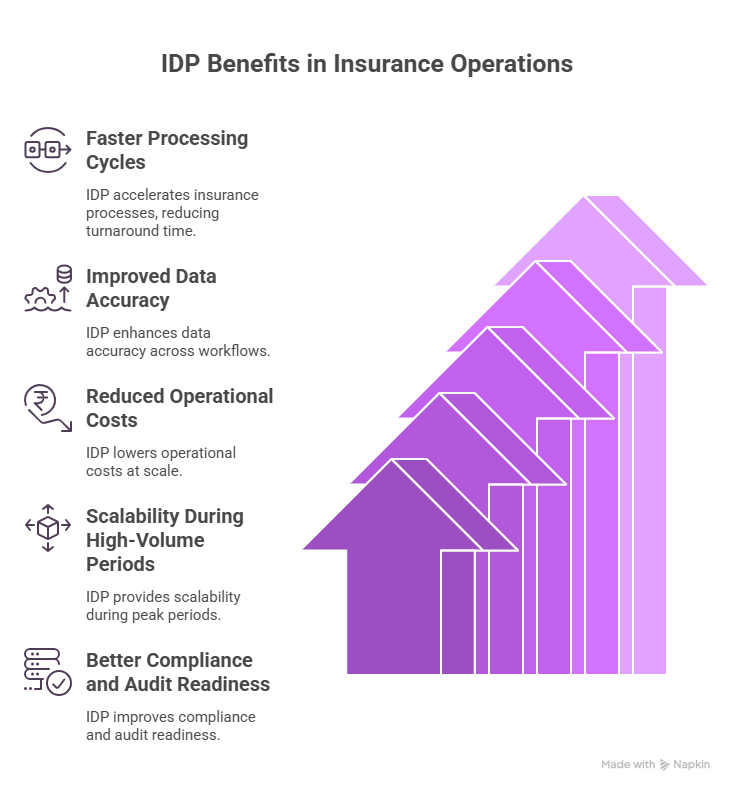
Intelligent Document Processing (IDP) improves how insurers handle document-heavy workflows across claims, underwriting, and policy servicing. By reducing manual steps and using AI-driven automation, it helps teams process documents faster, lower errors, and scale operations without increasing costs.
Faster Processing Cycles (Reduced Turnaround Time)
Eliminating manual data entry significantly reduces processing time across insurance workflows. Claims that once waited in intake queues for days can now be processed in minutes or hours. Underwriting submissions and policy updates move faster, enabling insurers to respond quickly and improve overall customer experience. According to McKinsey & Company, automation in insurance workflows can reduce claims processing time by up to 50%, significantly improving operational efficiency and customer experience.
Improved Data Accuracy Across Workflows
Manual entry often leads to inconsistencies and transcription errors, especially at scale. IDP systems apply consistent logic to extract and validate data, reducing error rates. This improves downstream processes by minimizing corrections, preventing payment inaccuracies, and reducing disputes across claims and policy management.
Reduced Operational Costs at Scale
By automating extraction from insurance documents, teams can handle larger volumes without increasing headcount. This leads to long-term cost efficiency, as fewer resources are required for repetitive tasks. Over time, organizations adopting automation at scale benefit from compounding savings and improved operational productivity.
Scalability During High-Volume Periods
Insurance operations often face sudden spikes during renewals, catastrophe events, or peak submission cycles. IDP systems can scale instantly to process increased volumes without delays. This eliminates the need for temporary staffing and prevents backlog accumulation during critical business periods.
Better Compliance and Audit Readiness
Every document processed through IDP generates a detailed audit trail, including extracted fields, validation steps, flagged issues, and final decisions. This structured logging supports regulatory compliance and simplifies audits, enabling insurers to maintain transparency and quickly respond to internal or external reviews.
Common Challenges of Implementing IDP in Insurance
While IDP delivers strong benefits, implementation requires careful planning. Understanding common challenges helps insurers avoid delays, improve adoption, and achieve faster time-to-value.
Document Variability Across Sources
Insurance documents originate from multiple sources, such as brokers, hospitals, claimants, and employers. Each source follows different formats and layouts. IDP models must be trained on diverse, real-world document samples to ensure consistent performance across this variability.
Handwriting and Poor Image Quality
Many insurance documents are scanned or handwritten, introducing noise and inconsistencies. Poor image quality can impact extraction accuracy. Advanced OCR and image enhancement capabilities are essential to handle these variations effectively and maintain reliable data capture.
Integration with Legacy Systems
Many insurers rely on legacy policy administration and claims systems that were not designed for modern integrations. Connecting IDP platforms to these systems via APIs can be complex and time-consuming, often becoming the longest phase of implementation.
Designing Efficient Exception Handling
Not all documents can be processed with high confidence. Effective IDP systems route only flagged fields to human reviewers instead of entire documents. Designing this workflow correctly is critical to maintaining efficiency while ensuring accuracy and compliance.
Model Training and Ongoing Maintenance
IDP models require initial training using labeled data from real insurance documents. Over time, document formats evolve, requiring continuous updates and retraining. A strong feedback loop ensures that accuracy improves rather than degrades as volumes increase.
How to Evaluate an IDP Solution for Insurance?
Not all IDP platforms are equally effective for insurance use cases. Evaluating the right solution requires focusing on performance, scalability, and industry-specific capabilities rather than just feature lists.
Accuracy on Unstructured Insurance Documents
Most platforms perform well on structured forms, but the real test is handling complex, unstructured documents. These include handwritten FNOLs, medical records, and multi-page loss runs. Evaluate accuracy benchmarks on similar real-world documents before making a decision.
Availability of Pre-Built Insurance Models
Starting from scratch increases implementation time. Platforms with pre-trained models for common insurance documents, such as ACORD forms and certificates, reduce setup effort and accelerate time-to-value, allowing teams to see results faster.
Integration Flexibility with Existing Systems
A strong IDP platform should integrate seamlessly with existing claims, underwriting, and policy systems. Evaluate API capabilities, supported connectors, and the level of effort required to implement integrations within your current technology stack.
Exception Handling and Human-in-the-Loop Design
The efficiency of an IDP system depends not just on extraction accuracy but also on how it handles exceptions. Well-designed workflows ensure that human reviewers only intervene where necessary, keeping workloads manageable and maintaining high throughput.
Security and Compliance Capabilities
Insurance data includes sensitive information such as PII and PHI. The chosen platform must meet strict security and compliance standards. Evaluate certifications, data handling practices, and regulatory alignment to ensure data protection and compliance readiness.
Throughput and Scalability Under Load
Accuracy on a demo document set doesn't tell you how a platform behaves at renewal-season or catastrophe-event volumes. Ask vendors for throughput benchmarks under peak load, not just steady-state numbers, and request a proof of concept using your own volume spikes, not idealized test batches.
Feedback Loops and Continuous Learning
A platform that doesn't improve from corrected exceptions will require the same manual review indefinitely. Evaluate whether flagged corrections actually retrain the model over time, and ask how quickly accuracy improves after a new document variant is introduced.
Total Cost of Ownership and ROI
The license fee is rarely the full cost. Factor in implementation time, integration effort, ongoing model maintenance, and the human review overhead that remains after go-live. Ask vendors to walk through a realistic ROI timeline based on your document volumes, not a generic case study.
Insurance-Specific Deployment Experience
A platform that performs well on invoices or receipts doesn't automatically transfer to ACORD forms, loss runs, and handwritten FNOLs. Ask for reference deployments specifically within insurance, and request accuracy benchmarks on the same document types you process.
Implementation and Support Maturity
Integration with legacy PAS and claims systems is often the longest phase of a rollout. Evaluate the vendor's track record on implementation timelines, the depth of their insurance-specific support team, and what post-launch support looks like once document formats inevitably shift.
How Infrrd Supports Intelligent Document Processing In Insurance?
Infrrd is built specifically for high-complexity document processing, the kind that matters most in insurance.
Trained on Insurance Document Types
Infrrd's models are trained on the document types insurers actually process: ACORD forms across commercial and personal lines, FNOL submissions, medical records, inspection reports, certificates of insurance, and loss runs. Teams spend less time on model training and more time on results.
High Accuracy on Unstructured Content
Where standard OCR struggles with handwritten fields and non-standard form layouts, Infrrd's AI maintains high extraction accuracy which is exactly why automating ACORD 130 workers compensation data with IDP delivers the accuracy improvements that manual review and OCR alone cannot. The platform handles the edge cases, not just the clean ones.
Exception Handling Built for Operations Teams
When a document falls below confidence thresholds, Infrrd sends only the flagged fields to a human reviewer, not the full document. Reviewers focus only on what needs attention, without going through already processed data. This keeps exception queues short and easy to manage.
Integration With Existing Insurance Systems
Infrrd integrates with policy administration systems, claims platforms, and underwriting workbenches through API connections. Data extracted from documents flows directly into downstream systems, removing the manual re-entry step from the workflow.
Case Study For IDP in Insurance: State National
Insurance provider State National struggled with OCR limitations and manual document intake. By implementing Infrrd’s IDP solution, they automated data extraction across complex document variations without templates. This reduced processing time, lowered costs, improved accuracy, and enabled scalable operations without increasing staff.
Want the full story?
Read this ebook to discover how Infrrd helped State National transform document intake and unlock scalable insurance automation.
Conclusion
The document problem in insurance isn't going away. Volume will continue to grow, document types will continue to diversify, and the gap between teams that process documents efficiently and those that don't will continue to widen.
Intelligent Document Processing gives insurance organizations a way to close that gap, not by replacing the humans who review and decide, but by removing the manual extraction work that slows everything else down. The organizations implementing IDP today are building the operational foundation to handle more volume, faster, with better data quality. That's not a future state. It's what good document processing looks like right now.
FAQs About Intelligent Document Processing for Insurance
What is intelligent document processing in insurance?
Intelligent Document Processing (IDP) uses AI and machine learning to automatically extract, classify, and validate data from insurance documents, including claims forms, applications, and medical records, without manual data entry.
How does IDP differ from basic OCR in insurance?
Basic OCR converts image-based text to digital text but doesn't understand context or structure. IDP layers NLP and machine learning on top of OCR so the system understands what each piece of extracted data means and where it belongs in a downstream workflow.
Which insurance document types can IDP process?
IDP can process ACORD forms, FNOLs, medical records, loss runs, certificates of insurance, inspection reports, driver records, signed endorsements, and most other document types that flow through insurance operations.
How accurate is IDP for insurance document extraction?
Accuracy depends on the platform and document type. Well-trained IDP models typically achieve high accuracy on standard document types, with exception-handling workflows managing documents that fall below confidence thresholds.
Can IDP integrate with existing policy management and claims systems?
Yes. Most enterprise IDP platforms support API-based integration with common policy administration and claims systems. The integration scope and complexity vary depending on the target system's architecture.
How long does it take to implement IDP in an insurance organization?
Implementation timelines vary based on document complexity, integration requirements, and existing infrastructure. Basic deployments with pre-built models can go live in weeks. More complex multi-line implementations typically take a few months.