- Straight-through processing (STP) in insurance refers to the automation of end-to-end insurance workflows without human intervention.
- Straight-through processing insurance relies on a sequence of automated steps.
- Achieving high straight-through processing rates is no longer a luxury, it is the baseline for insurance competitiveness in 2026.
Insurance companies process thousands of documents and transactions daily, from policies and claims to inspection reports and customer forms, with each document passing through multiple systems before a decision is reached. Every manual step in this chain slows the process down and increases the likelihood of errors.
Straight-through processing addresses this by automating data movement across systems, applying validation rules, and reserving human involvement only for exceptions. For many insurers, it has become the foundation of modern operations — driving faster decisions, better customer experiences, and measurably lower operational costs.
Industry research highlights the potential that remains. A report from McKinsey found that up to 95% of insurance policies could pass through underwriting without human involvement when supported by advanced analytics and automation.
Despite this opportunity, most insurers have yet to achieve high STP rates. Documents still arrive in different formats, many systems operate in isolation, and data often requires manual verification.
This guide explains how straight-through processing insurance works, where it applies, and how insurers move toward higher automation rates.
What Is Straight Through Processing In Insurance?
Straight-through processing (STP) in insurance refers to the automation of end-to-end insurance workflows without human intervention. Data moves automatically from input to final decision through integrated systems and rules.
The system captures incoming documents or digital data, extracts relevant fields, validates information, and processes the transaction. Human reviewers only examine cases that require clarification or additional information.
Straight-through processing helps insurers reduce delays, minimize errors, and increase operational efficiency.
Examples Of Straight Through Processing In Insurance
Several insurance workflows already support partial straight-through processing (STP), especially in digital policy issuance.
For example, a customer applies for an insurance policy by filling out an online form and uploading required documents such as identity proof, income details, or medical information. Once the submission is complete, automated systems capture the data from these inputs and validate it against predefined rules.
The system checks eligibility based on factors such as age, location, and policy criteria. It also evaluates risk using available data and applies pricing models to determine the premium. If all inputs fall within acceptable thresholds and no exceptions are detected, the system proceeds without manual intervention.
In this case, the platform automatically processes insurance application forms with high-level speed and accuracy. Human review is only required if the system identifies missing information, inconsistencies, or higher-risk cases that fall outside standard rules
Claims processing offers another example. Straight-through processing can begin at First Notice of Loss (FNOL), when the policyholder first reports a claim. If the submitted information is complete, documentation is clear, and policy details match, automated systems can validate coverage and move eligible claims toward approval and payment without manual review.
What Can Be Processed Straight Through in Insurance and What Still Requires Human Review
Not every workflow fits full automation immediately. However, several processes show strong potential for straight-through processing in insurance. These processes typically share common characteristics like standardized inputs, consistent decision rules, and predictable outcomes, which makes them well-suited for end-to-end automation with minimal human intervention.
Not every insurance transaction is a good candidate for straight-through processing. Cases involving greater complexity, uncertainty, regulatory scrutiny, or judgment are more likely to require human review.
The goal of STP is therefore not necessarily to remove humans from every insurance process, but to automate predictable cases while routing exceptions to the right reviewer.
Correct routing also matters. Allowing a risky claim to pass through STP can lead to claims leakage, regulatory exposure, or customer complaints, while routing too many straightforward claims for review reduces the efficiency STP is designed to create.
How Straight Through Processing In Insurance Works?
Straight-through processing insurance relies on a sequence of automated steps. Each step moves data through systems without manual entry. Modern insurance platforms combine document processing technology, artificial intelligence models, and workflow automation tools to support this flow.
Data Ingestion And Document Capture
The process begins the moment the system receives data from any one of several entry points. Customers may submit documents through digital portals, mobile applications, or email, while insurers also capture incoming files directly from partner systems such as repair shops or healthcare providers. Regardless of the source, the system automatically organises all incoming files and prepares them for the next stage of processing.
Data Extraction And Validation
Once documents have been captured, extraction technology goes to work identifying the relevant data fields within each file. These fields typically include policy numbers, customer information, claim descriptions, and financial values.
Advanced document processing tools are capable of reading both structured and unstructured content, pulling information from standard forms, scanned documents, and images alike. The extracted data is then cross-referenced against internal records, with validation rules confirming policy status, coverage limits, and claim eligibility before the workflow can proceed.
Automated Decision Workflows
With validation complete, decision engines take over and apply a set of predefined business rules to determine the appropriate outcome. A system might, for instance, automatically approve a claim if the payout value falls below a specified threshold and all relevant policy conditions satisfy the eligibility criteria.
When every rule is met, the system advances the case through the pipeline without any need for manual review, keeping the process both fast and consistent.
Exception Handling And Human Review
Not every transaction is straightforward enough to qualify for full automation. When the system encounters missing information, unusual patterns, or policy conflicts that fall outside its predefined rules, it flags the case and routes it to a human reviewer for closer examination. Reviewers analyse these exceptions and make the final call where automated judgment falls short. This hybrid model allows insurers to progressively expand their use of straight-through processing while preserving the operational oversight needed to handle complexity responsibly.
How Straight-Through Processing Works Across Insurance Workflows
Straight-through processing follows the same basic pattern across insurance: capture incoming information, validate it, apply decision rules, and either complete the transaction automatically or route an exception for review. The steps differ depending on the workflow.

Claims Processing
FNOL → Document Capture → Coverage Validation → Fraud/Risk Checks → Eligibility Decision → Payment or Exception Review
STP can begin at First Notice of Loss (FNOL), where claim information and supporting documents are captured. The system validates coverage, checks risk and eligibility rules, and moves qualifying claims toward payment. Cases with missing information, suspicious activity, or policy conflicts are routed for review.
Underwriting
Application → Supporting Documents → Data Verification → Risk Rules → Quote/Decision or Underwriter Review
Application data and supporting documents are captured and verified against predefined underwriting criteria. Low-risk cases that meet established thresholds can move directly to a quote or decision, while cases requiring judgment are routed to an underwriter.
Policy Issuance
Application → Identity & Eligibility Validation → Coverage Checks → Pricing → Policy Generation or Exception Review
Customer information is validated before eligibility, coverage, and pricing rules are applied. When requirements are met, the policy can be generated automatically. Incomplete or conflicting information interrupts STP and triggers review.
Policy Renewals
Existing Policy Data → Updated Risk Checks → Eligibility Validation → Renewal Decision → Policy Renewal or Review
Renewal workflows use existing policy and customer data to reassess eligibility and risk. Policies that remain within predefined thresholds can renew automatically, while material changes or exceptions are routed for review.
Insurance Document Processing
Document Intake → Classification → Data Extraction → Validation → Downstream System or Exception Review
Document processing supports each of these workflows by turning incoming insurance documents into structured, validated data. Once the information is ready for downstream systems, the transaction can continue automatically unless an exception requires human intervention.
Technologies That Enable Straight Through Processing
Several technologies work in concert to enable straight-through processing in insurance, each addressing a different stage of the workflow. Together, they form a connected automation environment capable of moving information reliably across systems from start to finish.
Intelligent Document Processing (IDP)
Intelligent Document Processing sits at the core of STP adoption in insurance. IDP systems extract information from claims forms, invoices, inspection reports, and policy records, converting document content into structured formats that downstream automation platforms can readily process. By eliminating manual data entry at the document stage, IDP prepares transactions for automated workflows from the very first step.
Artificial Intelligence And Machine Learning
Artificial intelligence enables systems to apply decision rules with far greater sophistication than traditional rule engines. Machine learning models analyse historical data to identify patterns in claims behaviour and underwriting outcomes, supporting more accurate validation and stronger fraud detection. AI also improves document interpretation accuracy over time by continuously learning from past examples.
Workflow Orchestration And APIs
Workflow automation tools define and coordinate every step of an insurance transaction, from document capture and data extraction through to validation, approval, and payment. Application programming interfaces complement this by enabling different systems to exchange data in real time, connecting policy platforms, claims systems, and customer portals into a unified operational environment.
Core System Integrations
For straight-through processing to work effectively, policy administration systems, claims management platforms, and document repositories must communicate seamlessly with one another. This integration allows automation platforms to retrieve policy details, validate claim data, and update records without manual intervention. Where integration is absent, automation workflows stall, and the efficiency gains of STP are significantly diminished.
Why Insurance Companies Still Struggle With Straight-Through Processing
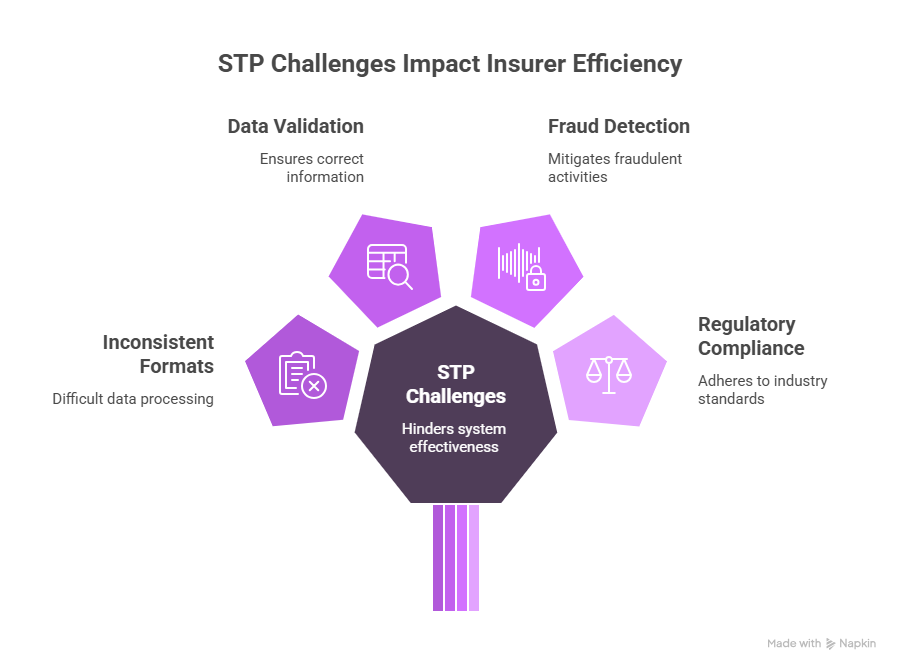
Despite significant investment in automation, many insurers still struggle to achieve end-to-end straight-through processing. The problem is rarely a single technology limitation. Document variability, disconnected systems, poor data quality, validation requirements, fraud controls, and internal processes can all introduce exceptions that send a transaction back to a human reviewer.
Insurance Document Variability
Insurance workflows depend heavily on documents that rarely arrive in a consistent format. Claims may arrive in multiple formats. Policy and underwriting documents can also vary by carrier, product, customer, and channel.
Automated systems must identify the document type, locate the required information, interpret it correctly, and convert it into structured data before the workflow can continue. When layouts change, or information is difficult to interpret, confidence drops and the case may require manual review.
This remains a significant barrier to STP. One study examining insurance claims processing found that only about 7% of claims achieved complete straight-through processing without human involvement, highlighting how frequently exceptions can interrupt automated workflows.
Integration Across Legacy Systems
Document extraction is only one part of the process. The extracted information often must move among policy administration systems, claims platforms, document repositories, underwriting applications, payment systems, and other internal tools.
Many insurers still operate legacy platforms that were not designed to exchange data with modern automation technologies. When these systems operate in silos, employees are left transferring information manually or resolving integration failures, breaking the straight-through flow.
Data Quality and Validation
Even a well-integrated workflow can stop when the incoming data is incomplete or inconsistent. Missing policy numbers, mismatched customer details, incorrect coverage information, or improperly formatted fields can prevent an automated system from making the next decision confidently.
Before a claim can be approved or a policy issued, systems may need to validate information against multiple sources. A small discrepancy can be enough to trigger an exception and send the case to an employee for investigation.
Fraud Detection and Compliance
Insurance transactions also require controls that go beyond extracting data quickly. Claims systems must identify suspicious activity, unusual values, duplicate submissions, or other indicators of potential fraud without unnecessarily delaying legitimate claims.
Regulatory requirements introduce another layer of scrutiny. Insurers may need to maintain records of what data was used, what checks were performed, how a decision was reached, and when human intervention occurred. Maintaining this level of traceability while keeping transactions moving automatically makes STP more difficult than simply automating individual tasks.
Workflow and Organizational Readiness
Automation changes how claims teams, underwriters, operations staff, and reviewers interact with documents and exceptions. Organizations may need to redesign workflows, define when humans should intervene, establish exception-handling processes, and retrain employees around new responsibilities. Without these changes, even capable automation technology can become another isolated tool rather than part of an end-to-end automated process.
These challenges explain why insurers commonly achieve partial automation before full straight-through processing. Reaching higher STP rates requires more than automating individual steps. Documents, data, systems, decision rules, controls, and human exception handling must work together without repeatedly interrupting the workflow.
Partial STP vs. Full STP
Partial STP automates selected stages of an insurance workflow but still requires human involvement for validation, approval, or other decisions. For example, AI may extract and verify claim data before an adjuster approves the claim. Full STP takes the transaction from intake through validation, decision, and completion without human intervention. Human reviewers step in only when predefined rules, confidence thresholds, fraud checks, or other exceptions are triggered.
Benefits of Straight Through Processing in Insurance
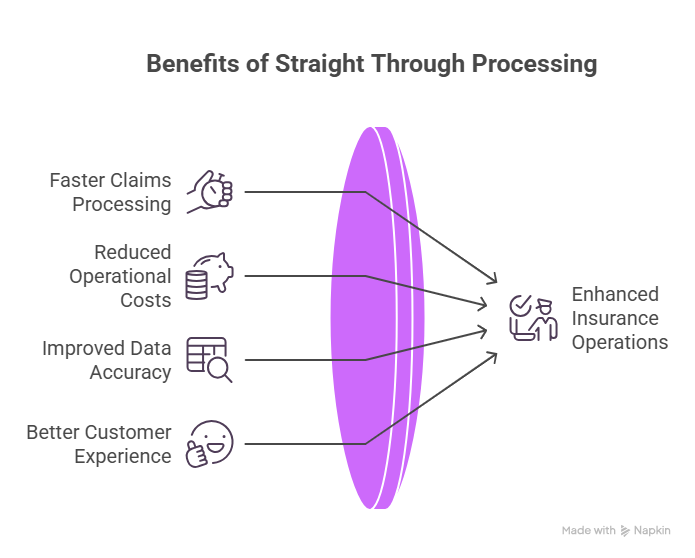
Straight-through processing delivers measurable improvements across multiple operational dimensions, from speed and cost reduction to data accuracy and customer experience. The benefits extend well beyond simple efficiency gains and compound as automation scales across the business.
Faster Claims Processing
Automated claims processing significantly shortens decision times, allowing customers to receive faster responses and quicker payouts. This directly reduces claim backlogs and raises customer satisfaction levels across the board.
Reduced Operational Costs
By automating routine transactions, insurers can manage growing workloads without a proportional increase in headcount. The cost savings are meaningful and continue to scale as transaction volumes rise over time
Improved Data Accuracy
Automated extraction and validation rules detect inconsistencies and verify information before any transaction is completed, eliminating the transcription errors that manual data entry inevitably introduces. Higher data quality improves reporting reliability and reduces operational disputes.
Better Customer Experience
Automation enables insurers to respond promptly to policy requests and claims submissions while keeping customers better informed through timely updates. Faster, more transparent service builds trust and contributes to stronger long-term customer relationships.
How Insurance Companies Can Implement STP Successfully?
Successfully implementing straight-through processing requires careful planning, honest assessment of existing workflows, and a disciplined approach to gradual deployment. Organisations that approach STP strategically are far better positioned to realise its full potential.

Assessing Automation Readiness
The first step is a thorough analysis of current workflows to identify processes that rely on repetitive tasks, structured inputs, and consistent decision rules. These represent the strongest candidates for automation and form the foundation of a prioritised and realistic implementation roadmap.
Selecting The Right Automation Platform
Insurers should evaluate technology providers on their ability to handle document-heavy workflows, integrate with existing systems, and scale as transaction volumes grow. The right platform should complement existing operations rather than disrupt them.
Running Pilot Implementations
A focused pilot program allows teams to measure real performance improvements, surface operational challenges early, and refine workflows and validation rules before broader deployment. The insights gained at this stage are invaluable for informing enterprise-wide rollout decisions.
Scaling Automation Across Insurance Workflows
With a successful pilot in place, insurers can extend automation progressively across underwriting, policy renewals, customer onboarding, and claims processing. Scaling gradually allows organisations to manage operational risk while steadily increasing efficiency across the business.
How Infrrd Helps Achieve Straight Through Processing In Insurance
Straight-through processing insurance depends heavily on the ability to interpret documents and convert them into structured data. Infrrd focuses on automating document-heavy workflows that appear across insurance operations.
Automating Document-Heavy Insurance Workflows
Insurance documents contain critical information required for claims decisions, underwriting assessments, and policy processing. Infrrd processes these documents and extracts relevant fields so systems can process transactions automatically. This automation reduces manual data entry and prepares transactions for automated workflows.
Improving STP Rates Using AI-Driven Data Extraction
Unstructured documents often prevent full automation. Inspection reports, invoices, and handwritten forms require advanced processing technology. Infrrd interprets these documents and converts them into structured data that automation systems can validate and process. As a result, insurers can increase straight-through processing insurance rates across claims and policy workflows.
Enabling Advanced Straight-Through Processing
Automation platforms often require manual intervention when document data remains unclear.
Infrrd reduces these interruptions by extracting and validating document information before workflows begin. This capability allows insurance systems to process more transactions automatically and reduces the number of cases routed for manual review.
Conclusion
Straight-through processing in insurance is not about removing people from every decision. It is about automating predictable, rules-based transactions while sending complex or high-risk cases to the right reviewer. Higher STP rates depend on more than one automation tool. Insurers need reliable document data, connected systems, clear validation rules, fraud controls, and well-defined exception handling. When these elements work together, claims, underwriting, policy issuance, and renewals can move faster with fewer manual handoffs. The result is a more efficient insurance operation where teams spend less time on repetitive processing and more time on cases that genuinely require human judgment and expertise.
FAQs About Straight Through Processing in Insurance
What Is Straight-Through Processing In Insurance?
Straight-through processing in insurance refers to workflows that move insurance transactions from input to final decision through data extraction, capture, and validation steps. Systems collect information from submitted documents, validate it against predefined rules, and complete the transaction based on those conditions. Human review is required only for exceptions, such as missing information or data that falls outside defined thresholds.
What Insurance Processes Can Use STP?
Several insurance workflows support straight-through processing. These include claims processing, policy issuance, underwriting decisions, policy renewals, and customer onboarding processes.
What Is The Difference Between STP And Manual Insurance Processing?
Manual processing requires staff to review documents, enter data, and approve transactions. Straight-through processing insurance automates these steps through integrated systems and validation rules.
What Technologies Enable Straight-Through Processing?
Key technologies include intelligent document processing, artificial intelligence models, workflow automation platforms, and system integrations that connect insurance applications.
What Is A Typical STP Rate In Insurance?
STP rates vary across insurance companies and workflows. Some simple claims achieve high automation rates, while complex claims require human review. Industry research indicates full automation remains limited for many claim types.
Why Do Insurers Struggle To Achieve Full Straight-Through Processing?
Several factors limit automation adoption. Insurance documents often contain unstructured content. Legacy systems also restrict integration between platforms. Data quality issues may require manual verification. Automation technologies continue to improve these limitations, allowing insurers to increase STP rates gradually.