- Agentic document extraction uses AI agents that can plan tasks, extract data, validate information, and take actions with minimal human involvement.
- Agentic document extraction enables organizations to move beyond manual and rule-based processing toward scalable, automated document workflows.
- the shift to agentic extraction is the difference between automation as a cost tool and automation as a growth enabler.
Enterprises have long struggled with document-heavy workflows. Contracts, invoices, claims forms, medical records, and compliance reports accumulate faster than teams can process them. Traditional solutions such as increasing headcount or relying on basic OCR, have not been sufficient to handle this scale effectively.
Agentic document extraction introduces a more advanced approach. It uses AI agents that can plan tasks, extract data, validate information, and take actions with minimal human involvement. This shift enables organizations to move beyond manual and rule-based processing toward scalable, automated document workflows.
The result is not only faster processing but also a system that can handle growing document volumes with greater accuracy and efficiency.
This guide explains how agentic document extraction works, who uses it, its key benefits, and how it compares with traditional OCR and template-based IDP systems.
What Is Agentic Document Extraction?
Agentic document extraction is the use of AI agents to autonomously handle the full lifecycle of document processing, from intake and classification to field extraction, validation, and downstream system updates.
Traditional extraction tools respond to inputs: you send a document, and they return data. Agentic systems operate more like a coordinator who receives the document, determines its type, selects the extraction logic to apply, checks the output for errors, resolves inconsistencies, and routes the result to the appropriate system, without waiting for a human to approve each step.
The word "agentic" refers to this capacity for autonomous decision-making across a multi-step workflow. The agent does not just extract. It reasons through the task.
Why Agentic Document Extraction Matters Now?
Document processing has long been the roadblock for the industries that run on paper: insurance, healthcare, banking, logistics, and government. The problem was never the shortage of tools. It was the shortage of tools capable of handling real-world document chaos: varied layouts, missing fields, poor scan quality, multi-page structures, and exception cases that require contextual judgment.
First-generation OCR addressed digitization but not understanding. Intelligent Document Processing (IDP) added classification and semantic extraction. Agentic extraction takes the next step: it adds decision-making, self-correction, and orchestrated action.
According to McKinsey, over 50% of current work activities can be automated using AI technologies, with document-heavy workflows like invoice processing, claims handling, and report generation falling squarely into the "routine cognitive work" category with the highest automation potential.
The timing matters. Organizations that still rely on human reviewers for routine document tasks are paying a compounding cost: not just in labor, but in cycle time, error rate, and opportunity cost.
Where Agentic Document Extraction Applies?
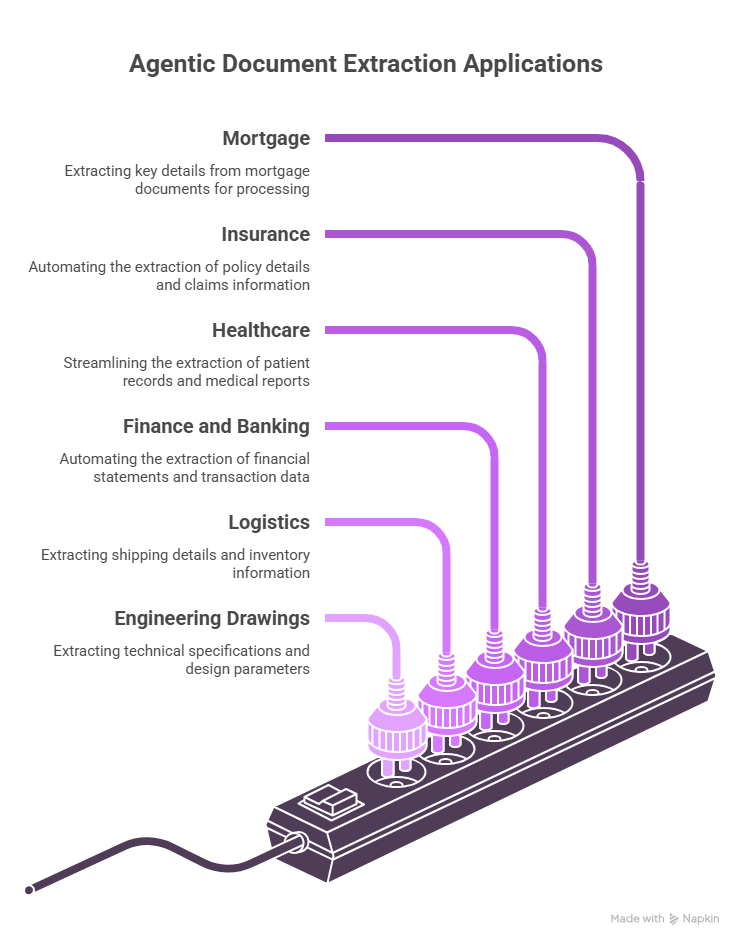
Agentic extraction is not a narrow solution. It applies wherever documents are the entry point for business decisions.
Mortgage
Mortgage processing involves stacking large document packages: income verification, tax returns, bank statements, title reports, and appraisals, that must be indexed, extracted, and ordered before underwriting can begin. Agentic systems handle document stacking and indexing automatically, pulling key fields from each document type, sequencing the package correctly, and producing an audit-ready file that meets investor and regulatory requirements without manual assembly.
Insurance
Policy applications, ACORD forms, loss run reports, claims submissions, and certificates of insurance all require extraction, validation against policy rules, and routing to underwriting or claims systems. Each document type carries its own field schema and compliance requirements. Agentic systems handle this variation without requiring a separate template per form type, processing each document according to the logic that fits it.
Healthcare
Patient intake forms, referral letters, lab results, and prior authorization requests all arrive in formats that resist standardization. In healthcare single patient encounter can generate ten or more document types across different systems and providers. Agentic systems classify, extract, and integrate this data into EHR platforms with minimal manual touchpoints, reducing the administrative burden on clinical staff.
Finance and Banking
Loan applications, KYC documents, audit reports, and regulatory filings require precise field extraction in accordance with strict compliance rules. Errors in financial document processing carry regulatory risk, not just operational cost. Agents can flag exceptions, request resubmissions, and escalate edge cases without pausing the entire queue or holding up downstream credit or compliance decisions.
Logistics
Bills of lading, customs declarations, shipping manifests, and supplier invoices come from dozens of counterparties in inconsistent formats. A single shipment can involve documents from multiple countries, carriers, and regulatory bodies. Agents normalize and process these without format-specific templates, keeping goods moving and reducing customs clearance delays.
Engineering Drawings
Technical drawings contain information that goes well beyond text: part numbers, geometric tolerances, material symbols, dimensional annotations, and revision histories are embedded in structured visual formats that traditional OCR cannot parse reliably. Agentic extraction models trained on engineering document types identify and extract parts lists, interpret dimension markings and symbols, capture metadata like drawing numbers and revision levels, and feed this structured output directly into PLM or ERP systems for downstream manufacturing or procurement workflows.
How Agentic Document Extraction Works?
Unlike traditional IDP workflows that extract data and pause for human intervention, agentic capabilities operate on top of or alongside IDP workflows, extending them into validation, decisioning, and execution. The steps below show how a document moves through a standard IDP pipeline, enhanced by an agentic layer that continuously reviews, adapts, and acts on the extracted data.
Step 1: Document Intake and Classification
The agent receives a document, whether a scanned PDF, email attachment, image, or structured file, and immediately classifies it by document type, format, and originating source. This classification is not a simple file-type check. The agent reads layout signals, header patterns, and contextual cues to determine which document schema applies, ensuring the right extraction logic and validation rules are loaded before any field-level work begins.
Step 2: Intelligent Field Extraction
Using a combination of OCR, large language models, and layout-aware parsing, the agent extracts structured data from the document. Unlike template-based tools that break when a layout shifts, agentic systems infer field locations from context, reading surrounding text, positional cues, and semantic meaning to locate values accurately even across unfamiliar or inconsistent document layouts.
Step 3: Validation and Confidence Scoring
Traditional IDP applies basic validation rules and assigns confidence scores. The agentic layer expands this into a multi-dimensional evaluation, checking extracted data against business rules, cross-document relationships, and historical patterns. Instead of simply flagging low-confidence fields, the system determines their impact and prepares them for automated correction, secondary validation, or prioritized review.
Step 4: Exception Handling and Resolution
This is where agentic systems diverge most sharply from earlier extraction tools. When extraction fails, or a validation rule is broken, the agent does not return a flat error and stop. It attempts resolution by reprocessing data, referencing other documents, applying alternate rules, or using additional models. Only unresolved or high-risk issues are escalated, significantly reducing manual review volume while improving accuracy and maintaining workflow continuity.
Step 5: Downstream Action and Integration
Once the extracted data clears validation, the agent routes it directly to the appropriate downstream system: ERP, CRM, claims platform, or compliance tool. It can also trigger follow-on workflows such as generating a response document, updating a record in a connected system, or notifying a responsible team, all without requiring a human to bridge the extraction output to the next business process.
Agentic Document Extraction vs OCR vs Traditional IDP
Agentic extraction did not emerge in a vacuum. OCR and template-based IDP both addressed real problems in their time, and they still have a role. Understanding where each approach fits and where it breaks down helps teams make the right architectural decision rather than defaulting to the newest option. The distinction comes down to what the tool can do when the document does not behave as expected.
What OCR Still Does Well
OCR remains the right tool for digitizing high-volume, high-consistency documents where the goal is character recognition rather than semantic understanding. Printed text on standard forms, typed invoices with fixed layouts, and scanned documents destined for archival all benefit from fast, cost-effective OCR. When the document population is predictable, and the extraction task is limited to converting an image to text without downstream decision logic, OCR performs reliably and without the overhead of a more complex system.
Where Template-Based Extraction Still Fits
Template-based IDP works well in controlled environments where a small number of document formats repeat at high volume and layout variation is minimal. Internal purchase orders, standardized government forms, and captive counterparty invoices are good candidates. The configuration cost is justified when the document type is stable, and the volume is high enough to amortize the template setup. Problems arise when counterparties change layouts, new document types enter the workflow, or exception rates exceed what manual queues can absorb.
Where Agentic Workflows Outperform
Agentic extraction is built for environments where document variability is the norm rather than the exception. When an enterprise receives invoices from hundreds of vendors, claims from thousands of policyholders, or records from dozens of healthcare providers, no template library keeps pace. Agentic systems adapt at the document level, applying contextual reasoning to extract fields accurately regardless of layout. They also close the loop between extraction and action, eliminating the handoff gaps that slow traditional pipelines.
A Comparison Table by Document Complexity
Challenges Solved By Agentic Document Extraction
Document processing at enterprise scale fails in predictable ways. Formats vary, exceptions pile up, cycle times stretch, and the gap between extraction and action creates its own set of manual steps. Agentic extraction addresses each of these as a design principle rather than a workaround. The challenges below represent the friction points that earlier tools accepted as given.
Inconsistent Document Formats
Enterprises receive documents from hundreds of counterparties, each with its own layouts, terminology, and field structures. A logistics company processing invoices from 300 suppliers cannot build and maintain 300 templates. Template-based systems fail at this scale because any layout change breaks the extraction logic. Agentic extraction adapts to document-level format variability, inferring field locations from context without requiring per-vendor configuration or manual template updates when layouts shift.
High Exception Rates
In traditional IDP pipelines, exceptions create manual review queues that grow faster than teams can clear them, and the backlog becomes the bottleneck. Agentic systems reduce exception rates by handling more edge cases autonomously through fallback extraction strategies, confidence-based re-routing, and rule-based resolution logic. Human reviewers receive only the cases that genuinely exceed the system's resolution capacity, with full extraction context attached, so review time stays short.
Slow Cycle Times
Manual review introduces latency at every stage of a document pipeline. An invoice that should be processed in seconds sits in a queue for hours while staff work through volume. Agentic extraction removes the queue entirely for routine documents, processing and routing them without pause. Cycle times that previously ran in days compress to minutes, which matters most in time-sensitive workflows like claims settlement, loan approvals, and customs clearance.
Siloed Extraction and Action
Legacy tools extract data and stop at the output file. Downstream action, whether updating a system, triggering a workflow, or notifying a responsible team, requires a separate integration layer that someone has to build and maintain. Agentic systems collapse extraction and action into a single orchestrated process, with extracted data flowing directly into connected systems and triggering the next step in the workflow without manual transfer or additional middleware.
The Business Case for Agentic Document Extraction
The productivity gains from agentic AI are well-documented. OECD research across experimental studies found a 5% to 25% productivity increase in tasks that directly mirror document extraction workloads: writing, summarization, and data processing. At the task level, these gains compound quickly across high-volume document environments.
McKinsey projects $450B to $650B in annual value potential from agentic AI by 2030, with 5% to 10% revenue uplift in advanced industries where document-intensive workflows are common. For organizations processing thousands of documents daily, even partial automation of extraction and validation work delivers measurable cost reduction and faster decision cycles.
The business case is clearest in volume-driven environments. An insurer processing 10,000 claims a month does not benefit from marginally faster manual review. It benefits from removing manual review from the routine 80% of claims entirely.
Benefits of Agentic Document Extraction
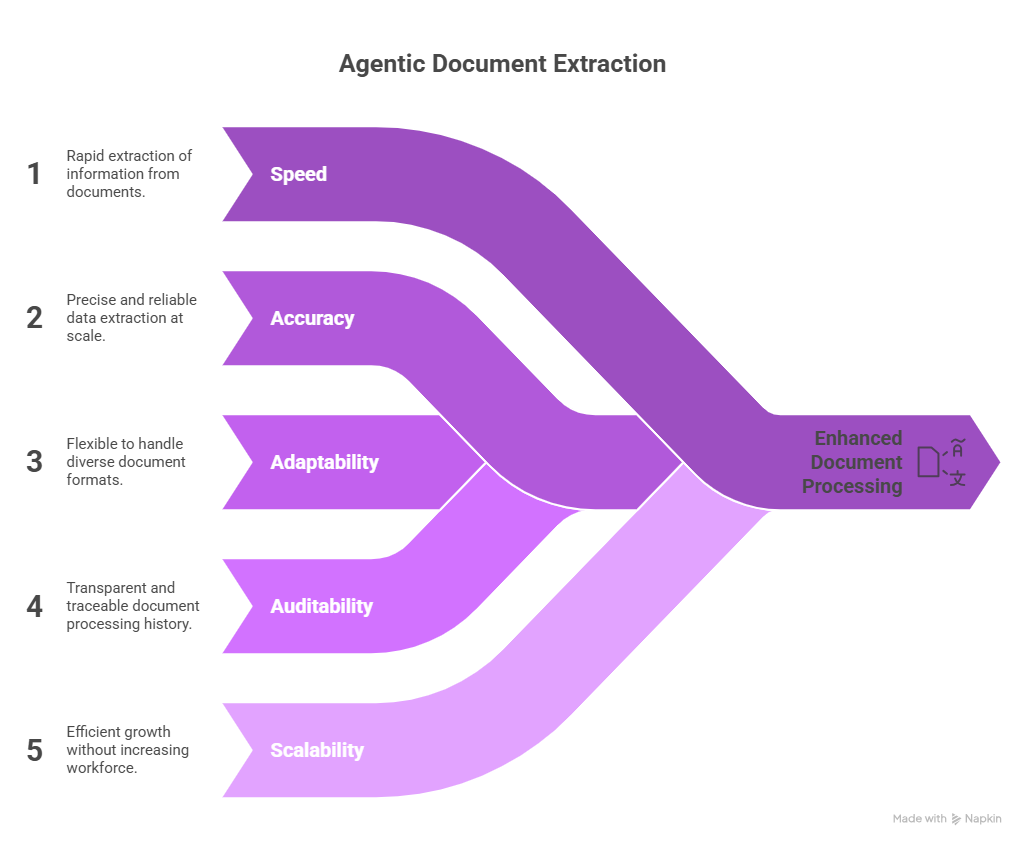
The value of agentic extraction is not limited to faster processing. It compounds across every dimension of document operations: speed, accuracy, adaptability, compliance, and cost structure. For organizations running high-volume, high-variability document workflows, the shift produces gains that are measurable at both the task level and the business level.
Speed
Documents that once took hours to process are complete in seconds because the agent handles every step in the pipeline without idle time between handoffs. Extraction, validation, exception resolution, and downstream routing happen in sequence without queues forming between them. For time-critical workflows like insurance claims, loan decisions, and customs clearance, this compression in cycle time translates directly into business outcomes.
Accuracy at Scale
AI models trained on domain-specific document types consistently outperform manual data entry for routine field extraction, particularly as volume increases and human attention degrades. Confidence scoring and validation logic catch errors that human reviewers miss when processing at speed. The result is a system that gets more reliable as volume grows, rather than less, which is the opposite of what happens with manual review teams under load.
Adaptability
Unlike template-based tools that require reconfiguration every time a vendor changes a layout or a regulator updates a form, agentic systems adapt to document variation as a built-in capability. The extraction logic does not depend on fixed field positions. It reads context, infers structure, and locates values from meaning rather than position, which means new document formats enter the pipeline without manual template work or processing delays.
Auditability
Every agent decision, from initial classification through field extraction, validation rule application, and exception routing, is logged with full context. This audit trail is not an afterthought. It is a core operational record that supports compliance reporting, quality assurance reviews, dispute resolution, and regulatory examination. Organizations in regulated industries get the traceability they need without building a separate audit logging layer.
Scalability Without Headcount
Processing volume can grow substantially without a corresponding increase in operations staff because the agent layer absorbs volume spikes that would otherwise require temporary hiring or outsourcing. Seasonal peaks in claims, tax-period surges in financial documents, and acquisition-driven increases in counterparty volume all pass through the same pipeline without service degradation or manual overflow queues.
How Infrrd Powers Agentic Document Extraction?
Infrrd's document intelligence platform brings together OCR, AI extraction, and agentic orchestration into a single pipeline designed for enterprise document complexity.
Adaptive Extraction Across Document Types
Infrrd's models handle structured, semi-structured, and unstructured documents without per-template configuration. Whether the input is a standardized ACORD form or a freeform supplier letter, the extraction engine identifies fields, infers context, and returns structured output with confidence scores attached.
Built-In Validation and Exception Routing
Infrrd does not treat validation as a post-processing step. The platform applies business rules inline, during extraction, and routes exceptions to human review queues with full context attached. Reviewers see the document, the extracted fields, the confidence scores, and the specific rule that flagged the record. Resolution is faster because reviewers are not diagnosing from scratch.
Integration with Downstream Workflows
Extracted data moves directly into the systems that need it: ERP platforms, claims management tools, EHR systems, and compliance databases. Infrrd's integration layer supports REST APIs, pre-built connectors, and event-driven triggers, allowing extracted data to initiate downstream actions without manual transfer steps.
Domain-Specific Models for Complex Verticals
Mortgage, insurance, healthcare, and financial services documents require models trained on domain-specific terminology, form structures, and regulatory requirements. Infrrd's pre-trained models cover these verticals out of the box, reducing deployment time and improving extraction accuracy from day one.
Mortgage Ally: Agentic AI Built for Mortgage Workflows
Mortgage Ally extends Infrrd’s IDP with a mortgage-native agentic layer that understands end-to-end loan workflows. Trained on industry documents, it extracts, validates, and interprets data with high accuracy, automates income checks, ensures compliance, and adapts through continuous learning. With deep integrations, audit trails, and real-time alerts, Ally drives faster decisions and reduces risk across the mortgage lifecycle.
Summary
Agentic document extraction is not an incremental upgrade to OCR or IDP. It is a different model of automation, one where the system takes ownership of the full extraction workflow, handles its own exceptions, and drives downstream action. For enterprises where document processing is a daily operational burden, the shift to agentic extraction is the difference between automation as a cost tool and automation as a growth enabler.
Frequently Asked Questions About Agentic Document Extraction
What is agentic document extraction?
It is an AI-driven approach where autonomous agents handle the complete document processing workflow (classification, extraction, validation, exception handling, and downstream routing) with minimal human involvement for routine documents.
How is agentic extraction different from traditional IDP?
Traditional IDP tools extract data and return it to a human for validation and action. Agentic extraction adds decision-making to each step: the agent validates its own output, resolves common exceptions, and triggers downstream workflows without waiting for human approval.
What types of documents can agentic extraction handle?
Invoices, insurance forms, medical records, loan applications, contracts, shipping manifests, regulatory filings, and most other business documents. Systems trained on domain-specific data handle complex or regulated document types most accurately.
How does agentic document extraction handle exceptions?
Rather than returning an error and stopping, the agent attempts resolution by reprocessing with an alternate model, applying fallback logic, or escalating to human review with full extraction context attached. This reduces manual queue volume significantly.
What industries benefit most from agentic document extraction?
Insurance, healthcare, banking, logistics, and government operations all process high volumes of documents with variable formats and strict accuracy requirements. These are the environments where agentic extraction delivers the clearest return.
How accurate is agentic document extraction?
Accuracy depends on document type, training data quality, and validation rules applied. For structured and semi-structured documents in trained domains, extraction accuracy consistently exceeds manual processing accuracy at high volume.
How long does it take to deploy an agentic document extraction system?
Deployment timelines vary by document complexity and integration requirements. Systems with pre-trained models for specific document types can reach production-ready accuracy in weeks rather than months.
Can agentic extraction integrate with existing enterprise systems?
Yes. Modern agentic extraction platforms support API-based integration with ERP, CRM, EHR, claims management, and compliance systems. Extracted data can trigger workflows in connected systems without manual transfer steps.
What happens when a document is too complex for the agent to process?
The agent flags it for human review with extraction context, confidence scores, and the specific issue attached. Reviewers receive enough information to resolve the exception quickly rather than reviewing the document from scratch.
Is agentic document extraction suitable for regulated industries?
Yes, provided the platform includes audit logging, confidence scoring, and configurable validation rules. Every agent decision should be traceable for compliance reporting purposes.