- Automated KYC verification uses AI to confirm customer identity and assess risk using digital documents and trusted data sources.
- Automated KYC changes how financial teams handle onboarding, compliance, and risk.
- For organizations modernizing onboarding and compliance, automated KYC is now a practical necessity.
Financial institutions face a simple truth. Customer onboarding keeps rising. Regulations keep tightening. Teams still deal with long queues of documents every day. This gap creates pressure, delays, and risk.
Automated KYC verification (Know Your Customer verification) changes how financial teams handle identity checks. Instead of manual reviews and repeated data entry, AI reads, validates, and routes documents at scale. This guide explains automated KYC, why it matters in 2026, how the workflow operates, and the challenges teams face. You will also see how Infrrd supports modern compliance programs.
What Is Automated KYC Verification?
Automated KYC verification uses AI to confirm customer identity and assess risk using digital documents and trusted data sources. It replaces slow manual review with fast, repeatable workflows.
In simple terms, automated KYC verification verifies identity using AI tools that read documents and extract key data. These tools process passports, driver’s licenses, utility bills, bank statements, and more. They capture names, addresses, dates of birth, and ID numbers in seconds.
The system then validates the data using trusted databases. The goal is simple. Confirm identity quickly and reduce manual work.
The Role of Automated KYC Verification in Document-heavy Workflows
Banks and financial firms process thousands of documents every day. Many still rely on human review. Teams open files, read fields, compare records, and enter data into systems. This takes time and invites errors.
Automation fits directly into this workflow. It reads documents as soon as they arrive. It extracts the required data. It sends the results to downstream systems. Staff can focus on exceptions instead of repetitive tasks.
Why Automated KYC Matters in 2026
Digital banking keeps expanding, and remote onboarding is now part of everyday operations. Customers expect quick approvals with minimal friction, while regulators continue to raise the bar for compliance. Financial institutions feel this pressure from both sides. That is why many teams are rethinking how they handle KYC. Let’s take a closer look at the key benefits driving this shift.
Time, Cost, and Accuracy Impact
Manual KYC quickly becomes costly. One verification can run from $13 to $130 or more, and those numbers climb fast when you process thousands of customers each month. Automation helps bring those costs down. AI reads documents in seconds, removes repetitive data entry, and reduces common errors. Teams can then focus on higher-risk cases instead of routine reviews. Faster onboarding also improves the customer experience, no one wants to wait days just to open an account.
Compliance & Risk Mitigation
KYC failures can be very costly. Penalties can reach millions, and reputational damage can take years to recover from. Automation helps reduce that risk by applying the same validation rules to every document, every time. These systems also support ongoing monitoring, so if a customer’s profile changes, the team gets alerted quickly. This makes it easier to stay aligned with regulatory requirements.
The Key Benefits of Automated KYC Verification for Financial Institutions
Automated KYC changes how financial teams handle onboarding, compliance, and risk. Instead of relying on slow manual reviews, institutions gain speed, consistency, and visibility across the entire verification process. Here are the most important benefits.
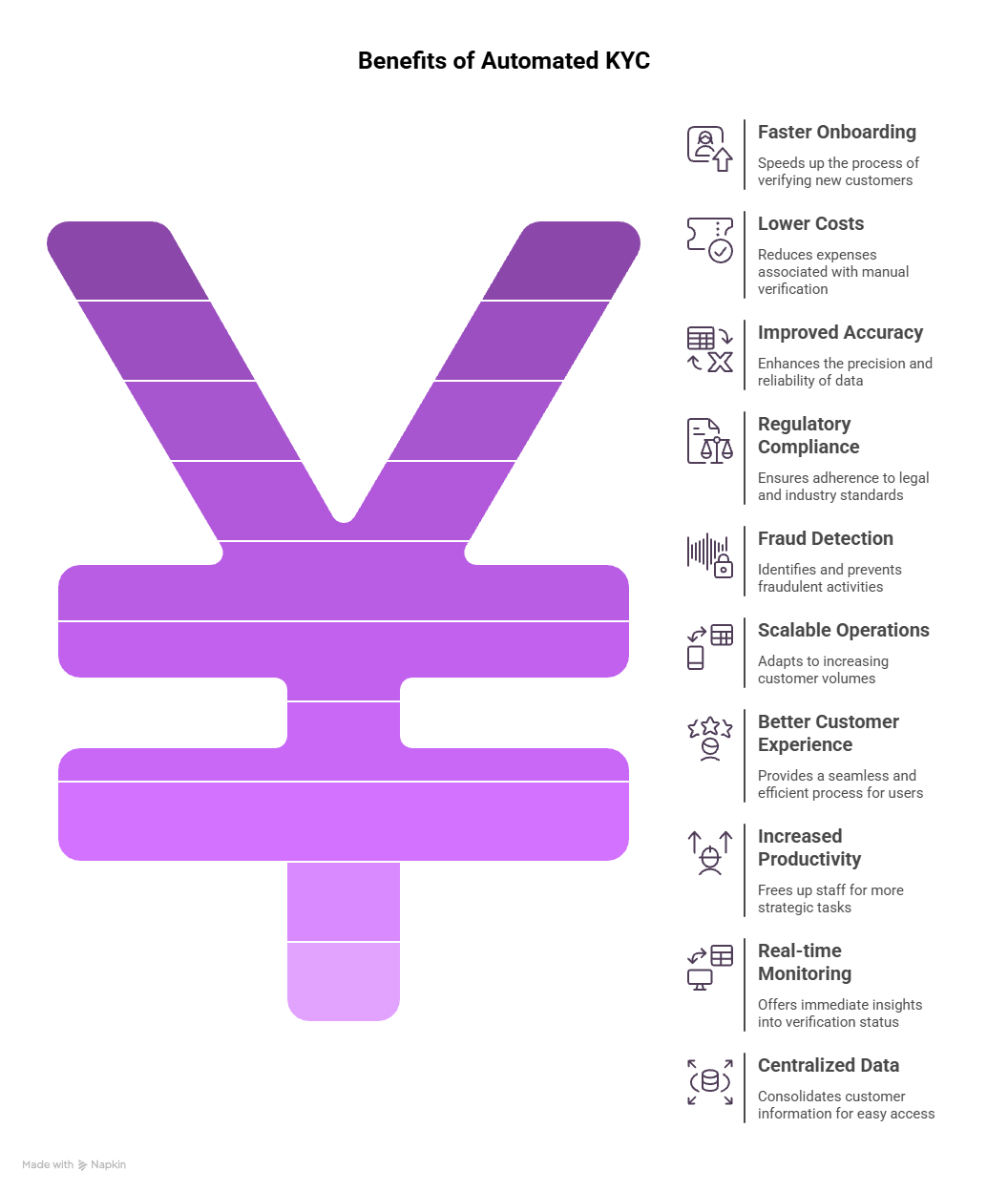
1. Faster customer onboarding: Automation reduces the time needed to verify documents and confirm identities. Customers upload documents, and AI reads and validates them in seconds. This shortens onboarding from days to minutes. Faster onboarding also reduces application drop-offs and improves conversion rates.
2. Lower operational costs: Manual KYC requires large review teams and long processing hours. Automation reduces repetitive tasks such as data entry and document comparison. Financial institutions can handle higher volumes without increasing headcount. This leads to measurable cost savings over time.
3. Improved accuracy and consistency: Human review can lead to fatigue and mistakes. Automated systems apply the same validation rules to every document. This creates consistent outcomes and reduces data entry errors. Reliable data improves downstream processes such as risk scoring and reporting.
4. Stronger regulatory compliance: KYC regulations demand clear audit trails and consistent checks. Automated systems record every step of the verification process. Teams can quickly show regulators how decisions were made. This reduces compliance risk and simplifies audits.
5. Better fraud detection: AI can detect patterns and inconsistencies that are easy to miss manually. It compares customer data across multiple databases and flags suspicious activity early. This helps prevent identity fraud and reduces financial losses.
6. Scalable operations during growth: Customer volumes often increase during promotions, product launches, or market expansion. Automated KYC systems scale easily to handle spikes in demand. Institutions can grow without building large verification teams.
7. Improved customer experience: Customers expect quick, digital experiences. Automated KYC removes long waiting times and reduces repeated document requests. A smoother onboarding journey builds trust from the first interaction.
8. Better team productivity: Automation handles routine checks, so compliance teams can focus on complex cases and investigations. This improves job satisfaction and increases overall productivity.
9. Real-time monitoring and updates: Automated KYC does not stop after onboarding. Systems can monitor customer profiles continuously. If risk levels change, teams receive alerts quickly and can take action.
10. Centralized customer data visibility: Integration with CRM, ERP, and risk systems creates a single view of the customer. Teams across departments can access the same verified information. This reduces data silos and improves collaboration.
Together, these benefits help financial institutions operate faster, reduce risk, and deliver better customer experiences.
How Automated KYC Verification Works (Step-by-Step)
Automation follows a clear workflow. Each step moves data from intake to validation and final approval.
KYC Intake Process
Customers upload documents through portals or apps. The system captures images or PDFs in real time. It prepares files for processing and organizes them automatically. No manual sorting required.
Document Data Extraction & Validation
AI extracts key fields from documents. It reads text, numbers, and layout. It identifies names, addresses, dates, and ID numbers. The system then checks the data against trusted sources. These may include government databases, credit bureaus, and sanctions lists. Validation happens in seconds.
Human-in-the-loop for Final Review
Automation handles most cases. Some cases still need human judgment. Blurry scans, mismatched records, or suspicious patterns trigger review. This hybrid approach balances speed with accuracy.
System Integration (ERP, CRM, LOS)
KYC data flows into existing systems automatically. Integration with ERP, CRM, and Loan Origination Systems keeps information consistent across departments. Teams see the same customer data everywhere. No more data silos.
Key Challenges and Solutions in KYC Automation
Automation delivers strong value, but teams still face real challenges.
Data Quality & Handwriting
Low-quality scans and handwritten notes can slow processing. AI-powered IDP models improve every year. They read poor images better than before. Still, some cases require manual review.
Multiple Document Types
KYC requires many document types. Each has different formats and layouts. A flexible document automation system must handle passports, IDs, bank statements, and proof of address without breaking the workflow. Modern AI adapts to new document formats quickly.
Conclusion
Automated KYC verification is quickly becoming a core part of modern financial operations. It helps institutions onboard customers faster, reduce compliance risk, and manage growing document volumes without expanding teams. As regulations tighten and customer expectations rise, automation gives financial teams the speed and confidence they need to move forward. For organizations looking to modernize onboarding and strengthen compliance, automated KYC is no longer optional, it is a practical next step.
FAQs on Automated KYC Verification
Q. What is automated KYC verification?
Automated KYC verification uses AI to confirm a customer’s identity using digital documents and trusted data sources. The system reads identity documents, extracts key fields, validates the information, and stores the results in internal systems. This replaces manual review and reduces the time needed to approve new customers.
Q. How does automated KYC verification work?
The process begins when a customer uploads identity documents. AI reads the files and extracts key data such as name, address, date of birth, and ID number. The system then checks this data against government databases, credit bureaus, and sanctions lists. If everything matches, the system approves the application. If something looks unusual, the case goes to a human reviewer.
Q. What are the key benefits of automated KYC for financial institutions?
Automated KYC speeds up onboarding, lowers operational costs, and improves data accuracy. It helps institutions detect fraud earlier and maintain consistent compliance. Teams also gain more time to focus on complex investigations instead of routine checks.
Q. How does automated KYC prevent fraud?
AI compares customer data across multiple trusted databases. It checks document authenticity, identifies mismatched information, and flags suspicious activity. This early detection helps stop identity fraud before accounts are approved.
Q. What are the challenges in implementing automated KYC?
Institutions often deal with poor image quality, handwritten data, and many document formats. Scaling systems to match customer growth can also be challenging. Modern AI models address these issues by improving document reading accuracy and adapting to new document types.
Q. What technologies are used in automated KYC?
Automated KYC uses artificial intelligence, machine learning, optical character recognition (OCR), and natural language processing (NLP). These technologies work together to read documents, extract data, validate information, and detect risk patterns.
Q. How does AI enhance automated KYC verification?
AI reads documents faster than manual review. It improves accuracy, detects patterns, and reduces repetitive work. It also supports continuous monitoring, which helps teams stay updated when customer risk levels change.
Q. Is automated KYC compliant with global regulations?
Yes. Automated KYC platforms follow global regulatory standards and maintain detailed audit trails. These records help institutions demonstrate compliance during audits and regulatory reviews.
Q. What are the best automated KYC solutions for banks?
Leading banks look for platforms that combine data extraction, validation, monitoring, and system integration. Infrrd provides a full KYC automation platform that supports fast onboarding and compliance workflows.
Q. Can automated KYC be used in insurance companies?
Yes. Insurance providers use automated KYC to verify policyholders during onboarding, validate identities during claims processing, and manage customer records throughout the policy lifecycle.

Priyanka Joy is a product writer at Infrrd who approaches automation tech like a curious detective. With a love for research and storytelling, she turns technical depth into clarity. When not writing, she’s immersed in dance, theatre, or crafting her next narrative.