- P&C automation reduces repetitive work across submissions, underwriting, claims, policy servicing, and compliance workflows.
- The strongest automation combines document intelligence, business rules, system integration, and human review for exceptions.
- Carriers, MGAs, and TPAs should start with measurable workflows, prove value, then scale automation gradually.
Picture an adjuster in 2018, buried under paper claims, manually cross-checking policy documents that took hours to verify. Fast forward to today, and P&C insurance automation has completely rewritten that story.
Carriers, MGAs, and TPAs are adopting P&C automation faster than ever, and McKinsey suggests the shift isn't incremental; it's structural. By 2030, underwriting as we know it today ceases to exist for most personal and small-business products across life and P&C insurance. The stakes go beyond speed, where Deloitte estimates that AI-driven, real-time fraud analytics alone could save P&C insurers up to $160 billion by 2032.
For an industry built on paperwork, precision, and compliance, automation has stopped being a "nice-to-have" and become the baseline for staying competitive. But with so many technologies, vendors, and use cases in the mix, knowing where to start and what actually delivers ROI can feel overwhelming. This blog helps you navigate P&C insurance automation in 2026, from claims and underwriting to compliance and beyond, so you can build a roadmap that fits your organization.
Why Manual Processes Are Costing P&C Carriers Money
Manual work rarely appears as a single cost line item. It spreads across submission entry, document sorting, follow-up emails, claim setup, policy checks, system updates, and quality reviews. Each step consumes precious time across thousands of policies and claims; those minutes add up to a major operating expense.
Carriers often struggle with scale, legacy systems, claims complexity, underwriting consistency, and regulatory oversight. MGAs face pressure to process submissions quickly while managing broker expectations, carrier requirements, and lean teams. TPAs must handle high claim volumes, document-heavy workflows, SLAs, payment controls, reporting requirements, and varied processes across multiple carrier programs.
The scale is visible in industry reporting. The NAIC recorded $85.4 billion in loss expenses and $235.9 billion in underwriting expenses for U.S. P&C insurers in 2024. Together, these categories exceeded $321 billion. They include far more than manual document work, so the figure should not be treated as automation savings. It does show how much cost sits inside underwriting and claim operations.
The labor impact is also clear. McKinsey reported that commercial P&C underwriters may spend 30% to 40% of their time on administrative work, including rekeying data and running manual analyses. That time does not improve risk selection. It delays quotes, limits submission capacity, and makes skilled staff handle tasks that software can complete.
Manual processes also create hidden costs: inconsistent decisions, missed data, slow handoffs, duplicate entry, and weak audit records. P&C insurance automation targets these repeated steps while keeping people responsible for judgment, approvals, and exceptions.
What Is P&C Insurance Automation?
P&C insurance automation uses software to complete repeatable work across underwriting, claims, policy servicing, compliance, and customer operations. It can collect documents, extract data, apply rules, trigger actions, and send results to core insurance systems.
The technology has moved through three broad stages. Robotic process automation, or RPA, follows fixed instructions across screens and systems. It works well with structured data but struggles when forms, layouts, or inputs change. Intelligent document processing, or IDP, reads PDFs, scans, emails, images, and ACORD forms. It classifies files, extracts fields, and turns unstructured content into usable data. Agentic AI orchestration coordinates several tools, makes limited workflow decisions, and sends uncertain or high-risk cases to people.
The transition remains measured. EIOPA found that assisted and semi-autonomous systems represented 83% of reported GenAI use cases, while agentic AI accounted for 9%. Human control still leads adoption, but insurers expect more agentic use during the next three years. The shift is gradual, meaningful, and unlikely to reverse.
Core Workflows P&C Insurance Automation Transforms
P&C insurance automation changes the workflows with the highest document volume, repeated data entry, and rule-based decisions. The strongest automation model connects intake, review, action, and system updates instead of automating one isolated task or passing delays between internal teams.
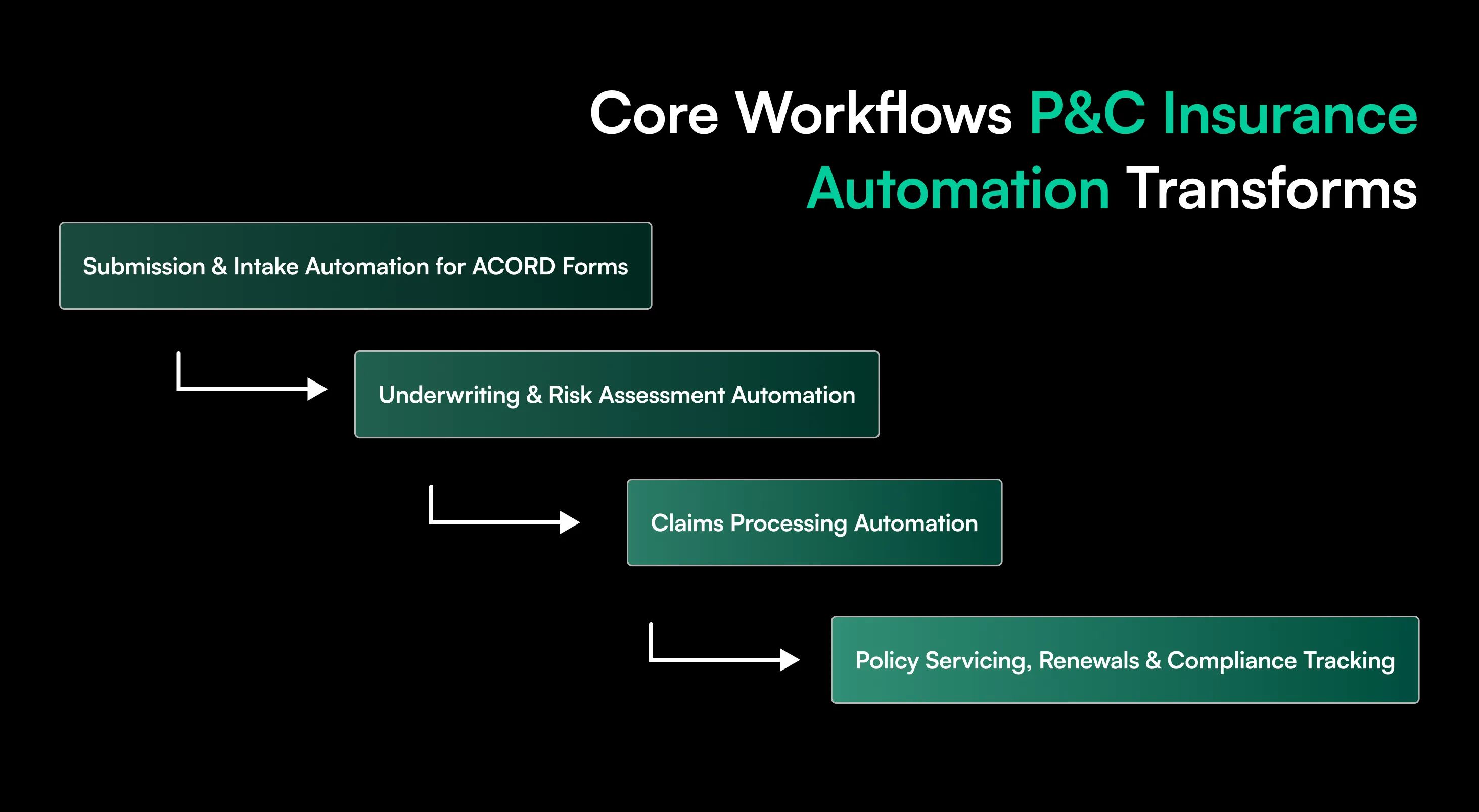
Submission & Intake Automation for ACORD Forms
The model receives broker emails, separates attachments, identifies ACORD forms, extracts risk data, checks required fields, and routes incomplete submissions. ACORD develops standard forms and data standards for insurance exchange, which makes these documents a practical starting point.
Underwriting & Risk Assessment Automation
The system organizes submission data, compares documents, applies appetite rules, flags conflicts, and prepares a risk file. Underwriters review the evidence and focus on pricing, terms, and judgment.
Claims Processing Automation
Claims automation speeds up work from first notice of loss through settlement. It captures claim details, sorts documents, checks invoices, verifies coverage, and routes approved payments. Claims with missing information, fraud signals, high values, or disputed liability move to an adjuster for review.
Policy Servicing, Renewals & Compliance Tracking
Automation helps teams manage endorsements, renewals, certificates, and policy updates without relying on manual tracking. It monitors key dates, checks coverage details, identifies missing documents, sends alerts, and records each action. This gives staff a clear history for audits, renewals, and customer service.
Business Benefits of P&C Insurance Automation
The value of P&C insurance automation comes from better operating control. Carriers, MGAs, and TPAs can process more work with fewer repetitive steps while keeping people involved where judgment, customer impact, or regulatory risk is high.
Cost & Operational Efficiency
Automation reduces sorting, rekeying, status checks, and duplicate updates, allowing teams to spend more time reviewing risk and resolving exceptions. In one P&C example documented by McKinsey, automating high-volume, low-risk claims reduced processing time by 30% to 40%. Another insurer using rules-based automation reduced leakage from payment errors by 4% of revenue.
Speed & Risk Reduction, Not Just Accuracy
Fast extraction has limited value if data enters the wrong workflow. Strong automation validates information, compares documents, applies business rules, and routes questionable cases for review. J.D. Power found that homeowners using digital tools to report claims and submit photos experienced average repair cycles of 15 days, compared with nearly 28 days for non-digital users.
Risk controls also matter financially. The Coalition Against Insurance Fraud estimates that property and casualty insurance fraud costs about $45 billion annually in the U.S., highlighting the value of stronger validation, anomaly detection, and exception review throughout insurance workflows.
Scalability, Compliance & Human-in-the-Loop Value
Automation can help insurers handle changing volumes without increasing manual effort at the same rate. Adoption is already widespread: an NAIC survey found that 88% of responding private passenger auto insurers and 70% of homeowners insurers either use, plan to use, or plan to explore AI/ML in their operations. P&C use cases already include underwriting, pricing, claims analysis, and fraud detection.
Scale, however, does not remove accountability. The NAIC states that insurers remain responsible for decisions supported by AI and that human oversight remains an important part of insurance decision-making.
How to Choose a P&C Insurance Automation Platform
Choosing a platform starts with the workflow, not the feature list. Review real submissions, claim files, policy documents, and system requirements before comparing vendors.
Key Capabilities to Evaluate
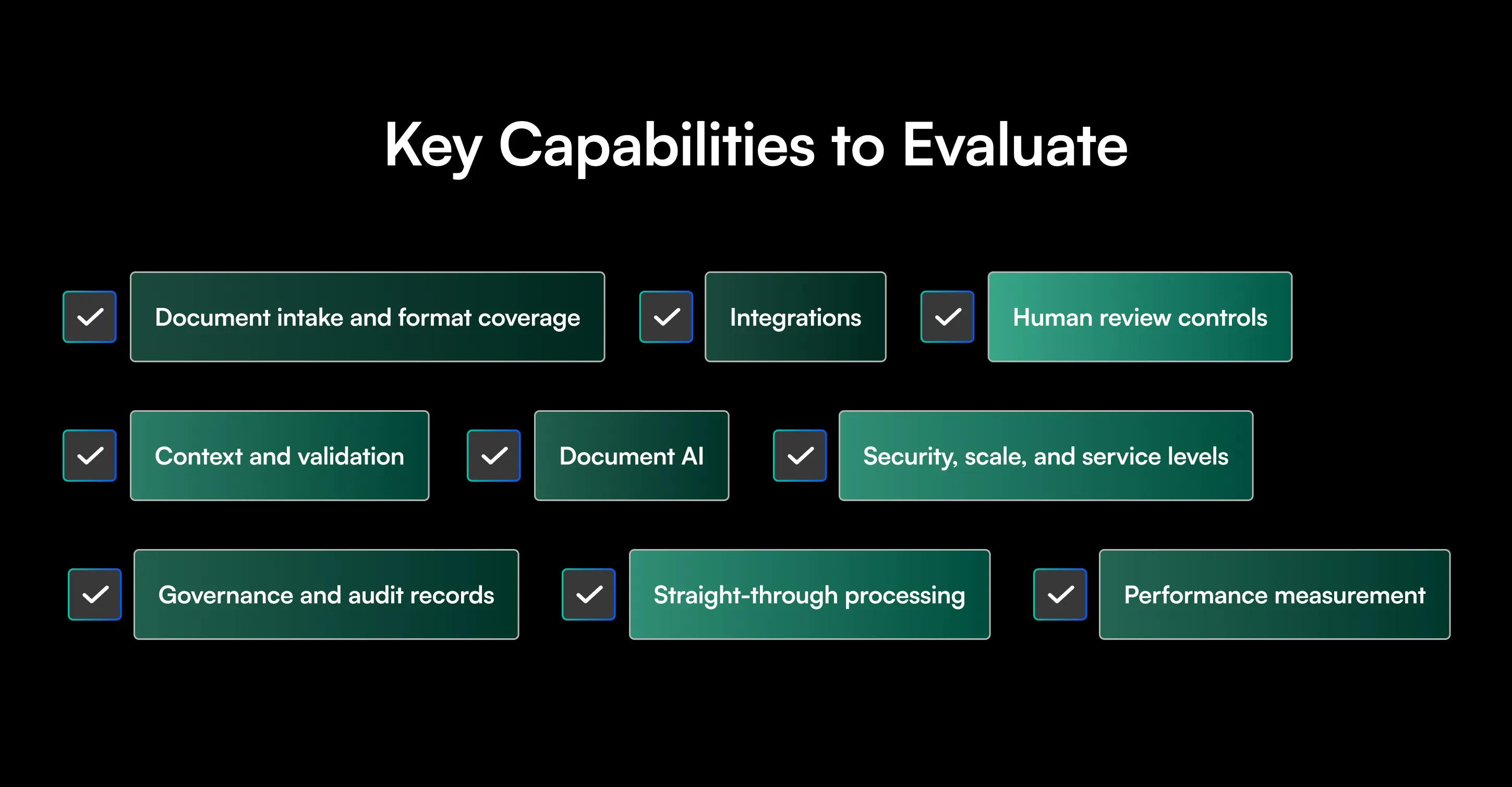
- Document intake and format coverage: Confirm that the platform can ingest email attachments, PDFs, scans, images, spreadsheets, portals, and batch files without forcing one intake path.
- Document AI: Test classification, document splitting, field extraction, tables, checkboxes, handwriting, and low-quality scans. Use your own ACORD forms, loss runs, invoices, estimates, and policy documents during evaluation.
- Context and validation: Look for cross-document checks, required-field validation, duplicate detection, business rules, and source evidence. A field value should link back to the page and document that produced it.
- Straight-through processing: Check how the platform sets confidence thresholds, applies rules, handles exceptions, and measures pass-through rates. Ask which cases can proceed automatically and which cases require review.
- Human review controls: Review queue design, role permissions, change history, reviewer notes, escalation rules, and approval steps. Staff should see why a case was flagged and what evidence supports the alert.
- Integrations: Confirm support for APIs, webhooks, secure file transfer, batch processing, and connections to policy, claims, billing, CRM, data warehouse, and underwriting systems.
- Governance and audit records: Ask how the platform logs model output, rule changes, user actions, overrides, and final decisions. NAIC guidance makes insurers responsible for compliant AI use, including third-party systems.
- Performance measurement: Define field accuracy, document accuracy, exception rates, turnaround time, straight-through processing, and manual effort before launch. Compare results by document type and workflow risk.
- Security, scale, and service levels: Review access controls, encryption, data retention, deployment options, volume limits, peak-load performance, uptime commitments, and recovery procedures.
How Infrrd Powers P&C Insurance Automation
Infrrd applies intelligent document processing to document-heavy insurance workflows, including submissions, claims, underwriting support, and policy tracking. The platform ingests files, separates and classifies documents, extracts data, validates fields, flags exceptions, and sends approved results into business workflows.
The goal goes beyond faster reading or higher field accuracy. Infrrd uses document intelligence to connect information across forms, tables, handwritten content, claim records, and policy documents. Teams can apply business rules, ask questions about document content, manage SLA-based queues, and keep human review for uncertain or high-impact cases.
For P&C teams, this supports ACORD processing, claim document review, policy verification, compliance checks, and insurance tracking without forcing staff to re-enter the same data across systems. Infrrd also provides APIs and workflow controls for integration with existing insurance technology.
Conclusion
The insurance industry isn't waiting for anyone to catch up. Every quarter spent on manual submissions, rekeyed claims data, and paper-based policy checks is a quarter competitors are using to quote faster, settle claims sooner, and free their underwriters for the judgment calls that actually win business. Automation has moved from experiment to expectation, and the carriers, MGAs, and TPAs treating it that way now are the ones who'll set the pace for everyone else. The good news is that leading doesn't mean overhauling everything at once. It means starting with one workflow, proving the ROI on real files, and scaling from there. The organizations that move first won't just work faster; they'll define what "competitive" looks like next.
Frequently Asked Questions About P&C Insurance Automation
What is P&C insurance automation?
P&C insurance automation uses software, rules, document AI, and workflow tools to complete repeatable work across submissions, underwriting, claims, policy servicing, and compliance. It moves data and tasks while staff handles judgment, exceptions, and customer decisions.
Which P&C insurance tasks can be automated?
Common targets include submission intake, ACORD form processing, document classification, data extraction, risk checks, claim setup, invoice review, policy verification, renewal tracking, customer notices, compliance checks, and updates to policy or claims systems.
How is IDP different from RPA in insurance?
RPA copies data and follows fixed steps across systems. IDP reads and interprets documents with changing layouts, including PDFs, scans, images, and forms. Many insurers use both: IDP reads the content, while RPA moves the results.
Can automation process ACORD forms?
Yes. Document AI can identify ACORD forms, extract fields, validate required data, compare related forms, and route missing information for review. ACORD provides standard forms and data standards that support consistent insurance data exchange.
What is straight-through processing in P&C insurance?
Straight-through processing lets an eligible case move from intake to completion without manual handling. The workflow checks data, rules, confidence levels, and risk conditions first. Cases that fail a check move to a person for review.
Can P&C claims be fully automated?
Some low-risk, complete, rule-based claims can move through highly automated workflows. Disputed liability, severe injuries, fraud concerns, unclear coverage, large losses, or conflicting evidence still require adjuster review and documented authority.
Will automation replace underwriters and claims adjusters?
Automation replaces repeated tasks more often than whole roles. It prepares files, checks data, and routes work. Underwriters and adjusters still assess unclear facts, negotiate outcomes, apply judgment, explain decisions, and manage high-impact cases.
Can P&C automation connect with legacy insurance systems?
Yes, but the connection method varies. Platforms may use APIs, webhooks, secure files, database connections, or RPA. Buyers should test data mapping, error handling, update timing, and recovery steps before moving a workflow into production.
How should insurers manage AI risk and compliance?
Insurers should document models, data sources, rules, testing, overrides, and human review. They should also monitor errors and consumer impact. NAIC guidance states that insurers remain responsible for legal compliance when they use AI systems.
Where should a carrier, MGA, or TPA start?
Start with one high-volume workflow that has repeated steps, measurable delays, and clear rules. Record the current cost, time, error rate, and review effort. Then test automation on real files before expanding to other processes.