- Faster Loan Processing: Mortgage workflow automation reduces manual tasks, processing delays, and repetitive document reviews.
- Improved Loan Quality: Automated data extraction, validation, and compliance checks help lenders identify discrepancies earlier.
- Smarter Automation Strategy: Start with repetitive, high-volume tasks, measure results, and gradually expand automation across workflows.
A mortgage loan workflow has a lot of moving parts. From applications to documents that need review and verification, to underwriters' work, and to loans moving through closing and quality control, every stage adds a checkpoint or stopping point. Doing all of this work manually adds to the delays, especially when discrepancies surface along the way.
That is where mortgage workflow automation can make a real difference.
Research from the Federal Reserve Bank of New York found that technology-based lenders processed purchase mortgages 7.5 to 9.4 days faster than other lenders. One baseline estimate showed a 7.9-day advantage, compared with an average processing time of 52 days.
The goal is not to automate every decision. It is to remove repetitive work, move data faster, and help teams focus on exceptions that need human judgment.
In this guide, we explain how mortgage workflow automation works, which processes to automate first, and how lenders, loan originators, mortgage operations teams, and QC teams can implement it practically.
What Is Mortgage Workflow Automation And Why It Matters Now
Mortgage workflow automation uses software and AI to execute repetitive tasks across the mortgage lifecycle with limited manual intervention. It can collect documents, classify loan files, extract borrower data, verify information, route work, trigger reviews, track conditions, flag exceptions, and prepare files for underwriting or quality control. People remain responsible for decisions that require judgment while software handles repeatable processing work.
How Mortgage Workflow Automation Differs from a Loan Origination System
A Loan Origination System (LOS) is the primary system used to manage a mortgage application and its associated loan record. It stores loan data, tracks milestones, supports underwriting activities, and manages the loan from application through closing.
Mortgage workflow automation works across and around the LOS.
For example, an LOS may contain a field for the borrower's monthly income. Automation can identify the correct paystub, W-2, tax return, or verification document, extract the relevant values, validate them, calculate income, flag discrepancies, and send approved data into the LOS.
The LOS remains the system of record. The automation layer performs work that would otherwise require processors, underwriters, closers, or auditors to move between documents and systems manually.
Why Mortgage Workflow Automation Matters Now
Mortgage operations face a basic productivity problem: a loan can contain many documents, data points, checks, and approvals, yet much of the information still arrives as PDFs, scanned forms, statements, and other unstructured files.
Adding more staff does not remove that operational friction. Automating repeatable work can help lenders process more loans without increasing headcount at the same rate.
Automation can also act earlier. Instead of discovering a missing document during underwriting or a data mismatch during QC, automated checks can flag the issue soon after the file enters the workflow.
The result is a process built around exceptions rather than repetitive review.
Workflow Automation vs. Document Automation vs. RPA
These technologies can work together. Document automation creates usable data. Workflow automation decides what should happen with that data. RPA can perform specific system actions where direct integrations are unavailable.
Stage-by-Stage Representation of Mortgage Workflow
Mortgage workflow automation becomes easier to plan when the loan lifecycle is divided into stages. Each stage has different inputs, decisions, systems, and manual tasks. The following model shows where automation can support the process from application through post-close review.
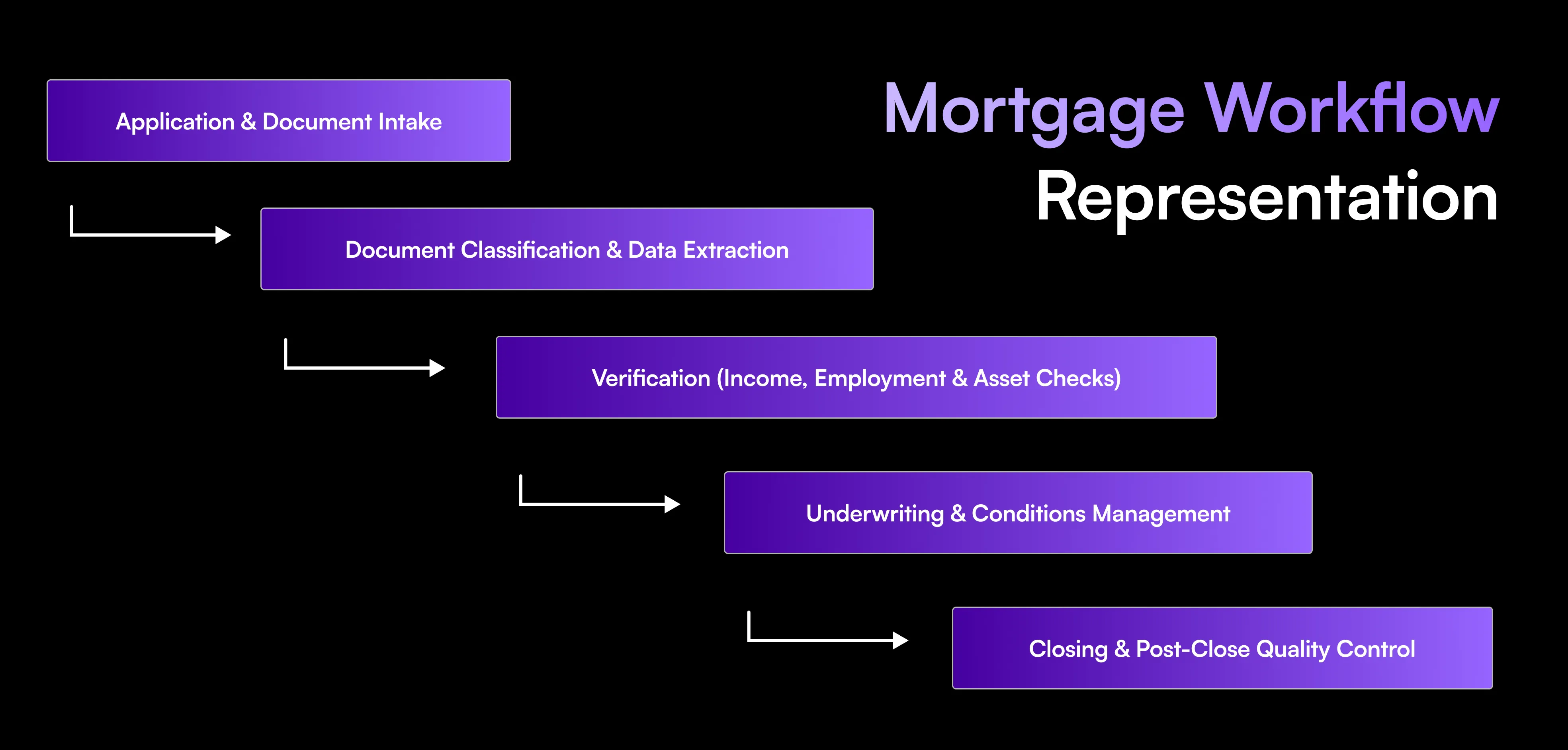
Application & Document Intake
The workflow begins when the borrower submits an application and supporting documents. These may include Form 1003, paystubs, W-2s, bank statements, tax returns, identification records, and property documents.
Automation can capture incoming files, associate them with the correct loan, detect missing information, and trigger document requests. This reduces manual intake work and gives processors a more complete file earlier.
Document Classification & Data Extraction
Incoming loan packages must be separated and identified before their information can be used. Document intelligence can classify each document, split combined files, identify versions, extract required fields, and convert document information into structured data. The output can then move into an LOS, underwriting platform, QC application, or another mortgage system.
Verification (Income, Employment & Asset Checks)
Once data is available, automation can compare information across documents and external sources. Income values can be checked across paystubs, W-2s, VOEs, tax forms, and bank statements. Asset information can be compared with account records. Employment details can be validated against supporting evidence.
Exceptions move to reviewers instead of forcing them to recheck every field.
Underwriting & Conditions Management
Underwriters need complete and dependable information before making a credit decision. Workflow automation can prepare underwriting data, detect missing documents, track outstanding conditions, assign work, trigger reminders, and route new information back for review. Automated rules can also highlight inconsistencies that require an underwriter's attention.
The underwriter spends less time preparing the file and more time evaluating it.
Closing & Post-Close Quality Control
Before and after closing, lenders must verify that the loan package is complete and consistent. Automation can compare Closing Disclosures, Loan Estimates, title information, borrower details, fees, and other documents. Post-close workflows can run predefined checks, identify missing documents, find data mismatches, assemble supporting evidence, and route exceptions to QC auditors.
Key Benefits of Automating Mortgage Workflows
Mortgage workflow automation affects more than processing speed. By reducing repetitive tasks and moving clean data between stages, lenders can improve loan quality, control operating costs, strengthen review processes, and give borrowers quicker answers.
Faster Loan Cycle Times
Researchers at the Federal Reserve Bank of New York found that technology-based mortgage lenders processed mortgage applications roughly 20% faster than other lenders, even after controlling for borrower, loan, and geographic characteristics.
Automation reduces time spent waiting for document sorting, data entry, verification, task assignment, and repetitive reviews. It also helps teams identify incomplete files earlier instead of discovering problems late in underwriting or closing.
For example, Infrrd's Ally, an agentic AI mortgage QC solution, helps lenders reduce auditing work that previously took around two hours to approximately 30 minutes. By automating repetitive document checks, data validation, and exception identification, Ally allows auditors to spend less time reviewing every detail manually and more time investigating findings that require human judgment.
Improved Accuracy and Fewer Manual Errors
Repeated data entry creates opportunities for discrepancies. Freddie Mac reported that lenders with extensive use of its Loan Product Advisor digital capabilities experienced approximately 40% fewer loan defects than lenders with low usage.
Automated extraction, validation, and cross-document checks can help teams detect mismatches before they move deeper into the loan process.
Stronger Compliance and Audit Readiness
Automation can record what was checked, which rule was applied, what data supported the result, and which exceptions required human review.
This creates a clearer trail for internal QC, investor reviews, and regulatory examinations. It also makes repeatable checks easier to apply across a larger share of the loan population.
A Better Borrower Experience
Borrowers notice delays even if they cannot see the operational cause. Faster document processing, earlier identification of missing information, and fewer repeated document requests can make the process easier to follow. Loan teams can also spend more time answering borrower questions instead of sorting documents or copying data.
Cost Efficient
Freddie Mac's Cost to Originate analysis found that lenders maximizing the digital capabilities of Loan Product Advisor could save up to $1,700 per mortgage loan. Freddie Mac also reported shorter production timelines among high-use lenders.
The financial case for automation comes from reducing repetitive labor, rework, processing delays, and defect-related costs rather than simply replacing individual tasks with software.
Common Challenges and How to Solve Them
Mortgage automation can fail if lenders automate isolated tasks without considering systems, data, security, and employees. Three issues appear frequently during implementation, and each should be addressed before automation expands across the loan lifecycle.
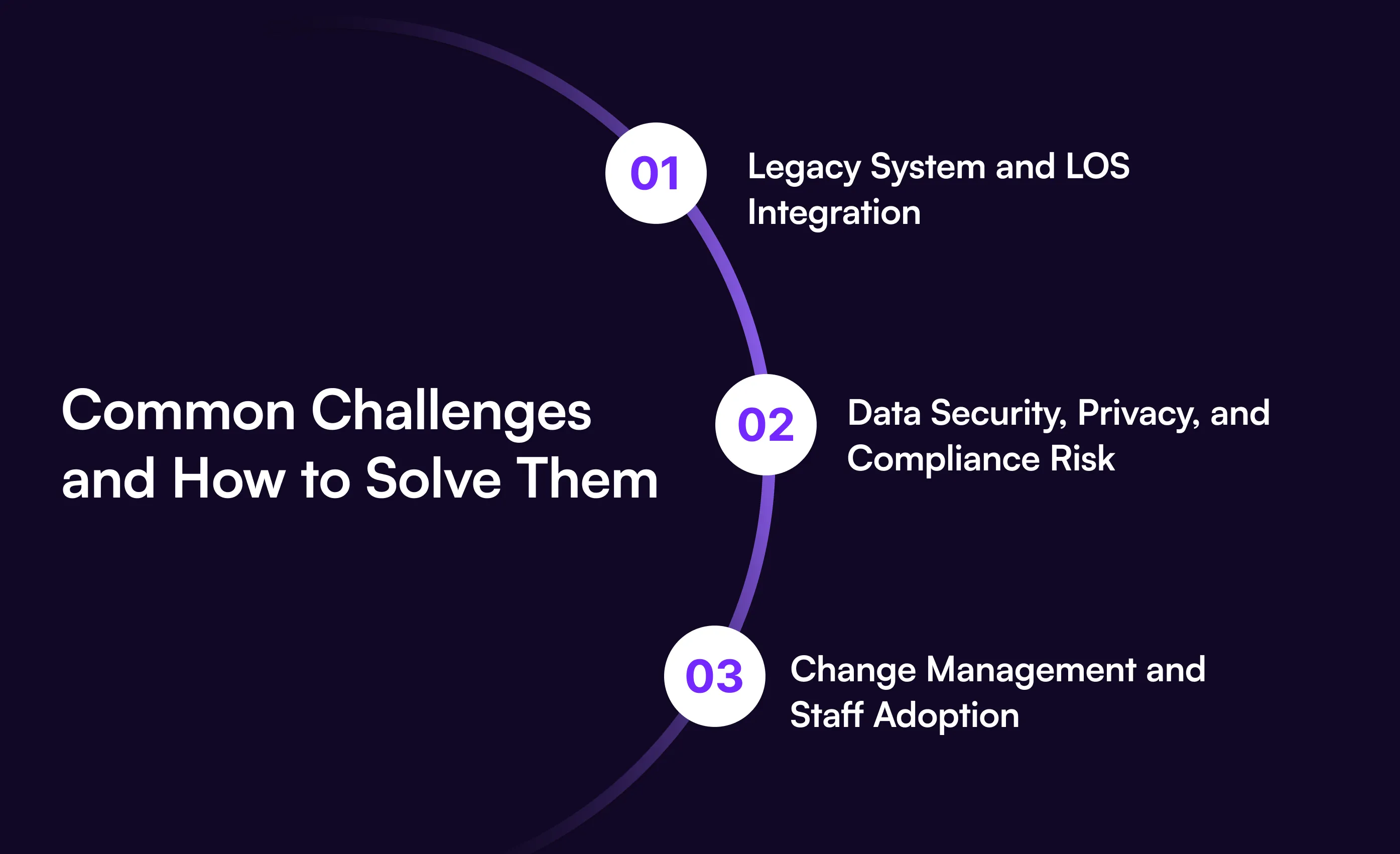
Legacy System and LOS Integration
Automation must exchange information with existing loan systems without creating another data silo. Use APIs where available, define the LOS as the system of record, and map exactly which data should enter or leave each system.
Data Security, Privacy, and Compliance Risk
Mortgage files contain sensitive borrower information. Teams should evaluate encryption, access controls, data retention, audit logs, hosting requirements, and vendor security controls before moving production documents through a new platform.
Change Management and Staff Adoption
Automation changes who performs each task. Define which activities software handles, which exceptions require people, and who owns the final decision. Train teams around the new workflow rather than teaching only the software interface.
How to Implement Mortgage Workflow Automation: A Step-by-Step Framework
A successful implementation starts with the workflow, not the technology. Mortgage teams should first understand where work stalls, which tasks repeat, and what information each downstream process requires before selecting an automation platform.
Use this checklist:
- Map the full mortgage workflow. Document each step from application intake through closing and post-close QC.
- Record every manual handoff. Identify where processors, underwriters, closers, and auditors move information between documents or systems.
- Measure current processing time. Capture turnaround time for major stages so improvements can be measured later.
- Find repetitive document tasks. Look for sorting, stacking, classification, data entry, comparison, and verification work.
- Identify high-volume bottlenecks. Prioritize tasks that occur across a large percentage of loans rather than rare exceptions.
- Evaluate the impact of errors. Give higher priority to processes where incorrect data creates underwriting, compliance, closing, or repurchase risk.
- Define the required integrations. Map connections with the LOS, AUS, document repository, verification providers, QC systems, and reporting tools.
- Choose build, buy, or partner. Compare internal development cost, implementation time, maintenance requirements, mortgage knowledge, and integration capabilities.
- Run a controlled pilot. Start with a specific workflow, document group, audit process, or loan population rather than attempting full automation at once.
- Set measurable success criteria. Track processing time, extraction accuracy, exception rates, manual touches, cost per loan, and defect rates.
- Review exceptions closely. Study where automation fails or requires human intervention and determine why.
- Scale proven workflows. Expand automation after the pilot meets agreed performance thresholds and employees understand the operating model.
The first process to automate should usually combine high volume, repetitive work, clear rules, measurable outcomes, and enough historical data to test performance. Automating the hardest judgment-based process first can make implementation slower without proving business value.
The Role of Document Intelligence in Workflow Automation
Clean, structured data is the foundation of a fast mortgage workflow. Mortgage information rarely enters an organization in a ready-to-use format. Critical data sits inside Form 1003 applications, pay stubs, W-2s, tax returns, bank statements, VOEs, credit reports, appraisals, Closing Disclosures, Loan Estimates, title documents, and hundreds of other document variations.
A workflow cannot automate verification, underwriting preparation, compliance checks, or QC effectively if the data feeding those steps is incomplete or incorrect.
This makes classification and extraction the first important intelligence layer.
The system must identify what each document is, separate mixed loan packages, select the correct document version, extract required values, normalize those values, and validate them before downstream rules use the information.
Once unstructured mortgage documents become reliable structured data, automation can move beyond document reading. It can compare values, apply business rules, calculate results, find exceptions, trigger tasks, and send information into downstream systems.
How Infrrd Powers Every Stage of the Mortgage Workflow
Infrrd has spent a decade building document intelligence technology and provides mortgage-specific automation for origination, processing, pre-fund QC, and post-close workflows.
MortgageCheckai handles document-heavy work such as splitting loan packages, classification, stacking, extraction, document versioning, data matching, and exception detection. It supports pre-fund and post-close QC workflows and can exchange information with systems such as an LOS or AUS.
Ally adds an agentic AI layer for mortgage QC. MortgageCheckAI prepares structured loan data, while Ally applies mortgage audit logic, performs cross-document checks, calculates and compares information, applies audit rules, identifies exceptions, and prepares findings for auditor review. Together, the two products can automate much of the repeatable work while auditors retain control over material judgments, overrides, escalations, and final approval.
Conclusion
Mortgage workflow automation works best when lenders stop treating automation as a collection of isolated shortcuts.
The larger opportunity is to connect document intake, extraction, verification, underwriting preparation, closing, and QC around reliable data and clear workflow rules. The New York Fed research shows why speed matters: technology-based mortgage processes have demonstrated materially shorter processing times. Automation can also support lower operating costs and better loan quality when applied carefully.
The starting point does not need to be the entire mortgage lifecycle. Find a repetitive, high-volume bottleneck. Measure it. Automate it. Validate the result. Then expand into the next stage. That approach turns mortgage workflow automation from a technology project into an operating model.
Frequently Asked Questions
1. What is mortgage workflow automation?
Mortgage workflow automation uses software and AI to handle repetitive loan tasks, route work, process documents, validate data, and send exceptions to people for review.
2. What mortgage processes can be automated?
Lenders can automate document intake, classification, extraction, income verification, asset checks, condition tracking, file preparation, compliance checks, closing reviews, and post-close QC.
3. What should a lender automate first?
Start with high-volume tasks that follow clear rules, require significant manual effort, create measurable delays, and occur consistently across a large percentage of loans.
4. Does mortgage workflow automation replace an LOS?
No. The LOS usually remains the system of record. Workflow automation performs tasks around it and exchanges data with the LOS and other mortgage systems.
5. What is the difference between mortgage workflow automation and document automation?
Document automation converts mortgage documents into structured data. Workflow automation uses that data to trigger checks, decisions, assignments, approvals, and downstream actions.
6. Can mortgage underwriting be automated?
Parts of underwriting can be automated, including document preparation, verification, calculations, rule checks, and condition tracking. Underwriters still handle decisions requiring professional judgment.
7. How does automation improve mortgage QC?
Automation can check loan packages against predefined rules, compare document data, identify missing files, flag discrepancies, assemble evidence, and route exceptions to auditors.
8. How does mortgage workflow automation reduce processing time?
It removes repeated data entry, document sorting, manual comparisons, task handoffs, and avoidable review work while identifying missing or conflicting information earlier.
9. What systems should mortgage automation integrate with?
Common integrations include the LOS, AUS, document management systems, income and employment verification services, asset verification platforms, QC applications, and reporting systems.
10. How should lenders measure mortgage automation performance?
Track cycle time, manual touches per loan, extraction accuracy, exception rates, defect rates, cost per loan, automation rates, rework, and employee processing capacity.