- Ally automates 80% of post-close audits, auditors keep judgment, escalations, overrides, and final sign-off.
- MortgageCheckAI preps the file; Ally reasons over data, flags exceptions, and drafts audit-ready findings.
- The remaining 20% isn't a gap, it's the accountability layer investors and regulators actually require.
Post-close quality control still depends on too much manual work. Auditors collect documents, recalculate figures, compare disclosures, trace missing data, and document every exception before they can make a final decision. That workload limits many lenders to reviewing only about 10% of closed loans, which is also the minimum mandate. The remaining files may receive less scrutiny until an investor, regulator, or internal review raises a question.
The work is repetitive, but the risk is not. A missed income mismatch, tolerance issue, title gap, or unsupported exception can lead to repurchase exposure, compliance findings, and auditor burnout.
What if auditing 10% or more of your closed loans could move faster without adding more auditors?
Infrrd’s answer is a paired workflow built around MortgageCheckai and Ally. MortgageCheckai prepares the loan package, and Ally works through the audit logic. Together, they can automate about 80% of the repeatable work across a 10-step post-close review, while the auditor keeps control of material judgments, escalations, overrides, and final sign-off.
Meet Ally and the 10 Steps It Takes Through Every Loan File
MortgageCheckai does the initial work of splitting, classifying, stacking, tagging, bookmarking, and extracting the loan documents. Ally then reasons over that extracted data, compares data across the file, applies regulatory and lender-specific audit rules, flags exceptions, and prepares findings for the auditor to review. Ally works a loan file the way a senior auditor would, through a fixed 10-step sequence.
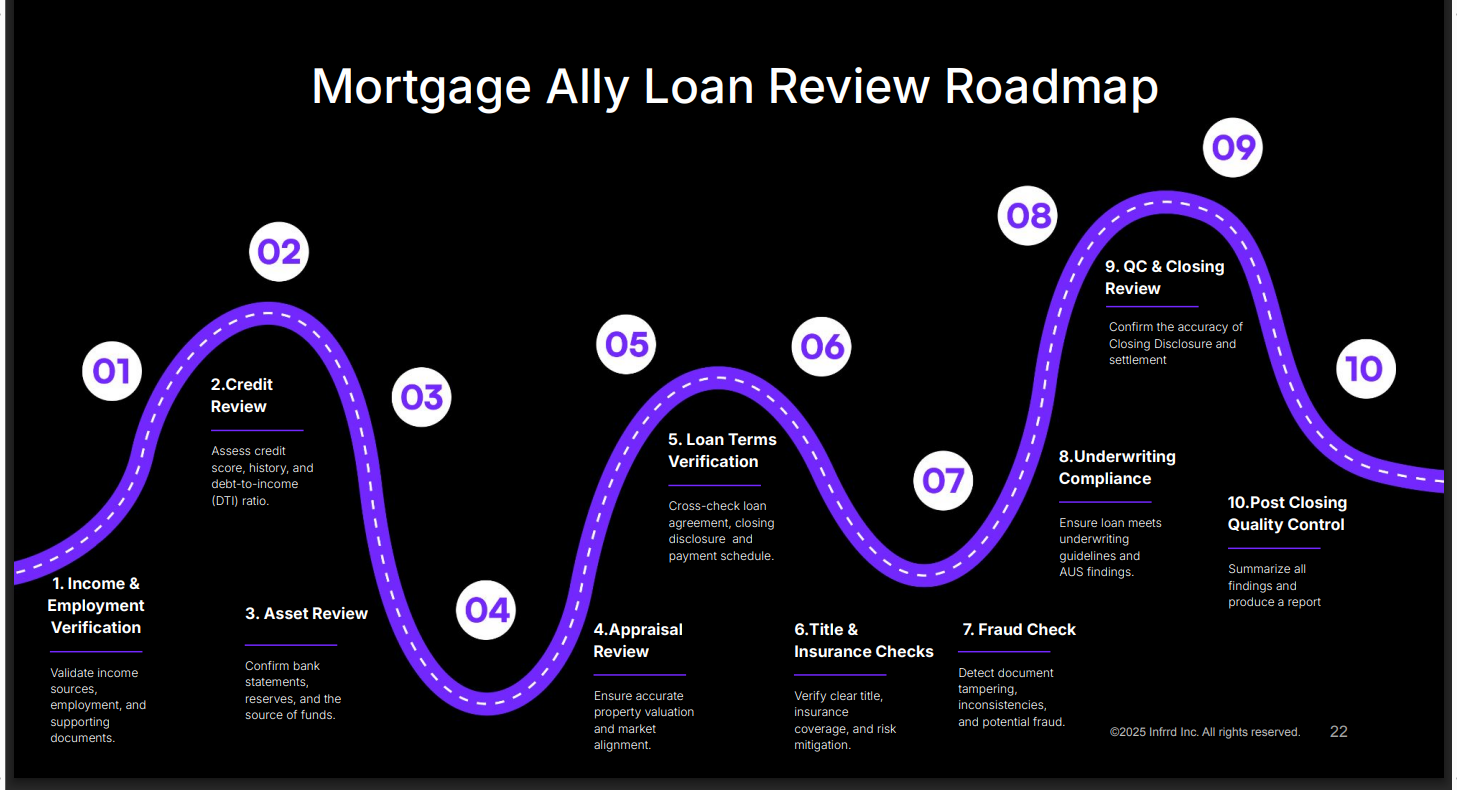
1. Income & Employment Verification
Ally gathers income and employment data from paystubs, W-2s, tax returns, verification documents, bank statements, and the loan application. It checks whether employer names, employment dates, pay frequency, year-to-date income, and qualifying income agree across the file.
For the auditor, this removes the first round of document hunting and spreadsheet work. Instead of rebuilding the borrower’s income picture from separate pages, the auditor starts with normalized figures, cited source documents, calculation results, and visible mismatches.
The auditor can then focus on cases that need professional review.
2. Credit Review
Ally reads the credit report, identifies liabilities, compares recurring debts with the application and underwriting records, and checks whether the debt-to-income calculation uses the right obligations.
It can also flag newly opened credit, undisclosed liabilities, inconsistent balances, or debts that appear to have been excluded without support.
This helps the auditor move from searching to evaluating. The system presents the credit facts and the exception. The auditor decides whether the issue is material, whether an exclusion was justified, and whether the final underwriting decision remains supportable.
3. Asset Review
Ally compares bank statements, asset verification, gift documentation, deposit records, and the final source-of-funds calculation. It checks balances, large deposits, reserve requirements, account ownership, and whether the documented funds support cash-to-close.
The auditor no longer needs to trace every number by hand before deciding what deserves attention. Ally can surface unexplained deposits, missing pages, ownership conflicts, sudden balance changes, and reserve shortfalls.
The auditor reviews the explanation, tests the supporting evidence, and decides whether the funds were acceptable under the applicable guideline.
4. Appraisal Review
Ally collects property and valuation facts from the appraisal, loan application, underwriting findings, title records, and closing documents. It compares the subject property address, occupancy, appraised value, property type, effective date, and other key fields.
The value for the auditor is faster issue isolation. A mismatch between the appraisal and the rest of the file appears as a defined exception rather than a fact hidden across hundreds of pages.
The auditor still owns valuation judgment, appraisal quality concerns, unsupported adjustments, reconsideration questions, and escalation to a qualified reviewer.
5. Loan Terms Verification
Ally compares the note, loan application, Loan Estimate, Closing Disclosure, underwriting output, and system-of-record data. It checks the loan amount, interest rate, term, amortization type, payment details, occupancy, purpose, and other core terms.
This step reduces repeated cross-document comparison. The auditor receives a clear view of where the terms agree and where they do not.
The human review then centers on the reason for the variance, the governing document, the timing of the change, and the effect on compliance or salability.
6. Title & Insurance Checks
Ally reviews title commitments, title policies, homeowner insurance evidence, flood documents, mortgage clauses, property addresses, insured amounts, effective dates, and named parties.
It can flag expired coverage, missing evidence, address differences, title exceptions, or incorrect lender information.
For auditors, this turns a scattered checklist into an exception-led review. Ally identifies the missing or conflicting item and points back to the source. The auditor decides whether the exception was cleared, whether the coverage was sufficient, and whether a title condition creates investor or collateral risk.
7. Fraud Check
Ally looks for conflicting borrower details, altered values, document inconsistencies, duplicate records, unusual changes between versions, and other warning signs across the package.
Infrrd also describes fraud and tampering checks that compare signatures, values, document content, and signs of editing.
Ally helps by applying the same checks across every reviewed file. It does not decide intent. The auditor investigates the pattern, requests added evidence where required, records the reasoning, and escalates suspected fraud through the lender’s approved process.
8. Underwriting Compliance
Ally compares the documented loan facts with underwriting findings, agency rules, investor rules, and lender overlays. It can test whether income, assets, liabilities, property facts, conditions, and approval terms support the final decision.
The auditor receives rule-linked findings instead of a blank checklist. This can shorten the time spent locating the right evidence and repeating calculations.
The auditor still decides how to treat guideline interpretation, compensating factors, approved exceptions, conflicting rules, and conditions that may affect eligibility.
9. QC & Closing Review
Ally checks the Closing Disclosure, settlement statements, note, final loan terms, fees, signatures, dates, and disclosure changes. It can compare versions, identify mismatched amounts, and surface fee or tolerance questions.
MortgageCheckai supports automated document comparison, CD balancing, versioning, and TRID-related checks. This gives the auditor a focused closing review. The system performs the repeatable matching. The auditor examines material fee changes, cure evidence, timing questions, valid change circumstances, and any issue that could affect borrower treatment or regulatory compliance.
TRID is the TILA-RESPA Integrated Disclosure rule, which sits under both TILA and RESPA.
10. Post-Closing Quality Control
Ally brings the findings from the first nine steps into a final review package. It groups exceptions, links evidence, records calculation results, and helps draft the audit summary.
It can also support issue tracking and a traceable record of what the system checked and what the auditor decided.
The auditor reviews the full defect picture, assigns severity, confirms root cause, documents any rebuttal or cure, and approves the final report. Ally prepares the evidence. The auditor owns the conclusion.

The Product Layer: How MortgageCheckAI and Ally Split the Work
The 10-step process depends on a clear division of labor.
MortgageCheckai prepares the file. It receives the loan package, identifies each document, separates combined PDFs, groups related pages, applies document labels, builds the stack, creates bookmarks, extracts fields, and checks basic consistency.
This sequence is described as classification, splitting, stacking, extraction, validation, exception flagging, and delivery.
Ally works with the post-close mortgage audit. It uses the extracted data to calculate, compare, cross-validate, apply regulatory mortgage rules, find exceptions, assemble evidence, draft findings, and support reporting.
It can also reconsider a result when a new document arrives or when an auditor corrects an earlier input. Ally is a mortgage-native AI built for origination, quality control, post-close audits, and servicing. Its continuous feedback loop helps it learn from every correction and improve over time.
The scale matters because a post-close file may contain hundreds of pages and many versions of the same fact. MortgageCheckai can reduce document sorting from 2 hours to approximately 30 minutes.
The platform supports 600+ mortgage document types, extracts 20,000+ data points, and has processed more than $1 billion in loan decisions.
The operating target is up to four times more auditor output because the auditor starts with an organized file, completed comparisons, and a list of exceptions.
Where enabled, Annie can act as a 24/7 assistant, giving users a conversational way to locate loan facts, review supporting evidence, and move through open questions without returning to a manual page search.
Walking the 10 Steps: What Ally Automates vs. What the Auditor Still Owns
The 80/20 split becomes clear when the 10 steps are grouped by the type of work involved.
Steps 1–3: Income, Credit, and Assets
What Ally automates: Ally gathers borrower facts, normalizes values, runs repeatable calculations, compares information across documents, and flags missing or conflicting evidence.
It can prepare qualifying income inputs, debt details, asset balances, reserve checks, and source-of-funds questions before the auditor opens the file.
What the auditor still owns: The auditor reviews unstable income, self-employed borrower judgment, debt exclusions, disputed liabilities, large-deposit explanations, gift-fund support, and any exception that depends on context.
The human decides whether the evidence supports the loan decision and records why.
Steps 4–7: Property, Terms, Title, Insurance, and Fraud
What Ally automates: Ally compares property facts, valuation fields, loan terms, title data, insurance details, document versions, and borrower identifiers.
It checks for expired records, missing coverage, mismatched addresses, changed values, and signs that deserve fraud review.
What the auditor still owns: The auditor assesses appraisal quality, material title exceptions, acceptable insurance evidence, valid changes in loan terms, and the meaning of a fraud signal.
Ally can identify a pattern. A trained person must decide whether that pattern reflects an error, an acceptable exception, or a case that requires escalation.
Steps 8–10: Compliance, Closing, and Final QC
What Ally automates: Ally tests documented facts against underwriting requirements, reviews closing data, compares disclosures, checks calculations, links issues to source documents, and prepares a draft audit record.
It also organizes open defects by category so the auditor can review the highest-risk items first.
What the auditor still owns: The auditor interprets policy where rules conflict, confirms whether an override was valid, assigns defect severity, evaluates materiality, reviews rebuttals, and approves the final report.
The auditor also decides whether a finding needs correction, management attention, investor notice, or a broader process review. This is the practical meaning of 80% automation. Ally handles the repeatable work that consumes time. The auditor handles the decisions that carry accountability.

Why Is It Only 80% Automation, Not 100%: The Deliberate Ceiling
The remaining 20% is not a failure to extract enough data but rather the judgment layer.
Post-close audits include decisions that depend on context. A variance may be small but systematic; an exception may be allowed under one investor overlay and unacceptable under another, or a missing document may have a valid substitute.
A fraud indicator may be a scanning issue, a clerical mistake, or a serious concern. An automated system can assemble the facts and apply known rules, but the auditor must weigh materiality, intent, documentation quality, and the effect on loan eligibility.
That human role protects the audit.
Investors and regulators need a traceable process, clear evidence, consistent tests, and accountable approval. They do not benefit from a system that hides the last decision behind a model output.
Final human sign-off shows who reviewed the exception, why the conclusion was accepted, and what action followed. Ally removes the bottleneck before judgment. It clears document preparation, comparison, calculation, and first-pass rule testing. The auditor spends the remaining time on matters that deserve experience.
That is why the 20% human layer acts as a safeguard rather than a drag on throughput.
Conclusion
Infrrd changes post-close QC by dividing the work where it belongs. MortgageCheckai prepares the loan package, while Ally applies audit logic across income, credit, assets, property, disclosures, compliance, and final reporting. The system handles repetitive preparation, while auditors maintain control over escalations and approvals. That 80/20 model helps teams review more loans without turning final judgment over to software.
Infrrd is not selling another extraction step or a separate workflow tool. It gives audit teams the evidence, speed, and control needed to audit larger volumes of loans with confidence and consistency at greater scale.