- Automated indexing identifies, organizes, and routes mortgage documents correctly before extraction, validation, underwriting, or QC begins.
- AI reduces manual sorting and indexing errors while accelerating loan processing and improving downstream document accuracy.
- Confidence-based human review catches uncertain documents before classification mistakes create extraction errors or false exceptions downstream.
Lenders often treat automation as an all-or-nothing goal; digitizing intake, verification, underwriting support, quality control, and audit in one sweep. But the real work lies in how well each step performs individually. Every downstream stage inherits errors from the one before it, making data validation at each step non-negotiable.
Fannie Mae reports that loans with at least one digital validation component are 33% less likely to produce defects. That does not mean one tool fixes loan quality. It shows why dependable digital inputs matter.
Mortgage document indexing is one of those inputs. Before a system can extract income, compare balances, check disclosures, or flag missing records, it must know what document it received and where that document belongs.
So mortgage document automation starts with a basic question: What is this document? This guide explains how automated mortgage document indexing answers that question, what happens behind the process, where it can fail, and how lenders can build from indexing into broader loan automation.
What Is Mortgage Document Indexing and Why Manual Indexing Fails at Scale
Mortgage document indexing is the process of identifying loan documents, assigning them to the correct document type, organizing them in a defined order, and attaching labels or metadata that downstream systems can use.
A single mortgage file may contain hundreds of pages across borrower income, assets, credit, property, title, insurance, disclosures, and closing records. Those pages may arrive as separate files, email attachments, scans, or one combined PDF.
In a manual loan origination workflow, an operations employee opens the package, finds document boundaries, names each file, applies the correct category, and places documents in the required stack. The work looks simple until volume rises.
Manual indexing creates three common bottlenecks. It consumes staff time before higher-value review begins. It creates inconsistent naming and document placement across employees. And a wrong label can send the wrong document into the next process.
If a bank statement is indexed as a pay stub, for example, the extraction system may search for payroll fields that do not exist. The error starts at indexing, but its impact can appear later as missing income data, failed validation, or unnecessary manual review.
Indexing vs. Classification vs. Data Extraction: Where They Overlap
These three terms describe different jobs, but they work as one document-processing chain.
Document classification answers, “What type of document is this?” The system may identify a page set as a W-2, pay stub, bank statement, appraisal, Closing Disclosure, or another mortgage document type.
Document indexing answers, “Where does this document belong, and how should the system reference it?” After classification, the platform can group pages, assign document labels, tag borrower or loan information, create bookmarks, and place the document in the required loan stack.
Data extraction answers, “What information should I read from this document?” The system captures fields such as employer name, gross pay, account balance, property value, loan amount, borrower name, dates, and fees.
The processes overlap because the output of one guides the next. Classification gives indexing the document identity. Indexing gives extraction the correct document context. Extraction then provides structured values for validation, underwriting support, quality control, and audit checks.
How Automated Mortgage Document Indexing Works
Automated mortgage document indexing turns an incoming loan package into an organized, machine-readable file. The workflow usually combines OCR, document classification, page grouping, metadata tagging, and document rules before the package moves to extraction, validation, or audit.
OCR and AI-Based Document Classification
OCR, or Optical Character Recognition, converts scanned or image-based pages into machine-readable text. AI-based classification then uses text, layout, visual structure, field patterns, and document context to identify the document type.
The system may detect phrases such as “gross pay,” “year-to-date earnings,” or “pay period” on a pay stub. A bank statement has different signals, such as account numbers, transaction tables, deposits, withdrawals, and statement periods. Good classification also works across document versions, lender formats, and does not depend on one fixed template.
Automated Metadata Tagging and Document Naming
After the system identifies the document, it can assign metadata such as document type, borrower name, loan number, statement period, document date, page range, or version.
That metadata helps the platform create consistent names, bookmarks, folders, and stacks. It also makes documents easier for downstream systems and reviewers to locate without opening every page. Rules can then route a W-2 to income verification, an appraisal to property review, or a Closing Disclosure to fee and closing checks.
Common Mortgage Document Types Automated
Common document types include
- W-2 forms
- Pay stubs
- Bank statements
- Tax returns
- Credit reports
- Appraisals
- Loan Estimates
- Closing Disclosures
- Form 1003 loan applications
- Purchase agreements
- Title documents
- Verification of Employment (VOE) records
The challenge is that document signals can overlap. A pay stub and bank statement may both show the borrower’s name, employer deposits, dates, and dollar amounts. A weak classifier may treat an account page containing recurring payroll deposits as income documentation.
If that mistake passes downstream, the extraction model may pull the wrong amount as income. A validation rule may then compare that value with the application and flag a false discrepancy. An underwriter or auditor now spends time resolving a problem created several steps earlier.
Automated indexing must therefore do more than assign labels. It must detect document boundaries, use page-level context, distinguish similar records, and send uncertain cases to review before incorrect document identity spreads through the loan workflow.
Key Challenges in Mortgage Document Indexing Automation
Mortgage files are rarely clean or consistent. Indexing systems must handle different lender layouts, scan quality, page order, versions, and mixed-document PDFs. They must also know when confidence is too low for an automated decision.
Handling High Document Variability and Non-Standard Formats
Take two pay stubs from different payroll providers. One may use a clean table with fixed labels. Another may place earnings, deductions, and year-to-date totals across several sections. Add rotated scans, handwritten notes, stamps, missing pages, or mobile photos, and simple template rules begin to fail.
A useful indexing system must recognize the document from several signals rather than one position or keyword.
Balancing Full Automation with Human-in-the-Loop Review
Full automation should not mean forcing a label onto every document.
Suppose a page contains payroll deposits but lacks a clear statement header. If the system has low confidence between “bank statement” and “income document,” it should route the page for review. A reviewer can correct the label before extraction begins. This approach keeps routine documents moving while reserving human attention for uncertain cases.
Business Benefits of Automating Mortgage Document Indexing
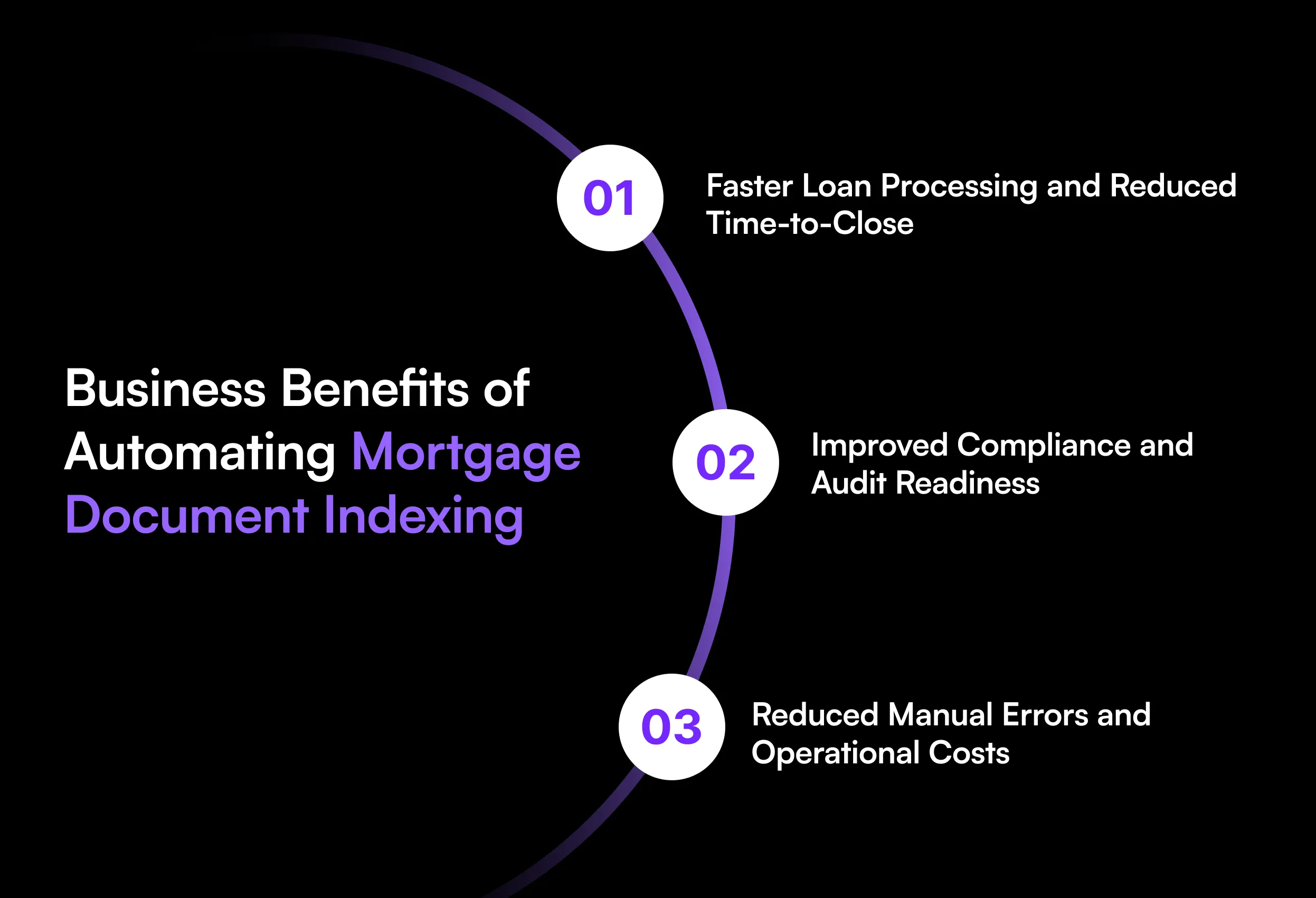
The value of mortgage document indexing appears downstream. Better document identity and organization reduce search work, help extraction models use the right context, and give lending teams a more consistent loan package for review, validation, compliance checks, and audit.
Faster Loan Processing and Reduced Time-to-Close
Automated indexing removes the need to manually split, rename, bookmark, and stack every incoming document. Underwriters and processors can start with an organized file instead of preparing one.
That also reduces delays between document intake and the next task. Income documents can move to income review, appraisals to collateral checks, and disclosures to compliance checks without waiting for manual sorting.
Improved Compliance and Audit Readiness
A consistent document stack makes it easier to confirm whether required records are present, identify the correct document version, and connect findings back to source pages.
Metadata such as document type, date, borrower, version, and page range also gives reviewers a clearer record of what entered the workflow and what the system used.
Reduced Manual Errors and Operational Costs
Manual indexing costs more as loan volume increases because each new file adds repetitive preparation work.
Automation reduces that workload and limits errors caused by inconsistent naming, missed pages, incorrect stacks, and document misclassification. Human reviewers can spend more time on exceptions, credit judgment, policy questions, and findings that require domain knowledge.
How Infrrd Automates Mortgage Document Indexing
Infrrd provides intelligent document processing technology built for document-heavy mortgage workflows. Its mortgage products use document AI to prepare loan packages before deeper validation and quality-control work begins.
Indexing is only the first layer. Infrrd can identify and split documents, classify page groups, create stacks and bookmarks, extract mortgage data, compare values across files and systems, flag issues, and preserve review history.
For lenders, that means mortgage document indexing does not have to operate as a separate point solution. The indexed document can continue through extraction and validation without being handed to another disconnected process.
Infrrd also supports API-based integration with loan origination systems, automated underwriting systems, databases, and other data sources. Structured mortgage data and flagged exceptions can move into the systems where processors, underwriters, closers, or auditors already work.
This matters because a clean stack by itself does not close a loan. The value comes from carrying correct document context into the next decision.
MortgageCheckai: Indexing-to-Audit in One Workflow
MortgageCheckai is Infrrd’s mortgage quality-control automation platform. It automatically indexes, categorizes, and reviews loan documents, including auto-stacking and document versioning.
The current Infrrd mortgage workflow pairs MortgageCheckai with Ally. MortgageCheckai handles preparation work such as splitting, classifying, stacking, tagging, bookmarking, extracting, and basic validation. Ally then works with the extracted data to run audit logic, compare information, apply defined rules, flag exceptions, and prepare findings for human review.
The goal is simple: do the document preparation and repeatable checks before the reviewer starts digging through the file.
Infrrd has achieved
- 600+ mortgage document types supported
- 20K+ critical mortgage data points supported for intelligent extraction
- $1B+ in loan-decision volume processed
This reflects the scale of mortgage documents and data the platform has been built to process.
Conclusion
Every mortgage automation journey has a starting point. For document processing, that starting point is reliable mortgage document indexing. A system cannot extract the right fields, validate borrower data, run document checks, or support an audit if it does not first identify the document correctly. Indexing gives every later process the context it needs.
The practical goal is not to automate the entire mortgage operation in one move. It is to make each step dependable enough to feed the next one.
Infrrd gives lenders a path beyond indexing by connecting document identification, stacking, extraction, validation, exception handling, and mortgage audit workflows in the same processing chain.
Frequently Asked Questions
1. What is mortgage document indexing?
Mortgage document indexing identifies, labels, groups, and organizes loan documents so processors and automated systems can find the correct records and route them to the next task.
2. What is automated mortgage document indexing?
Automated mortgage document indexing uses OCR, AI classification, page grouping, metadata, and rules to identify and organize incoming mortgage documents with less manual sorting.
3. How is mortgage document indexing different from document classification?
Classification determines what a document is. Indexing uses that identity to label, group, name, bookmark, stack, and route the document within the loan file.
4. Why is document indexing important in mortgage processing?
Correct indexing gives extraction, validation, underwriting support, and QC systems the right document context. A wrong label can create incorrect data or false exceptions downstream.
5. Which mortgage documents can AI index automatically?
Systems can index W-2s, pay stubs, bank statements, tax returns, appraisals, credit reports, 1003s, Loan Estimates, Closing Disclosures, title documents, and other loan records.
6. Can automated indexing handle one large PDF with many document types?
Yes. More advanced systems detect page boundaries, split combined PDFs, classify each document group, and rebuild the package into a defined stack with bookmarks and metadata.
7. What happens if AI classifies a mortgage document incorrectly?
A wrong classification can send incorrect context into extraction or validation. Confidence thresholds and human review can catch uncertain documents before the error moves downstream.
8. Does mortgage document indexing use OCR?
Often, yes. OCR converts scanned pages into machine-readable text. Classification models then combine that text with layout and visual signals to identify document types.
9. Where does human review fit into automated mortgage indexing?
Human review should focus on documents with low confidence, unclear boundaries, poor scans, or conflicting signals rather than requiring employees to index every document manually.
10. How does automated indexing support mortgage QC?
Automated indexing gives QC systems an organized document stack, correct document identities, page references, versions, and metadata needed for completeness checks, comparisons, and audit findings.