- Automated loan origination helps lenders reduce manual intake, document review, and verification delays across the lending lifecycle faster.
- Automated loan origination works best when IDP turns borrower documents into validated data before underwriting and compliance review.
- Automated loan origination improves control by routing exceptions to reviewers while keeping audit trails for every decision made.
Automated loan origination is becoming essential as lenders face tighter margins, rising borrower expectations, and growing pressure to close loans faster without adding more manual work. Traditional loan processing still depends on repeated data entry, document chasing, manual verification, and back-and-forth reviews across teams. These delays slow approvals, increase errors, and make it harder to scale when application volumes rise. Lenders are already prioritizing this shift.
In Fannie Mae’s Q2 2025 lender survey, 37% ranked business process streamlining as a top priority, while 22% ranked back-end process technology as a top priority.
Loan origination automation is often the first step because it improves the quality and speed of data entering the lending lifecycle. Once intake, document review, and verification become faster, downstream workflows such as underwriting, compliance, QC, and closing also become easier to optimize. This guide explains how AI and IDP support that change.
What Is Automated Loan Origination and Why Does It Matter Now?
Automated loan origination uses AI, workflow rules, and system integrations to reduce manual work across application intake, underwriting, compliance review, and closing. It matters now because lenders face higher volume pressure with limited room to add staff.
MBA expects single-family mortgage originations to rise to $2.2 trillion in 2026, up from $2.0 trillion in 2025. Purchase originations are forecast at $1.46 trillion, refinance originations at $737 billion, and the loan count is expected to rise from 5.4 million to 5.8 million.
Manual origination incurs costs due to repeated data entry, missing documents, slow validations, and borrower drop-off. The process usually starts with application intake and digital onboarding. It then moves to document collection, classification, and verification. Underwriting teams review income, assets, liabilities, and risk. Compliance teams check rules, disclosures, and exceptions before decisioning and closing. Automation connects these stages so data moves earlier, cleaner, and faster.
Where Intelligent Document Processing Fits in Loan Origination Automation?
In Q1 2026, the Mortgage Bankers Association reported that total loan production expenses reached $11,898 per loan, compared with a historical average of $7,903. Loan origination is one of the strongest places for lenders to prioritize automation because it combines high operating costs, document-heavy workflows, and significant quality risk.
The best place to start is the work that consumes time without requiring a lending decision: document intake, classification, data extraction, validation, and data entry into the LOS.
Borrowers submit pay stubs, W-2s, bank statements, tax returns, IDs, credit reports, and appraisals. Teams then need to identify these documents, find the right values, compare information, and move the data into downstream workflows.
This is where Intelligent Document Processing (IDP) can create an immediate foundation for broader loan origination automation.
Instead of stopping at OCR, lenders can automate a sequence of repetitive document tasks:
- Classify and separate incoming documents so files reach the right workflow automatically.
- Extract borrower, income, asset, and property data instead of manually keying fields.
- Validate information across documents, such as comparing income or borrower details across pay stubs, W-2s, and bank statements.
- Flag missing, inconsistent, or low-confidence information for human review rather than manually reviewing every field.
- Deliver validated data into the LOS so processors and underwriters can work from structured information sooner.
The priority, then, is not to automate the lending decision itself. It is to automate the repetitive document work surrounding that decision, giving loan teams more time to investigate exceptions, assess risk, and make informed lending decisions.
Measurable Benefits of Automating Loan Origination with AI
Automating loan origination with AI gives lenders measurable gains across speed, data quality, compliance control, and operating costs. The value comes from removing repeatable manual work while giving teams clearer files, earlier exceptions, and cleaner data for downstream decisions.
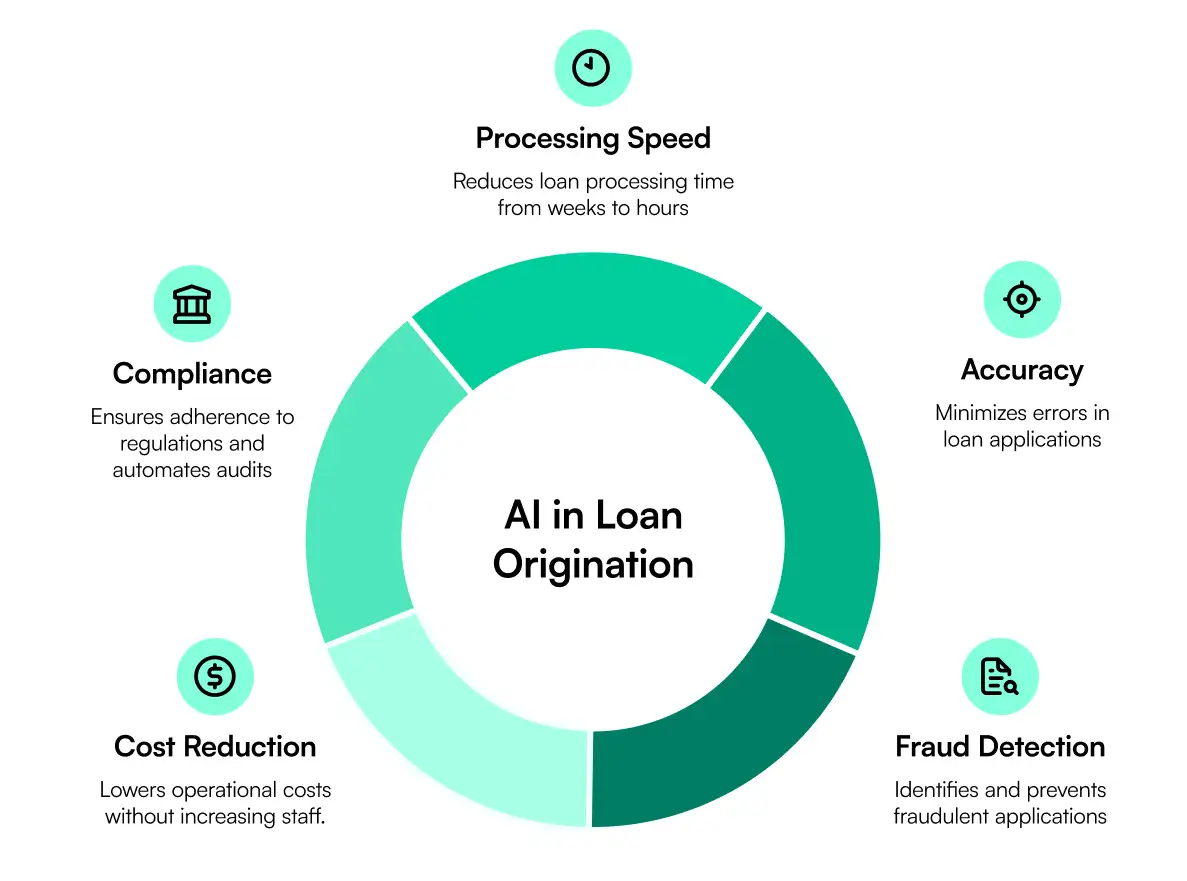
Processing Speed: From Weeks to Hours
AI reduces cycle time by reading documents as soon as they enter the workflow. It classifies files, extracts fields, and routes complete records without waiting for a processor to open each file. This helps teams move faster from intake to underwriting and shortens borrower wait times.
Accuracy and Error Reduction at Scale
Manual entry creates small errors that can become loan-level delays. IDP reduces this risk by capturing data consistently, validating fields, and comparing values across documents. When confidence is low, the system sends the item for human review rather than passing unvalidated data into the LOS.
Compliance Readiness and Audit Trail Automation
Loan teams need proof of what changed, who reviewed it, and why an exception was cleared. Automated loan origination can record evidence from documents, field values, user actions, and review outcomes. This makes compliance checks faster and gives audit teams a clearer record.
Operational Cost Reduction Without Proportional Headcount Growth
Origination volume can rise faster than staffing plans. AI helps lenders handle more files without increasing their manual processing capacity. Teams spend less time sorting documents, keying data, and chasing missing information, which lowers cost per loan over time.
Fraud Detection and Identity Verification During Intake
AI can help detect fraud risks earlier by checking identity documents, borrower details, signatures, and submitted records for mismatches or signs of tampering. It can flag suspicious files during intake, helping lenders review risky applications before they move deeper into underwriting.
How to Implement Automated Loan Origination: A Practical Framework?
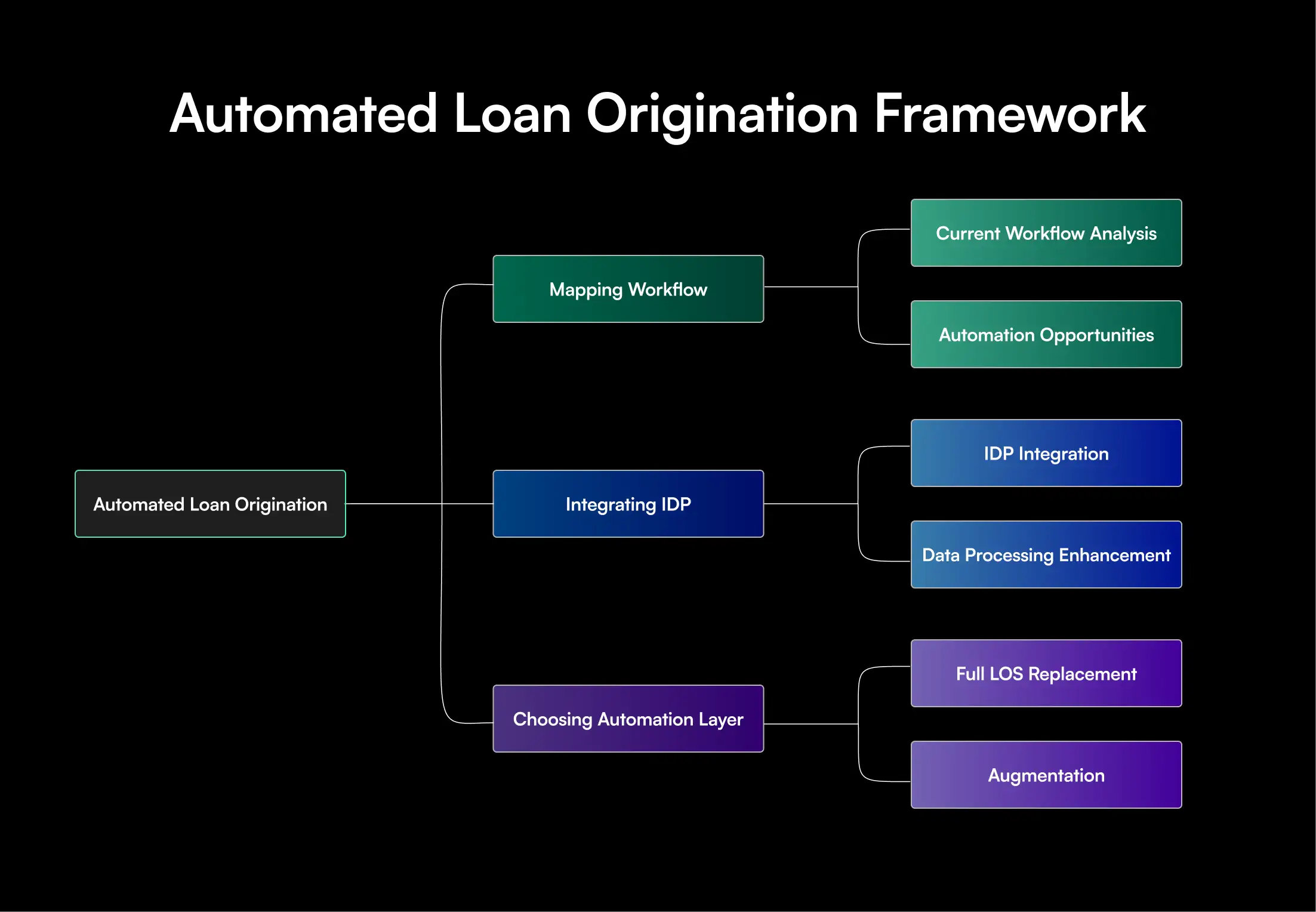
A strong implementation starts with a clear view of the current workflow. Lenders should identify where work slows down, where errors appear, and where teams repeat the same checks across every file. Then they can apply automation in the right places first.
Mapping Your Current Origination Workflow to Automation Opportunities
Start by listing each step from application intake to closing. Track who touches the file, what data they enter, what documents they review, and where delays happen. Prioritize high-volume, rule-based work because it usually delivers the fastest automation value.
Integrating IDP with Your Existing Loan Origination System (LOS)
IDP should pass clean data into the LOS without forcing teams to rebuild their process. Look for API, SFTP, and workflow integration options. The goal is to reduce manual entry while keeping loan officers, processors, underwriters, and QC teams in familiar systems.
Choosing the Right Automation Layer: Full LOS Replacement vs. Augmentation
Many lenders do not need to replace their LOS to improve origination. Augmentation adds IDP and AI workflow layers around the current system. This approach can reduce change risk, protect existing investments, and improve document-heavy work faster than a full platform switch.
Infrrd in Action: Automated Loan Origination Results
Infrrd is an IDP company that helps lending teams automate document-heavy work across origination, underwriting support, QC, post-close review, and other mortgage workflows. Its platform reads incoming loan documents, classifies them, extracts key data, validates fields, flags exceptions, and sends approved information to LOS systems. This helps lenders reduce manual review while keeping humans focused on decisions that need judgment.
Infrrd has helped clients reach 11x ROI and lower processing costs per loan by 60%. In live mortgage workflows, 40% of documents have moved through processing and into LOS systems without human intervention. For origination teams, that means cleaner intake, faster document checks, fewer rework loops, and stronger downstream data for underwriting, compliance, and closing. It gives teams a practical path to faster loans without losing process control.
Conclusion
Automated loan origination helps lenders improve the first and most data-heavy part of the lending lifecycle. It reduces manual intake work, speeds up document review, improves data quality, and gives downstream teams better files to work with. IDP plays a central role by turning loan documents into validated, usable data. AI adds routing, exception handling, and workflow control. The result is faster processing, lower cost per loan, and a clearer audit record. Lenders that start with origination automation can build a stronger base for underwriting, QC, post-close review, and future workflow optimization across the full mortgage operation.
FAQs
What types of loan documents can AI process automatically?
AI can process common mortgage documents such as loan applications, paystubs, W-2s, bank statements, tax forms, IDs, credit reports, loan estimates, closing disclosures, title documents, appraisals, purchase contracts, and income verification documents.
How does automated loan origination connect with AUS systems like Fannie Mae DU?
Automated loan origination connects with AUS systems through LOS integrations, APIs, or standardized formats like MISMO. AI and IDP prepare cleaner borrower and document data before submission, helping AUS return faster underwriting findings.
How does automated loan origination handle regulatory compliance?
Automated loan origination supports compliance by applying business rules, flagging missing or inconsistent data, and recording review actions. It can show which document supported a field, who reviewed an exception, and what changed before approval.
How long does it take to integrate IDP into an existing loan origination workflow?
Timelines depend on document volume, LOS setup, integration method, and review rules. Many lenders start with a defined workflow or document set first, then expand after the first live use case proves value.
What is the difference between a loan origination system (LOS) and IDP?
A LOS manages the loan workflow, borrower data, tasks, approvals, and the system of record. IDP reads and validates documents that feed the LOS. In simple terms, the LOS runs the loan process, while IDP prepares trusted document data for that process.