- Reduce Billing Errors: Automated telecom invoice processing detects duplicate charges, incorrect rates, and billing discrepancies early.
- Simplify Invoice Processing: AI extracts complex carrier invoice data, reducing manual entry and improving processing accuracy.
- Improve Cost Control: Automated validation checks contract rates, flags overcharges, and routes exceptions before payment approval.
Telecom invoices can hide expensive errors inside thousands of line items, service IDs, taxes, usage charges, and contract rates. That risk grows fast when finance teams review bills manually. A U.S. Coast Guard recovery audit examined 14,000 telecommunications invoices from fiscal years 2005 through 2010 and initially identified $4.14 million in payment errors. After providers challenged some claims and the invoices were reviewed again, the Coast Guard re-established about $1.496 million in claims.
The lesson is simple: telecom billing errors are not always obvious, and finding them after payment can become a second project. That is why finance and telecom teams are turning to telecom invoice processing automation. Instead of re-keying fields and checking charges line by line, automated workflows can capture invoice data, compare it with contracts and service records, flag exceptions, and route clean invoices for approval.
What Is Telecom Invoice Processing?
Telecom invoice processing is the process of receiving, reading, validating, approving, and paying invoices from telecom carriers and service providers. It covers recurring services such as voice, internet, mobile, circuits, cloud connectivity, and related network charges. The goal is to turn detailed carrier bills into accurate, structured records that finance and telecom teams can review and pay.
Common Challenges in Manual Telecom Invoice Processing
Manual review becomes difficult because one invoice can contain hundreds or thousands of charge lines. Teams may need to compare account numbers, circuit IDs, locations, service dates, rate plans, taxes, discounts, and one-time fees against contracts or internal records. The work becomes harder when carriers use different layouts or send bills through several channels.
Error Rates, Duplicate Payments, and Billing Disputes
Duplicate invoice numbers are easy to catch. A duplicate service charge across two accounts is harder. Telecom teams may also face services billed after disconnect dates, incorrect rates, missed credits, unexpected usage charges, or taxes applied to the wrong service. If these issues reach payment, AP may need to open disputes, request credits, and track adjustments across later billing cycles.
Time and Resource Costs of Manual Data Entry
Manual entry also creates operational drag. Staff must download invoices, enter header and line-item data, assign cost centers, check approvals, and reconcile exceptions. Large consolidated bills can turn a routine AP task into hours of review. Repetitive work also increases the chance of keying errors.
Telecom invoice processing differs from standard AP invoice processing because the bill is often tied to a changing service inventory, not a simple shipment of goods. A standard AP invoice may match a supplier, PO, quantity, and price.
A telecom invoice can require validation at the account, location, circuit, phone number, service, usage, tax, and contract level. That level of detail makes automated capture and validation even more important.
Telecom Invoice Processing Workflow
A reliable telecom invoice processing workflow moves each bill from intake to payment while preserving the detail needed for review. The steps below show where automation can capture data, test charges, prevent disputes, and route exceptions for review.
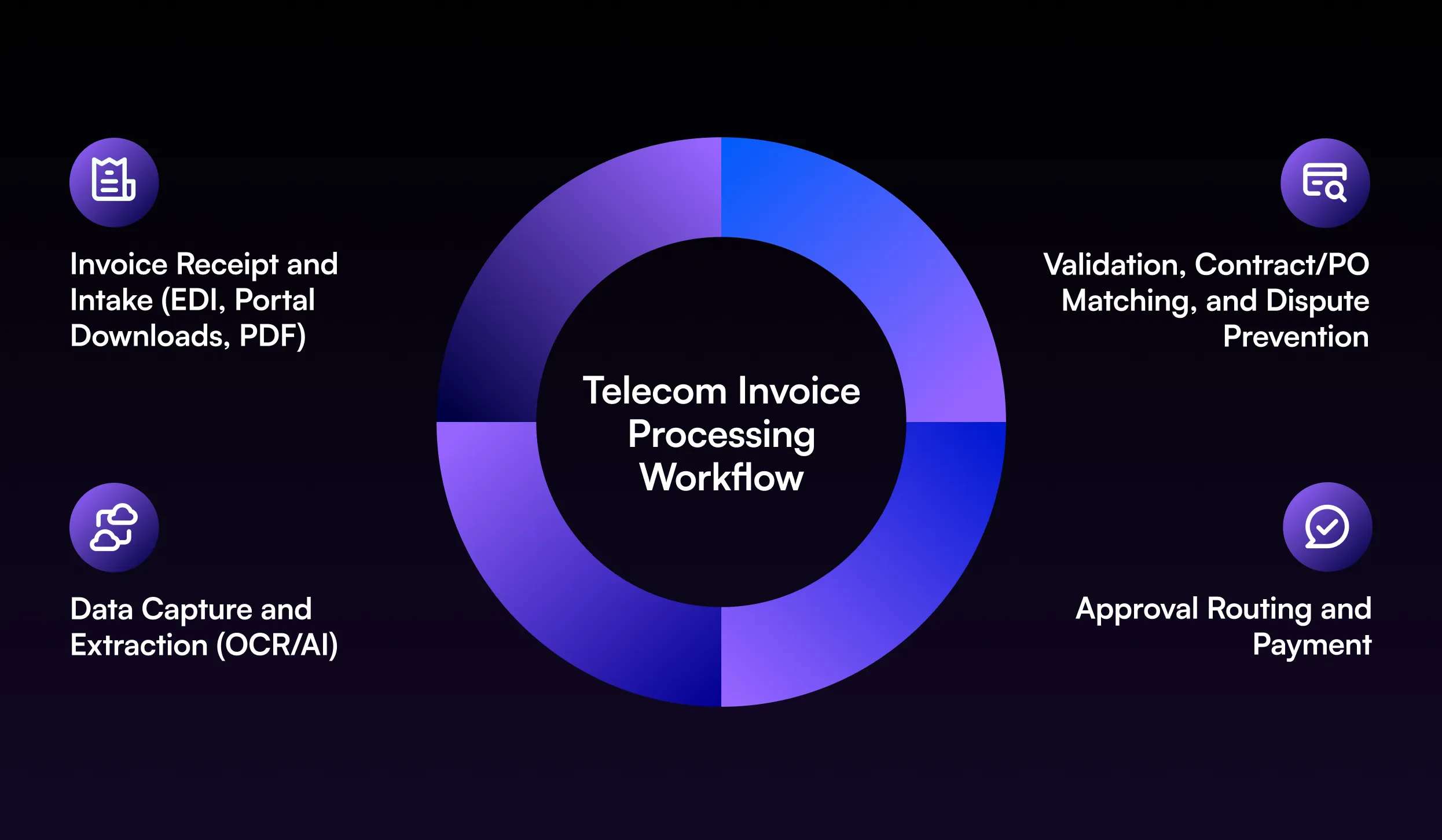
Invoice Receipt and Intake (EDI, Portal Downloads, PDF)
Invoices may arrive through EDI, carrier portals, email attachments, SFTP, or PDFs. The intake layer collects them into one queue, identifies the carrier and account, detects duplicates, and keeps the original invoice for audit purposes.
Data Capture and Extraction (OCR/AI)
OCR and AI extract invoice numbers, dates, account IDs, service addresses, circuit IDs, line items, taxes, fees, usage, and totals. Structured output reduces manual keying and gives downstream systems data for validation.
Validation, Contract/PO Matching, and Dispute Prevention
The system compares charges with contracts, purchase orders, rate cards, service inventories, prior bills, and business rules. It can flag price changes, duplicate services, missing credits, disconnected lines, or unusual surcharges before payment. Teams can then review the exception while the supporting billing data is still easy to trace.
Approval Routing and Payment
Clean invoices move to the correct approver based on carrier, amount, cost center, location, or exception type. Approved records then flow to the ERP or AP system for payment. Exceptions stay visible with supporting invoice data so teams can resolve them quickly.
Why Telecom Invoices Are Uniquely Hard to Process
Telecom bills carry more operational detail than most supplier invoices. A statement can combine recurring charges, usage, circuit records, credits, taxes, and regulatory fees. The sections below explain why this data is harder to review and validate at scale.
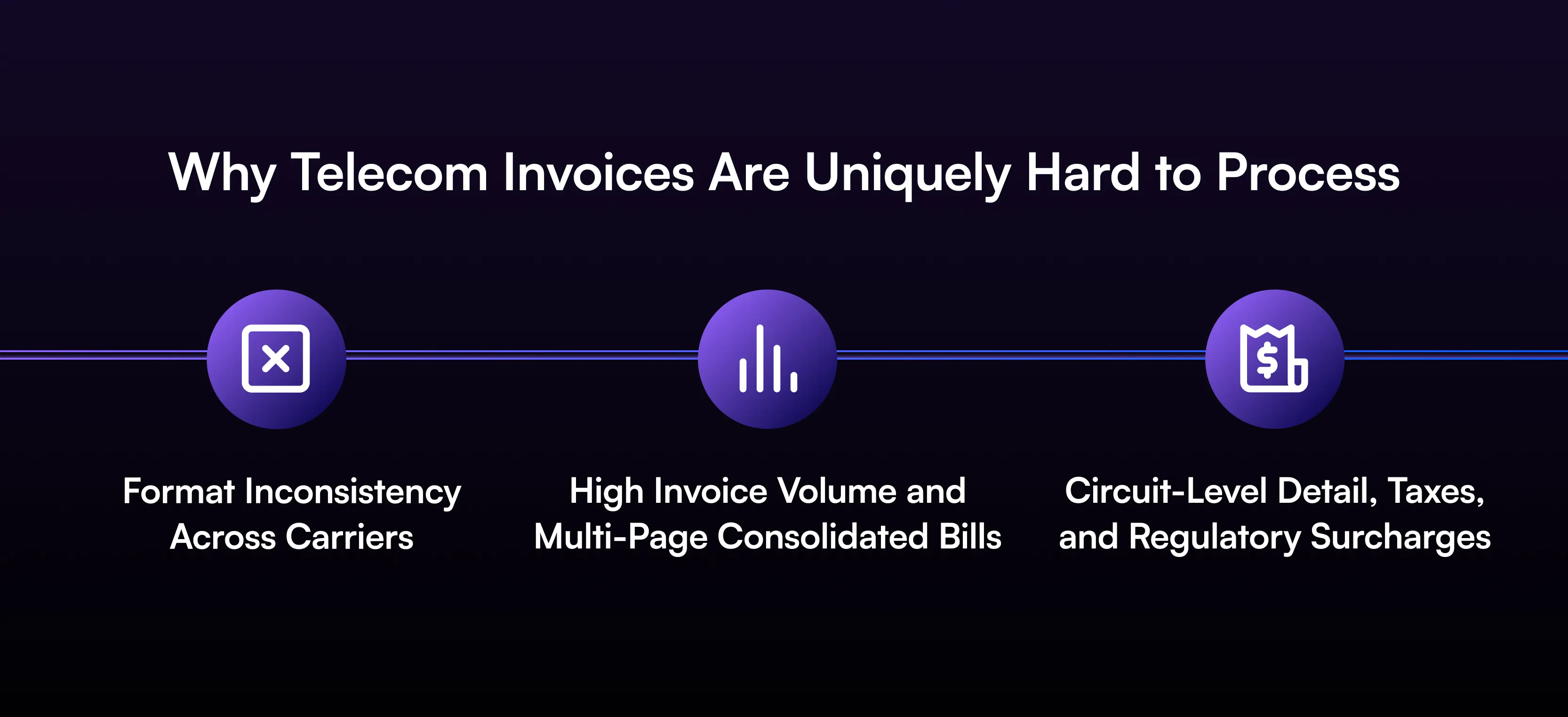
Format Inconsistency Across Carriers (AT&T, Verizon, Lumen, Regional CLECs)
Major carriers such as AT&T, Verizon, and Lumen use different invoice structures, field names, account hierarchies, and file formats. Regional competitive local exchange carriers can add more layouts.
Fixed templates can fail when a carrier changes a bill design, moves a field, or adds a charge category.
High Invoice Volume and Multi-Page Consolidated Bills
Enterprises may receive bills across many locations, accounts, circuits, mobile lines, and business units. Consolidated invoices can run for hundreds of pages, with summary totals at the front and service-level detail later.
Reviewers must connect those levels before they can confirm the total.
Circuit-Level Detail, Taxes, and Regulatory Surcharges (USF, EUCL, 911 Fees)
Telecom charges can include circuit IDs, access charges, service features, usage, credits, taxes, and regulatory items.
U.S. invoices may include charges related to the Universal Service Fund, End User Common Line elements, and 911 programs. Federal rules specifically address End User Common Line charges as part of telecommunications access-service billing.
These items can vary by service, jurisdiction, or carrier, so processing often requires line-level capture instead of header-only AP data.
How AI and Intelligent Document Processing (IDP) Solve These Challenges
AI and intelligent document processing automate parts of telecom invoice processing without forcing every carrier bill into one fixed layout. The value comes from reading varied invoices, structuring line-level data, and sending it into the systems teams already use.
Template-Free Extraction Across Carrier Formats
Template-free extraction uses document AI to identify fields by meaning and context rather than fixed coordinates.
It can capture account numbers, circuit IDs, service periods, charge descriptions, taxes, totals, and line items when carrier layouts differ. Confidence scores and validation rules can route uncertain fields to a reviewer instead of passing them through automatically.
Integration with TEM Platforms and ERPs
Extracted data becomes more useful when it connects with telecom expense management platforms, ERPs, and AP systems.
APIs or structured files can pass validated records downstream for contract checks, coding, approvals, disputes, and payment. This reduces duplicate entry while keeping teams inside existing systems.
Choosing a Telecom Invoice Processing Solution: What to Look For
A telecom invoice processing solution should capture service-level detail, validate charges, and connect with existing systems. Use this checklist to compare options based on accuracy, control, scale, and deployment effort.
Accuracy, Scalability, and Compliance (ISO/GDPR)
- Captures line-item, circuit, tax, fee, and usage data
- Handles high volumes and long consolidated bills
- Adapts to carrier format changes without constant template updates
- Provides confidence scores and review for uncertain fields
- Maintains audit trails and role-based access
- Supports ISO 27001 controls and GDPR requirements where applicable
- Preserves source documents for audits and dispute review
- Supports configurable validation rules for different carriers
Speed of Implementation and ROI
- Connects with TEM, ERP, and AP systems through APIs or exports
- Validates charges against contracts, rate cards, and service inventory
- Routes exceptions without delaying clean invoices
- Tracks processing time, manual touches, disputes, and overcharges
- Supports a focused pilot before wider rollout
Conclusion
Telecom invoice errors can hide inside the details that standard AP checks were never built to review. The current times show how much money can sit behind a large batch of carrier invoices and how much effort may be required to validate disputed claims later.
Telecom invoice processing moves that control earlier in the cycle. By capturing line-level data, comparing charges with contracts and service records, and routing exceptions before payment, teams can reduce manual work and improve invoice review.
The goal is not automation for its own sake. It is a faster, more reliable way to know what the business is paying for.
Frequently Asked Questions
What is telecom invoice processing?
Telecom invoice processing is the receipt, extraction, validation, approval, and payment of carrier invoices, including service charges, usage, taxes, fees, credits, and circuit details.
Why are telecom invoices harder to process than standard AP invoices?
Telecom invoices contain service-level data, changing usage, circuit identifiers, carrier-specific formats, taxes, surcharges, and contract rates that often require deeper validation than standard AP bills.
What types of telecom invoices can be automated?
Automation can process invoices for mobile, voice, internet, WAN, circuits, cloud connectivity, unified communications, and other carrier services received as PDFs, EDI files, or portal downloads.
How does AI extract data from telecom invoices?
AI identifies fields and line items by context, then converts invoice content into structured data such as account numbers, circuit IDs, service periods, charges, taxes, and totals.
Can telecom invoice processing detect duplicate charges?
Yes. A processing workflow can compare invoice numbers, accounts, service IDs, prior bills, and line items to flag possible duplicates before the invoice reaches payment.
How does telecom invoice processing prevent billing disputes?
It can compare charges against contracts, rate cards, service inventories, disconnect records, and prior invoices, allowing teams to question mismatches before payment instead of chasing credits later.
What is the role of OCR in telecom invoice processing?
OCR converts text from scanned or digital invoice documents into machine-readable data. AI and validation rules then help interpret fields, line items, and relationships between charges.
Can telecom invoice processing integrate with TEM and ERP systems?
Yes. APIs, structured exports, EDI, or other integrations can send validated invoice data into telecom expense management, ERP, and AP systems for approval and payment.
What should companies measure after automating telecom invoices?
Track processing time, manual touches, exception rates, duplicate charges caught, billing disputes, overcharges identified, approval time, and the percentage of invoices processed without manual data entry.
Does telecom invoice automation remove the need for human review?
No. Human review remains useful for low-confidence fields, contract disputes, unusual charges, and exceptions. Automation should reduce routine work so reviewers can focus on decisions.