- Calculate True Costs: Include labor, engineering, error correction, and operational overhead to establish accurate ROI.
- Measure Real Savings: Compare current processing costs against automation expenses to determine savings and payback periods.
- Maximize IDP Returns: Reduce manual effort, improve accuracy, and scale document processing without proportional staffing increases.
The strongest case for Intelligent Document Processing is often not the extraction accuracy alone. It is the total cost of running the process.
OCR can read text. RPA can move data between systems. A self-built pipeline can combine models, scripts, APIs, review tools, and validation rules. But each option can still leave a company paying for manual review, engineering support, maintenance, software, exception handling, and rework.
This blog is about Intelligent Document Processing ROI and whether automation reduces that full operating cost enough to justify the investment.
A useful ROI model should therefore compare the current cost of processing documents with the expected cost after IDP. That means looking beyond software licensing and accounting for people, engineering time, processing volume, errors, and operational overhead.
What Is IDP ROI and Why It’s Hard to Pin Down
Intelligent Document Processing ROI measures the financial return a company receives after replacing part of its manual document workflow with IDP.
The calculation sounds simple: compare the cost before automation with the cost after automation. The difficulty lies in building the baseline.
Manual document processing includes more than data-entry salaries. Companies may also pay engineers to maintain extraction rules, supervisors to manage processing teams, software fees, training costs, and error correction costs. Some benefits are also harder to price. Faster processing may reduce turnaround time. Better accuracy may lower rework. Higher capacity may let teams process more documents without adding employees.
A credible IDP ROI calculation should separate measurable cost savings from estimated business impact.
The True Cost of Manual Document Processing (Your ROI Baseline)
Your ROI baseline should capture the full annual cost of processing documents before IDP enters the workflow.
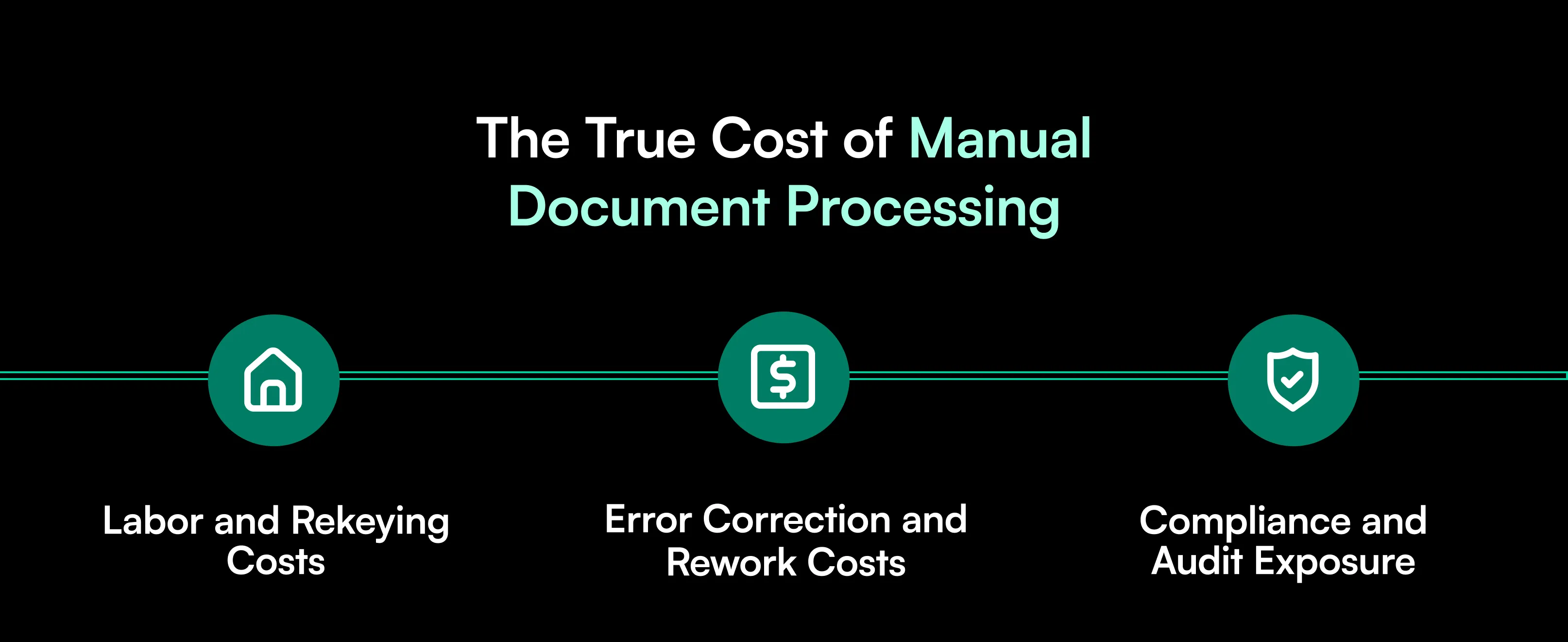
Labor and Rekeying Costs
Start with the employees who read documents, enter data, verify fields, and correct results.
The Infrrd ROI model uses employee count, hourly rate, monthly working hours, and the percentage of employee time assigned to the process.
For example, the model uses 15 data-entry employees working 168 hours per month at $16 per hour. That produces a monthly labor cost of $40,320 and an annual cost of $483,840.
Engineering support should also be included. In the example, two engineers spend 100% of their time supporting document processing at $75 per hour. Their annual cost reaches $302,400.
Error Correction and Rework Costs
Manual processing creates costs after the initial data entry. Teams may need to check incorrect values, correct fields, reprocess documents, resolve exceptions, and answer downstream questions.
The ROI calculator includes a field for the cost of errors associated with manual processing. The current example sets that value to zero, which means its ROI estimate does not depend on assumed error savings. That makes the model more conservative, but companies with measurable rework costs can add them to the baseline.
Compliance and Audit Exposure
Document-heavy processes often require proof of who reviewed information, what was changed, and when an action occurred. Manual workflows may require additional review time, record-keeping, employee training, and management oversight.
The Infrrd model includes fields for training, hiring, and managing data-entry teams, slow turnaround, and engineering opportunity cost. These fields are set to zero in the current example. Companies should include these costs only when they can support them with internal data.
How to Calculate Intelligent Document Processing ROI
IDP ROI starts with one comparison: what the process costs today versus what the same workload is expected to cost after automation.
The ROI Formula
A standard ROI formula is:
ROI = (Financial benefit − IDP investment) ÷ IDP investment × 100
If a company spends $60,000 on IDP and receives $726,240 in net annual savings, the calculation becomes:
$726,240 ÷ $60,000 × 100 = 1,210% ROI
It is also useful to calculate cost reduction separately:
Cost reduction = Annual savings ÷ Current annual cost × 100
These two metrics answer different questions. ROI measures the return on the investment, while cost reduction measures how much the operating cost falls.
Payback Period Formula
Payback period shows how long it takes for savings to recover the IDP investment.
Payback period = IDP investment ÷ Monthly savings
If annual savings equal $726,240, monthly savings are approximately $60,520.
With a $60,000 annual IDP cost, the initial investment is recovered in roughly one month based on the calculator assumptions.
The worksheet also shows a monthly burn rate of $60,520 without Infrrd.
Scenario-based Example
The figures below are hypothetical.
The example processes 50,000 pages per month. It assumes 15 data-entry employees and two engineers support the workflow.
Annual data-entry cost: $483,840
Annual engineering cost: $302,400
Direct annual operating cost: $786,240
Infrrd cost: $5,000 per month, or $60,000 annually.
Using direct costs:
$786,240 − $60,000 = $726,240 estimated annual savings
The calculator also produces a fully loaded annual baseline of $943,488 after operational overhead. Against the same $60,000 Infrrd cost, that equals $883,488 in annual savings and a 93.64% reduction in annual processing cost.
Where ROI Comes From: Cost Savings vs. Revenue Gains
IDP ROI can come from lower operating costs, fewer errors, faster processing, and the ability to handle more volume without matching headcount growth.
Labor and Cost Savings
Labor is usually the easiest benefit to measure. Calculate how many employees support document entry, review, corrections, and supervision. Then add the engineering cost required to maintain extraction logic, templates, integrations, and workflow rules.
IDP creates value when it reduces this effort enough to exceed the cost of the platform.
Accuracy and Error Reduction
Errors create work downstream. An incorrect invoice amount may require AP review. A missing mortgage field may stop a quality-control process. Incorrect claims data may require another review cycle.
Companies can calculate this benefit by measuring current error volume, average correction time, employee cost, and the percentage of errors that automation is expected to prevent.
Avoid assigning a dollar value without historical data.
Speed, Scalability, and Revenue Protection
Speed creates value when document delays affect business operations. Faster processing can reduce queues and support higher transaction volumes without adding employees at the same rate.
The value depends on the workflow. A company should measure current processing time, monthly volume, backlog, staffing requirements, and the cost of delayed processing.
Revenue impact should remain separate from direct savings unless the company can connect the improvement to measurable financial results.
IDP ROI by Use Case
The ROI formula stays similar across industries, but the costs behind the calculation change based on the document workflow.
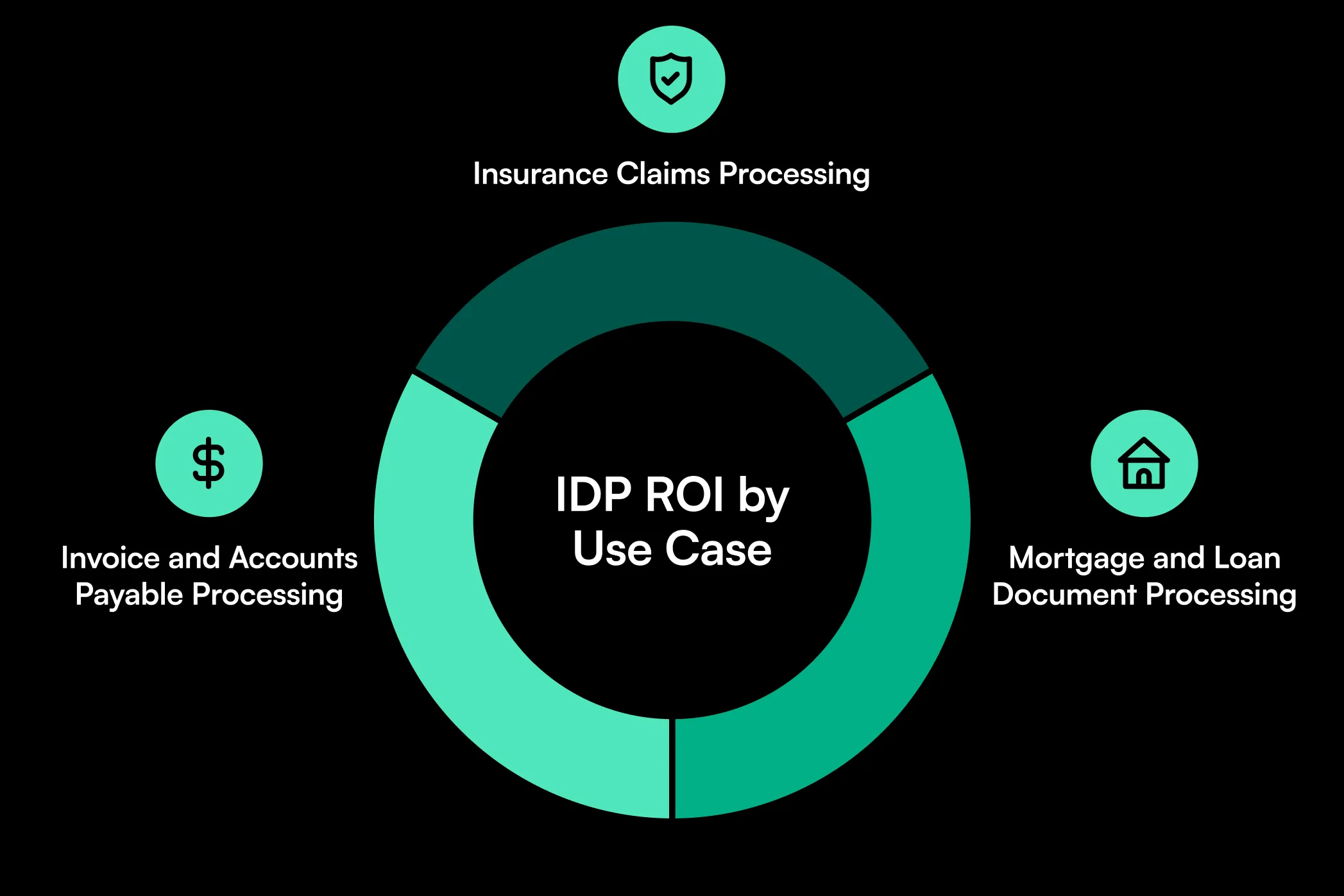
Invoice and Accounts Payable Processing
AP ROI usually comes from lower data-entry effort, fewer corrections, faster invoice processing, and reduced engineering support. The Infrrd calculator models this directly through monthly page volume, data-entry staffing, hourly labor cost, engineering cost, software cost, and operational overhead.
For high-volume AP teams, these inputs provide a clear baseline before automation.
Mortgage and Loan Document Processing
Mortgage ROI should include the people required to review loan documents, validate fields, handle exceptions, and support quality-control processes. Companies can also include engineering and software costs used to maintain internal document pipelines.
The same model applies: calculate the current annual processing cost, subtract the expected automated cost, and compare the savings with the IDP investment.
Insurance Claims Processing
Insurance teams can apply the same framework to claims documents. The baseline may include intake staff, data-entry teams, reviewers, engineering support, correction work, and current software.
Claims teams should also measure how document volume affects staffing requirements. This helps separate real productivity savings from assumptions about faster processing.
What IDP Implementation Actually Costs (So Your ROI Number Holds Up)
A credible Intelligent Document Processing ROI calculation must include the complete cost of the new system. Start with annual software fees. Then add onboarding, implementation, integration, infrastructure, internal engineering time, employee training, human review, and ongoing support where they apply.
The Infrrd example assumes a $5,000 monthly platform cost and no one-time onboarding fee.
The model also assumes 100% projected effort savings for both engineering and data-entry teams. That assumption has a major effect on the result.
For a customer-facing calculation, replace it with the expected automation rate based on the actual workflow. If IDP removes 60% of manual effort, calculate savings using 60%, not 100%.
Frequently Asked Questions
What is a good ROI for IDP?
A good IDP ROI means measurable annual savings exceed software, implementation, support, and remaining review costs by a meaningful margin.
How long does it take to see ROI from IDP?
Payback depends on document volume, labor cost, automation rate, and implementation cost. Higher-volume manual workflows can recover investment faster.
Does IDP ROI differ by industry?
Yes. Each industry has different document volumes, labor requirements, review steps, error costs, compliance needs, and processing-time requirements.