- Financial spreading automation reduces manual data entry, giving analysts more time to evaluate borrower risk effectively.
- Automated extraction, mapping, validation, and ratio calculations create faster, more consistent financial data for decisions.
- Human review remains essential for exceptions, financial adjustments, borrower context, credit policy, and final lending decisions.
Commercial credit teams are paid to judge risk, structure loans, and decide whether a borrower can repay. Instead, much of a transaction analyst's day goes into spreadsheets: rekeying line items, reconciling periods, and rebuilding statements into a standard spread by hand. Manual spreadsheet work like this is slow and error-prone, with small mistakes carrying real risk. Financial spreading automation exists to close that gap.
In an academic study of loan officers, roughly 40% of working time went to loan-disbursement tasks that included verifying applications and collecting borrower information. Commercial lending also requires deep financial review. Federal Reserve standards for qualifying commercial loans call for two years of historical financial condition, analysis of projected repayment capacity for the next two years, key ratio tests, and ongoing financial statements.
By turning borrower financials into standardized, review-ready data, financial spreading automation lets analysts spend more time interpreting risk instead of transcribing it. This guide explains what the process is, how the technology works, where it helps, and what lenders should evaluate before adopting it.
What Is Financial Spreading Automation?
Financial spreading automation uses software to extract financial data from borrower documents, place that data into a lender’s standard spreading format, calculate required ratios, and flag items that need analyst review.
Manual financial spreading depends on a credit analyst reading each statement and entering values into spreadsheets or a credit system. The analyst may also normalize account names, reconcile totals, identify one-time items, combine related entities, and calculate metrics such as debt service coverage, leverage, liquidity, and margins.
Financial spreading automation handles much of this repeatable preparation while leaving policy decisions, adjustments, and final credit judgment with the lender.
Common Challenges in Manual Financial Spreading
Time-consuming data entry and reconciliation. Analysts may work across income statements, balance sheets, cash flow statements, tax returns, personal financial statements, and supporting schedules. Each value has to be located, keyed, checked, and tied back to the source.
Inconsistent analysis across credit teams. Two analysts may map the same borrower line item differently or make different normalization choices. Those differences can make portfolio-level comparisons less reliable.
High error rates and compliance risk. A transposed figure or incorrect mapping can flow into ratios, risk grades, covenants, and credit memos. The issue may not surface until a second review or an audit.
Difficulty handling multi-entity and consolidated statements. Commercial borrowers often operate through several entities, guarantors, or subsidiaries. Analysts may need to separate intercompany activity, avoid double counting, and build a combined view of cash flow and debt.
Why It Matters for Credit Risk and Commercial Lending
Financial spreading is more than data entry because the spread becomes a core input to the credit decision.
The Federal Reserve’s Commercial Bank Examination Manual states that complete and accurate information about a borrower’s financial condition is essential to safe and sound credit approval. For typical commercial loans, it also says banks place significant emphasis on the financial strength, profitability, and cash flow of the business and should monitor that condition throughout the life of the loan.
That requirement creates a basic operational problem. Credit teams need dependable data before they can apply judgment. If the spread is late, the decision is late. If the spread is inconsistent, ratio analysis and risk grading can become inconsistent. If a number is wrong, the error can move into debt service calculations, covenant testing, approval documents, or portfolio monitoring.
The workload also continues after origination. Federal Reserve underwriting standards for qualifying commercial loans require documented financial condition for the prior two fiscal years, analysis of repayment ability over the next two years, and borrower financial statements at least quarterly under required covenants.
Financial spreading automation gives lenders a way to standardize the preparation layer. It can extract data, map line items, calculate ratios, and route uncertain values for review before information reaches the final credit analysis.
The goal is not to automate credit judgment; it is to give analysts cleaner, faster, traceable inputs so judgment starts earlier and rests on better-organized evidence.
Manual vs. Automated Financial Spreading: A Side-by-Side Comparison
The main difference is where analyst time goes: manual spreading emphasizes transcription, while automation shifts effort toward review, exceptions, and credit judgment.
How Financial Spreading Automation Works
Financial spreading automation usually follows a controlled sequence. The system receives borrower documents, extracts values, standardizes them, calculates credit metrics, sends uncertain items to reviewers, and passes approved data into lending or credit systems.
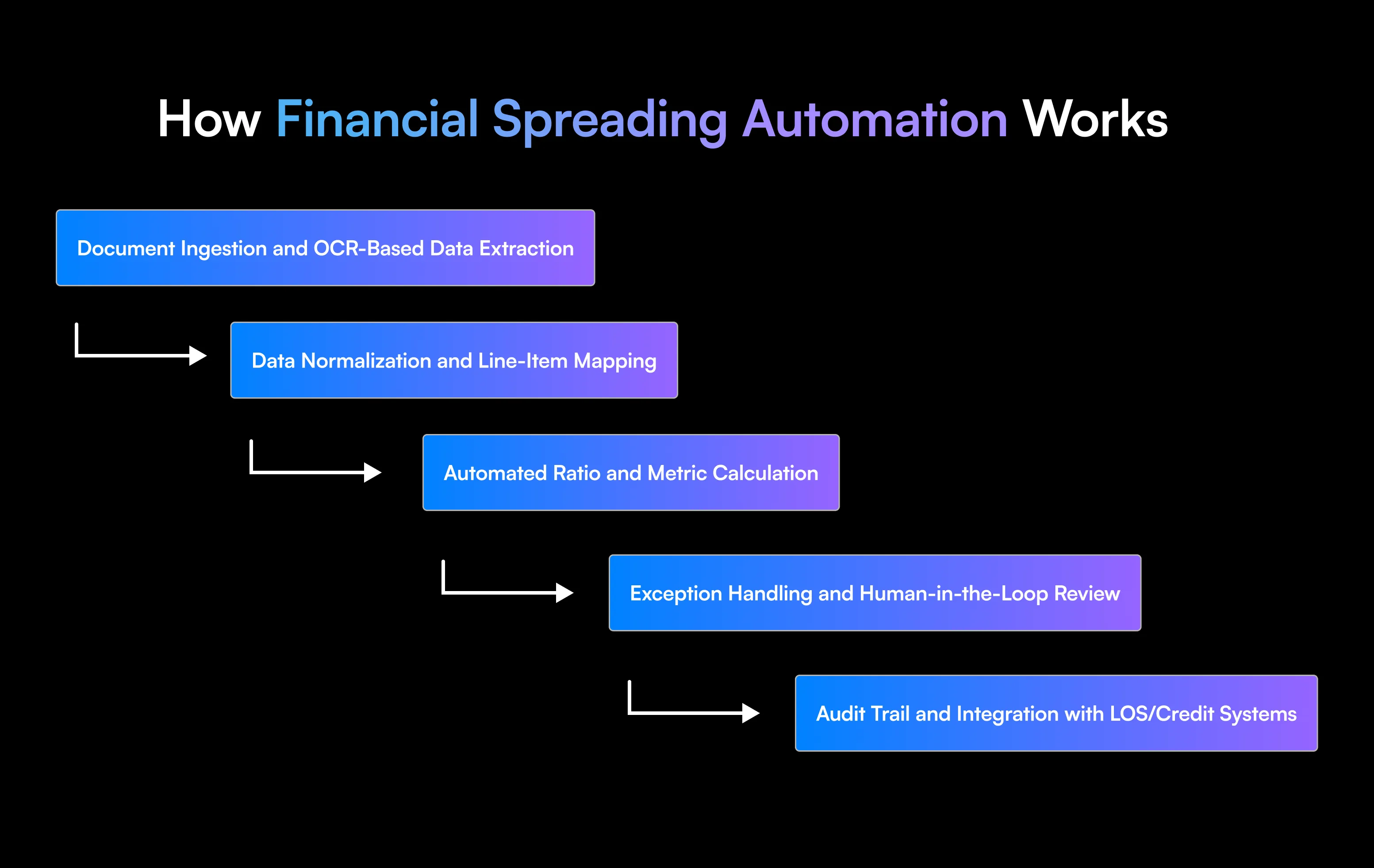
Document Ingestion and OCR-Based Data Extraction
The workflow starts with documents such as audited or internally prepared financial statements, tax returns, personal financial statements, bank statements, and supporting schedules.
OCR, or Optical Character Recognition, converts scanned content into machine-readable text. Document AI then identifies fields, tables, reporting periods, entities, and values that matter to the spread. This step removes much of the manual search and rekeying that happens before financial analysis can begin.
Data Normalization and Line-Item Mapping
Borrowers use different account names and reporting formats: one company may report "sales," another "net revenue," another "operating revenue."
The system maps these source labels into the lender’s standard chart or spreading template. It should also preserve the original value, label, entity, and period so an analyst can verify how each item reached the spread.
Automated Ratio and Metric Calculation
Once values are standardized, the workflow can calculate lender-defined metrics such as DSCR, current ratio, debt-to-equity, leverage, working capital, EBITDA margins, and trend changes.
Calculations should follow the lender’s approved formulas rather than forcing every institution to use the same generic model.
Exception Handling and Human-in-the-Loop Review
Automation should not hide uncertainty. Low-confidence values, missing schedules, mismatched totals, unusual adjustments, and ambiguous mappings should move to a review queue. Analysts can correct the data, document the reason, and approve the spread before it enters underwriting. This keeps human judgment focused on the areas where it adds the most value.
Audit Trail and Integration with LOS/Credit Systems
The final spread should retain links to the source document, page, field, change history, and reviewer action. Approved data can then move into a loan origination system, credit platform, data warehouse, or risk system through APIs or other integrations. This reduces duplicate entry and keeps the financial spread connected to the wider credit workflow.
Core Technologies Powering Financial Spreading Automation
Several technologies work together to move borrower data from documents into a credit-ready structure. The value comes from combining extraction, interpretation, validation, workflow controls, and system integration.
OCR, NLP, and Intelligent Document Processing (IDP)
OCR reads printed or scanned text. NLP helps interpret labels, relationships, and financial context.
Intelligent Document Processing (IDP) brings these capabilities together with document classification, table extraction, validation, confidence scoring, and workflow logic. This allows financial data from different layouts and document types to move into consistent structured fields.
Machine Learning and Agentic AI for Exception Handling
Machine learning can improve document classification and line-item mapping as document patterns change.
Agentic AI can support multi-step work such as checking totals, comparing reporting periods, locating missing evidence, identifying mismatches, and routing exceptions. Lenders should still define clear approval boundaries for credit-sensitive decisions and material financial adjustments.
Integration with Loan Origination and Credit Systems
APIs and connectors move approved data into the systems analysts already use. Good integration reduces rekeying between the spread, LOS, credit memo, risk model, and portfolio-monitoring tools. It should also preserve access controls, data lineage, approval status, and version history across systems.
Benefits of Automating Financial Spreading for Lenders
The clearest gains come from removing repeatable preparation work without removing analyst control. Financial spreading automation can improve turnaround time, data quality, consistency, and capacity across commercial credit operations.
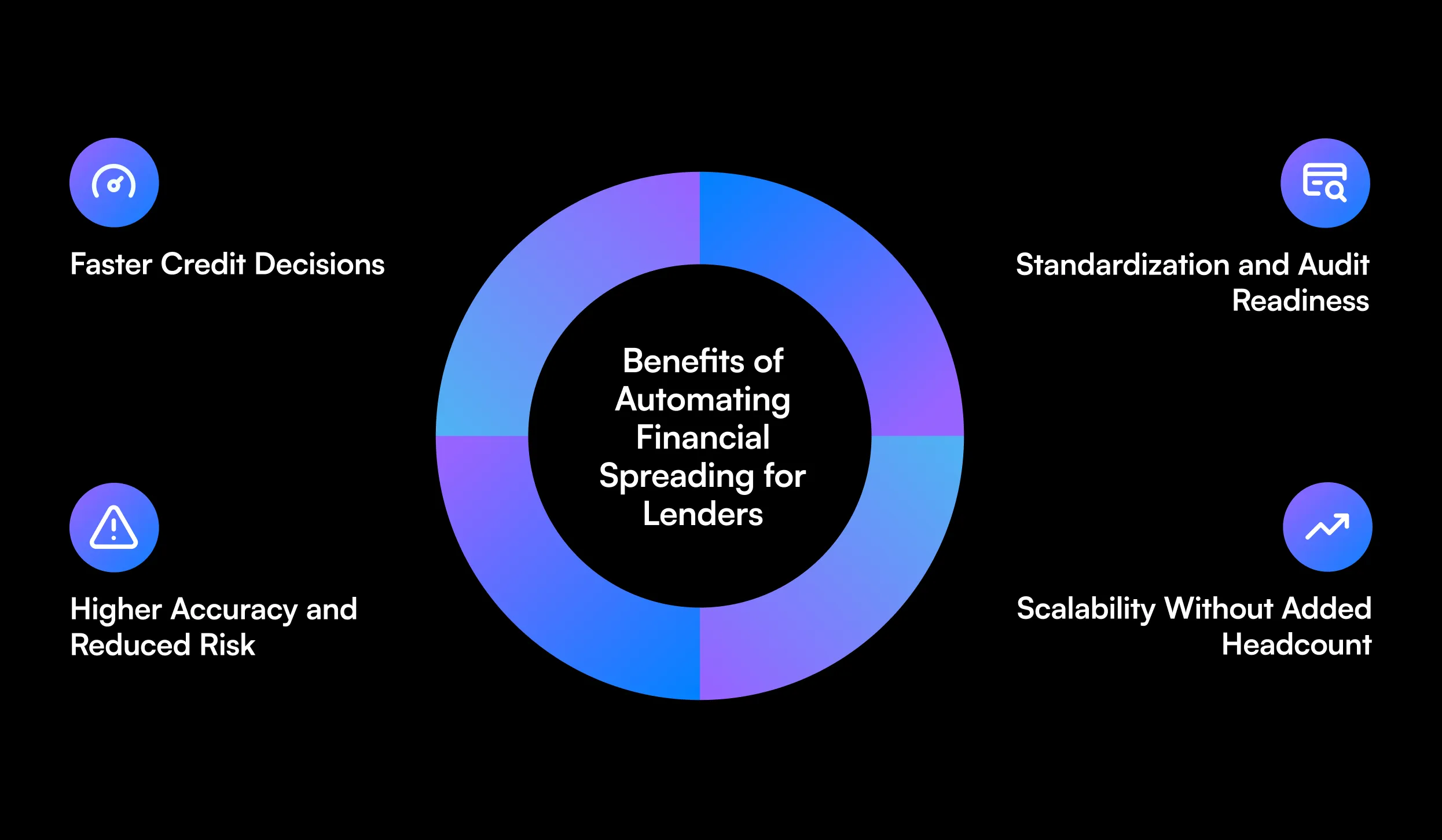
Faster Credit Decisions
Automated extraction and mapping can prepare a draft spread before an analyst begins full credit review.
That shortens the time between document receipt and meaningful analysis, especially for repeatable financial statement and tax-return packages. Analysts can begin evaluating repayment capacity sooner instead of waiting for manual data preparation.
Higher Accuracy and Reduced Risk
Validation rules can compare totals, periods, and related values before calculations run. Confidence scores and exception queues direct attention to uncertain data instead of asking analysts to recheck every value with the same level of effort. That reduces the risk of basic entry errors reaching downstream credit calculations.
Standardization and Audit Readiness
A controlled mapping framework gives teams a common way to categorize financial data. Source references, change logs, reviewer actions, and calculation logic also make it easier to explain how a figure reached the final credit file. This can support internal reviews, portfolio monitoring, and regulatory examinations.
Scalability Without Added Headcount
As loan volume grows, manual financial spreading can create a direct staffing burden. Automation lets teams process more borrower packages by concentrating analyst time on exceptions, risk factors, deal structure, and borrower performance rather than repetitive entry. Capacity can increase without requiring analyst staffing to grow at the same rate.
What to Look for in a Financial Spreading Automation Solution
A financial spreading tool should fit the lender’s credit policy, document mix, and existing systems. Evaluation should focus on data quality, coverage, reviewer control, traceability, and integration rather than extraction speed alone.
- Accuracy across tax returns and financial statements: Test the system on actual borrower files, including clean PDFs, scanned statements, tax schedules, tables, handwritten additions, and unusual layouts. Measure field extraction, mapping, and calculation accuracy separately. Check whether every value can be traced to its source.
- Multi-entity and multi-format support: Confirm that the platform can identify entities, periods, guarantors, subsidiaries, and consolidated statements without mixing values. Ask how it handles intercompany items, duplicate data, different fiscal periods, amended documents, and multiple file formats.
- Seamless LOS and credit system integration: Review how approved spread data reaches the LOS, credit platform, risk engine, or data warehouse. Look for APIs, field mapping, version history, access controls, and clear failure handling so one manual step is not simply replaced with another.
- Human review and exception controls: Analysts should be able to see low-confidence fields, correct mappings, document financial adjustments, and approve changes. The system should make uncertainty visible instead of forcing questionable values into the spread.
- Configurable calculations and credit policy: The lender should control ratio formulas, normalization rules, add-backs, thresholds, and approval logic. A fixed calculation model can create problems if it does not match the institution’s credit policy.
How Infrrd Applies Intelligent Document Processing to Financial Spreading
Infrrd builds Intelligent Document Processing technology for document-heavy workflows. Its platform uses AI to classify documents, extract data, validate values, apply confidence scores, and route uncertain items for human review. Those capabilities address the document-preparation layer that financial spreading depends on: turning varied borrower files into structured, traceable data.
For commercial lending, this approach can be applied to financial statements, tax documents, schedules, and supporting files before values move into spreading and credit-analysis workflows. The focus is on extracting information from difficult document formats while keeping source evidence and review controls available.
Infrrd’s mortgage deployments provide a lending-specific reference point. Its mortgage document platform supports 500+ document types and reports 95%+ accuracy, along with lending-system integrations and audit workflows.
That experience shows how IDP can operate across high-volume, document-heavy lending processes. For commercial lenders, the same document intelligence foundation can support faster financial spreading preparation while analysts retain control over financial interpretation and final credit decisions.
Conclusion
Commercial lending is moving away from workflows where skilled analysts spend hours copying numbers before they can assess risk. AI, machine learning, OCR, and IDP can prepare financial data, standardize line items, calculate metrics, and surface exceptions in a fraction of the manual workflow.
The result is a better division of labor: machines handle repeatable document work, while analysts focus on repayment capacity, deal structure, borrower context, and risk.
Infrrd can support that shift with document intelligence built for high-volume lending workflows, traceable extraction, human review, and system integration. For lenders trying to improve turnaround time without weakening credit control, financial spreading automation is a practical place to start.
Frequently Asked Questions
1. What is financial spreading automation?
Financial spreading automation extracts borrower financial data, maps it into a standard credit format, calculates required metrics, and routes uncertain items for analyst review.
2. What documents can financial spreading automation process?
It can process financial statements, tax returns, personal financial statements, bank statements, supporting schedules, and other borrower documents used in commercial credit analysis.
3. How is automated financial spreading different from OCR?
OCR reads text. Automated spreading also identifies financial fields, maps line items, validates values, calculates ratios, and prepares structured data for credit workflows.
4. Does financial spreading automation replace credit analysts?
No. It reduces repetitive preparation work. Analysts still evaluate repayment capacity, adjustments, borrower context, deal structure, policy exceptions, and the final lending decision.
5. Can financial spreading automation handle multi-entity borrowers?
Yes, if the platform supports entity detection and consolidation workflows. Lenders should test how it handles guarantors, subsidiaries, intercompany activity, and combined cash flow.
6. Which financial ratios can be automated?
Common examples include DSCR, current ratio, debt-to-equity, leverage, working capital, EBITDA margin, and other lender-defined metrics calculated from approved financial data.
7. How does automation reduce spreading errors?
It reduces manual rekeying, applies consistent mapping rules, validates totals, compares periods, and flags uncertain values so analysts can review potential issues before approval.
8. How should lenders measure financial spreading automation accuracy?
Measure extraction accuracy, line-item mapping accuracy, calculation accuracy, exception rates, and source traceability separately. Test each measure using representative production documents.
9. Can automated financial spreading integrate with an LOS?
Yes. APIs and connectors can send approved financial data into loan origination, credit, risk, and portfolio systems, depending on the lender’s technology architecture.
10. What is the best first use case for financial spreading automation?
Start with high-volume borrower packages where analysts spend significant time rekeying standard financial statements or tax data and where review rules are clearly defined.