- STP fails upstream, messy documents and disconnected systems, not flawed automation strategy, cause fallout.
- Field-level confidence scoring lets insurers automate confidently while routing genuinely uncertain claims to humans.
- Higher STP rates come from better data at intake, not from replacing entire core systems.
Claims teams are under pressure to settle faster, reduce operating costs, and improve policyholder experience.
J.D. Power’s 2025 U.S. Property Claims Satisfaction Study found that claims completed within 10 days scored 762/1,000 for customer satisfaction, compared with 595 when repairs took more than 31 days; a 167-point gap. Yet the average time from first notice of loss to final payment still exceeded 44 days.
The gap isn't about effort, it's about speed. Faster resolution directly drives satisfaction, and insurers are still falling short of it.
Automation is meant to close that gap. But when straight-through processing rates stay low, claims repeatedly fall out of the automated path and return to adjusters for manual review. The issue is often upstream: inconsistent documents, missing data, varying formats, and fraud signals spread across sources. A system that handles only clean and standard inputs will stop as soon as the claim becomes less predictable.
That creates a difficult question for lenders: Was the automation strategy wrong, or was the selected solution unable to handle real claims work? This blog explains where claims straight-through processing fits, why it breaks down, and what insurers should assess before selecting a platform for higher automation rates.
What Is Claims Straight-Through Processing?
Claims straight-through processing is the automated handling of a claim from intake to payment with little or no manual work. The system receives claim data, checks policy coverage, screens for fraud, applies business rules, calculates the payment, and sends the result to the next system.
Manual claims processing follows the same basic path, but people perform more of the work. Staff open files, read documents, enter data, compare policy terms, request missing information, assess risk, and approve payment. This approach gives adjusters control, but it can slow down routine claims and create inconsistent results.
Which Claims Qualify for Straight-Through Processing
Simple, low-complexity claims remain the strongest candidates for full straight-through processing. These claims usually have clear coverage, complete documents, low financial exposure, and no major fraud indicators. Examples include minor windshield damage, low-value travel claims, and standard property losses that meet defined rules.
However, STP does not have to stop at basic claims. Moderate-risk claims, and even some higher-risk claims, can move through automated processing when the insurer has clear rules for coverage, severity, documentation, fraud, and escalation. A claims solution trained for these workflows can extract data, apply checks, compare evidence, identify inconsistencies, and prepare a recommended outcome.
This does not mean the system automatically approves every claim. It separates claims with missing information, conflicting documents, unusual patterns, or serious risk indicators and sends them for review.
The system does not work to approve claims. It works to apply rules consistently and surface the facts. The final judgment remains with the adjuster, who can review the extracted information, findings, source evidence, and reasons for each conclusion through a single interface.
How Claims Straight-Through Processing Works, Step by Step
Claims STP connects intake, document processing, policy checks, fraud screening, decision rules, and payment. Each stage must pass accurate data to the next. If one stage fails, the claim moves to manual review.
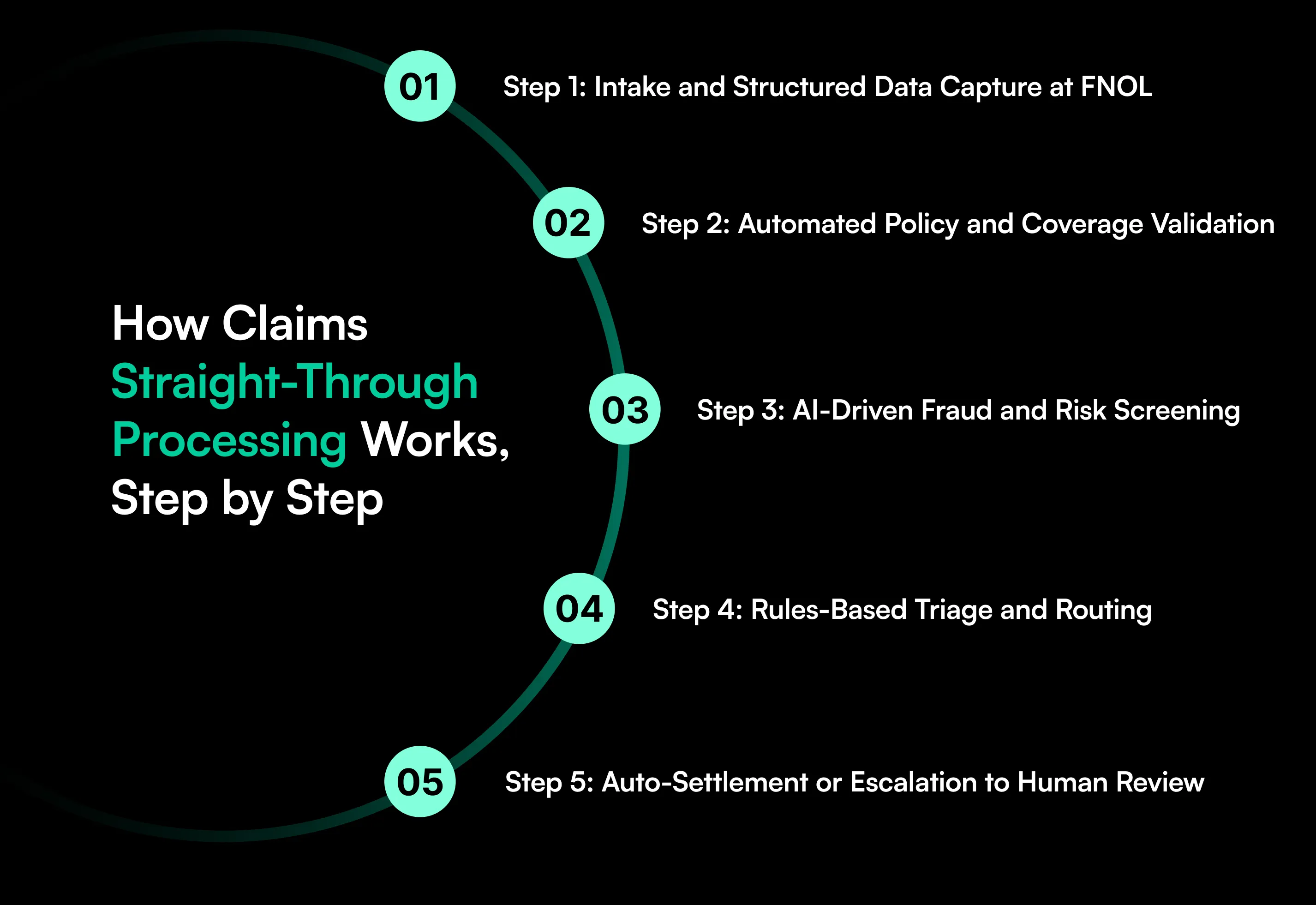
Step 1: Intake and Structured Data Capture at FNOL
The process starts at first notice of loss. The insurer collects policy details, loss information, contact data, images, forms, and supporting documents. AI extracts the required fields and converts varied inputs into structured data that downstream systems can use.
Step 2: Automated Policy and Coverage Validation
The system matches the claimant, policy number, loss date, coverage type, limits, exclusions, and deductible against policy records. It flags missing, expired, or conflicting information before the claim moves forward.
Step 3: AI-Driven Fraud and Risk Screening
Fraud models compare claim data with known patterns, prior claims, document signals, and external records. The system assesses risk and sends suspicious or inconsistent cases to a specialist rather than approving them automatically.
Step 4: Rules-Based Triage and Routing
Business rules classify claims by value, severity, coverage, risk, document completeness, and required expertise. Simple claims continue through automation, while claims with exceptions are routed to an adjuster, fraud team, medical reviewer, or legal team.
Step 5: Auto-Settlement or Escalation to Human Review
Claims that meet all rules can receive an automated settlement amount and move to payment. Claims that fail a check enter a review queue with the relevant data, source documents, and reasons for escalation for manual review.
Benefits of Claims Straight-Through Processing
Claims STP reduces work on predictable cases and gives adjusters more time for claims that need judgment. It can improve speed, data quality, operating cost, and customer communication across the settlement process.
Faster Cycle Times and Lower Loss Adjustment Expense (LAE)
Automation removes repeated data entry, document searching, and basic validation. Routine claims can move from intake to settlement faster, while insurers reduce the staff time spent on low-value administrative work. Shorter queues can also help teams meet service targets during seasonal spikes, thereby lowering loss adjustment expense per claim.
The impact of faster processing is already visible across the industry. J.D. Power’s 2026 U.S. Property Claims Satisfaction Study found that the average time from first notice of loss to final payment fell to 40.7 days, 3.4 days faster than the previous year.
Higher STP rates can also shorten queues during seasonal spikes and reduce the amount of adjuster time required per routine claim, contributing to lower loss adjustment expense.
Improved Data Accuracy and Fraud Prevention
A connected process applies the same extraction rules, policy checks, and fraud screens to each claim. It can identify missing fields, mismatched values, duplicate submissions, altered documents, and unusual claim patterns before payment. Consistent checks also reduce errors caused by rushed or repetitive manual review.
Better Policyholder Experience and Retention
Policyholders expect timely, transparent communication throughout their claims journey. Straight-through processing (STP) delivers on this by acknowledging claims immediately, flagging any missing documentation upfront, keeping policyholders informed at each stage, and disbursing payments without unnecessary delays. This kind of responsiveness cuts down on complaint volumes and repetitive check-in calls, while also building the trust that drives higher renewal rates.
Why Most Insurers Still Fall Short of Full Straight-Through Processing
Many insurers set STP rates as a target, train the underlying model, and push it into production, expecting hands-off claims processing from there. Yet adjusters still end up doing manual work around the automation. That's effectively double maintenance: running the model and still managing the workload it was supposed to eliminate.
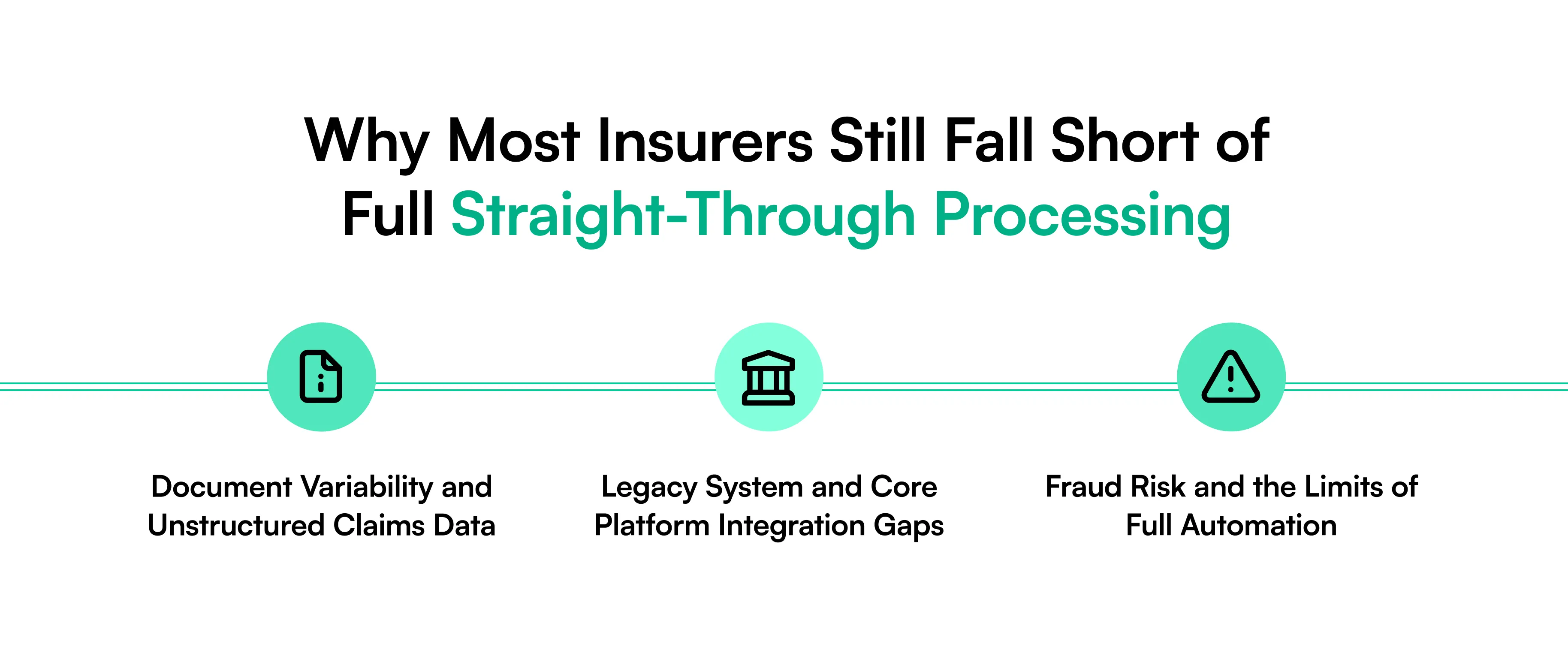
Document Variability and Unstructured Claims Data
Claims rarely arrive in one standard format. A single file may include handwritten notes, scanned invoices, photos, tables, medical records, police reports, and emails.
Basic OCR may read text but fail to understand context, relationships, or conflicting values. It may also miss data that appears across several pages or attachments. Poor extraction then forces adjusters to reopen the claim and correct the record.
Legacy System and Core Platform Integration Gaps
Claims platforms, policy systems, fraud tools, payment systems, and document repositories may store data in different formats. Weak integrations create duplicate entry, delayed updates, and broken handoffs.
Teams may automate document capture but still manually copy results into a core platform. Even accurate extracted data adds limited value if it cannot reach the correct system at the correct stage.
Fraud Risk and the Limits of Full Automation
Insurers cannot treat every claim as a low-risk transaction. Fraud may involve altered documents, repeated images, inflated values, hidden relationships, or inconsistent statements. False positives also create delays when rules are too strict.
Automation should score and route risk, but trained professionals must review cases where evidence, liability, or intent remains unclear.
How to Increase Your Claims Straight-Through Processing Rate
Higher STP rates require better input data, stronger document understanding, and connected workflows. Insurers can improve results without replacing every system by fixing the stages that create the most exceptions.
Standardize and Structure Data at First Notice of Loss
Collect required fields early through guided forms, validation rules, and clear document requests. Confirm policy numbers, dates, loss types, contact details, and supporting evidence before the claim enters the main workflow.
Better intake reduces avoidable follow-ups and prevents incomplete claims from entering automated decision steps.
Apply AI to Interpret Unstructured Claims Documents
Use document AI that can classify files, read varied layouts, extract fields, connect related values, and flag missing or conflicting information. The system should handle scans, handwriting, tables, images, and long claim packages.
It should also provide confidence scores and source references for review.
Modernize Incrementally Without Replacing Core Systems
Start with one high-volume claim type or one document-heavy stage. Connect the automation layer to existing claims platforms through APIs or controlled file exchange.
Track exception reasons, measure touchless rates, and improve the workflow in phases. This reduces change risk and creates a clear case for wider adoption.
How Infrrd Enables Claims Straight-Through Processing
Infrrd helps insurers turn claims documents into structured, validated data that can move through automated workflows. Its document AI supports varied claim formats, field-level confidence scoring, validation rules, exception routing, and integration with downstream claims systems.
The platform can support property, casualty, health, auto, and specialty insurance workflows where teams must process large volumes of forms, invoices, estimates, reports, images, and supporting files. Insurers can use it to automate selected document steps or support a wider claims STP program.
Structured Data Extraction from Claims Documents
Infrrd extracts data from typed forms, scanned files, handwritten content, tables, invoices, medical records, repair estimates, and other unstructured claim documents. It classifies the file, identifies the required fields, validates the results, and sends consistent data to the claims workflow.
The platform can also show the source for each extracted value. Reviewers can trace a field back to the relevant page and section, which helps them resolve exceptions without searching through the full claim file.
No-Touch Processing for High-Volume, Low-Complexity Claims
Infrrd refers to a higher level of document automation as no-touch processing, or NTP. Claims and fields move forward only when they meet strict confidence and validation rules.
Reviewers do not need to open qualifying documents. The required data is extracted, checked, and sent to downstream systems based on the defined workflow.
NTP extends the STP goal at the document level. It removes manual opening, reading, and keying for high-volume, low-complexity claims while routing uncertain cases to people. This allows insurers to automate routine work without forcing risky claims through the same path.
Infrrd provides audit-backed, explainable 100% accuracy at the field level, so only claims that meet the threshold move forward untouched.
Conclusion
Most insurers want higher claims STP rates because faster settlements can reduce cost and improve the policyholder experience. Many initiatives like these stall because the selected system works well with clean forms but struggles with the actual mix of claim documents, exceptions, integrations, and risk signals.
The right solution should read varied documents, structure data accurately, validate fields, connect with core systems, explain exceptions, and route uncertain cases to human reviewers. Insurers should also start with claim types that have clear rules and repeatable documentation, then expand based on measured results.
Infrrd supports this approach by converting difficult claim files into usable data and enabling no-touch processing for qualifying work. It helps insurers remove manual steps from routine claims while keeping human judgment in the cases where it matters.
Frequently Asked Questions
What is claims straight-through processing?
Claims straight-through processing automates claim intake, validation, risk screening, decision-making, and settlement with little or no manual intervention for qualifying claims.
What percentage of claims can be processed straight through?
The percentage varies by claim type, data quality, coverage rules, fraud risk, document consistency, and system integration. Low-complexity claims usually achieve higher STP rates.
Does STP eliminate the need for claims adjusters?
No. STP handles predictable claims and prepares exception files. Adjusters still assess disputed liability, severe losses, unclear coverage, fraud concerns, and unusual cases.
What technology enables claims straight-through processing?
Claims STP uses document AI, OCR, machine learning, rules engines, fraud analytics, APIs, workflow automation, policy systems, and payment integrations.
How is claims STP different from general insurance STP?
Claims STP focuses on loss intake, assessment, fraud checks, settlement, and payment. General insurance STP may also cover underwriting, policy issuance, renewals, and servicing.