- Agentic fraud detection helps teams catch hidden document risks across content, metadata, visuals, and related records.
- Agentic fraud detection reduces manual review by prioritizing high-risk exceptions instead of sending every suspicious document to reviewers.
- Agentic fraud detection gives regulated teams explainable alerts, audit trails, and stronger confidence before approvals, claims, or payments
Fraud detection is the process of identifying false, altered, or suspicious activity before it creates financial, legal, or operational risk. In 2026, this work has become more difficult because fraud itself has become more precise.
AI can now help create cleaner documents, sharper identity trails, and financial records that look believable at first glance. A forged bank statement, pay stub, invoice, claim form, or ID may pass visual checks and still carry hidden risks. Human reviewers may miss these issues when the fraud signal is spread across many files. That is why agentic fraud detection is becoming important. It can review documents, compare data, find inconsistencies, and explain risk across the full workflow.
This blog explains what agentic fraud detection is, why it matters now, where it fits, and how Infrrd supports this shift.
What Is Agentic Fraud Detection?
Agentic fraud detection is an AI-led approach where software does more than flag a transaction or document based on a fixed rule. It can inspect a case, break the review into smaller checks, compare evidence, look for conflicts in the document, score risk, explain why a case looks suspicious, and send the right exception to a reviewer.
Traditional fraud detection often works like this: if a field matches a rule, the system flags it. For example, if an invoice amount crosses a limit, if a name does not match a database entry, or if a date is missing, the case may be sent for review. That approach still has value. But it often misses fraud that hides across multiple signals.
Agentic fraud detection looks at the bigger picture. It can compare text, layout, metadata, document history, visual patterns, and related records. It can ask questions such as: Does the sales tax match the total? Does the bank statement style match the stated bank? Does the font change around the salary field?
Fraud moves faster than manual review because bad actors can now create and edit documents at scale. Review teams cannot inspect every pixel, field, file property, and cross-document mismatch by hand. Agentic fraud detection helps them focus on the cases that need judgment, not every document that enters the queue.
Why Agentic Fraud Detection Matters Now
Fraud is becoming faster, more coordinated, and harder to spot. The FBI IC3 2025 Annual Report says cyber-enabled fraud generated 452,868 complaints and more than $17.7 billion in reported losses in 2025. It also accounted for 45% of complaints and 85% of reported losses to IC3. That shows how much fraud has shifted into digital channels.
AI-generated fraud changes the risk model. A bad actor no longer needs advanced design skills to create a believable document. They can alter a bank statement, generate a fake invoice, rewrite a supporting letter, or create synthetic customer data with fewer visible flaws. The document may pass a quick visual check. The risk sits deeper.
False positives also remain a serious problem. If every small issue becomes a fraud alert, teams waste time. Customers wait longer while the good cases get slowed down. In mortgage, insurance, banking, and finance, this delay can hurt revenue and customer trust.
Document fraud is also no longer a back-office problem. It affects loan quality, claims leakage, onboarding risk, vendor payments, compliance exposure, and audit readiness. Fannie Mae states that when lenders validate income, employment, assets, and collateral through all four Day 1 Certainty components, repurchase risk is reduced by 64%. That shows why document validation matters in mortgage workflows.
Regulated teams also need explainable decisions. A black-box alert is not enough. Compliance, audit, QC, and risk teams need to know why a document was flagged. NIST’s AI Risk Management Framework also points to governance, mapping, measuring, and managing AI risks as core activities for responsible AI use.
Most fraud detection today is still too generic. It depends heavily on manual checks, simple verification steps, or broad risk scoring. That may catch obvious fraud, but it can miss document-level signals such as semantic inconsistency, font forgery, text-based manipulation, pixel changes, and copy-move edits. Agentic fraud detection matters because it connects these signals into one reviewable risk story.
Where Agentic Fraud Detection Fits in Document-Heavy Workflows?
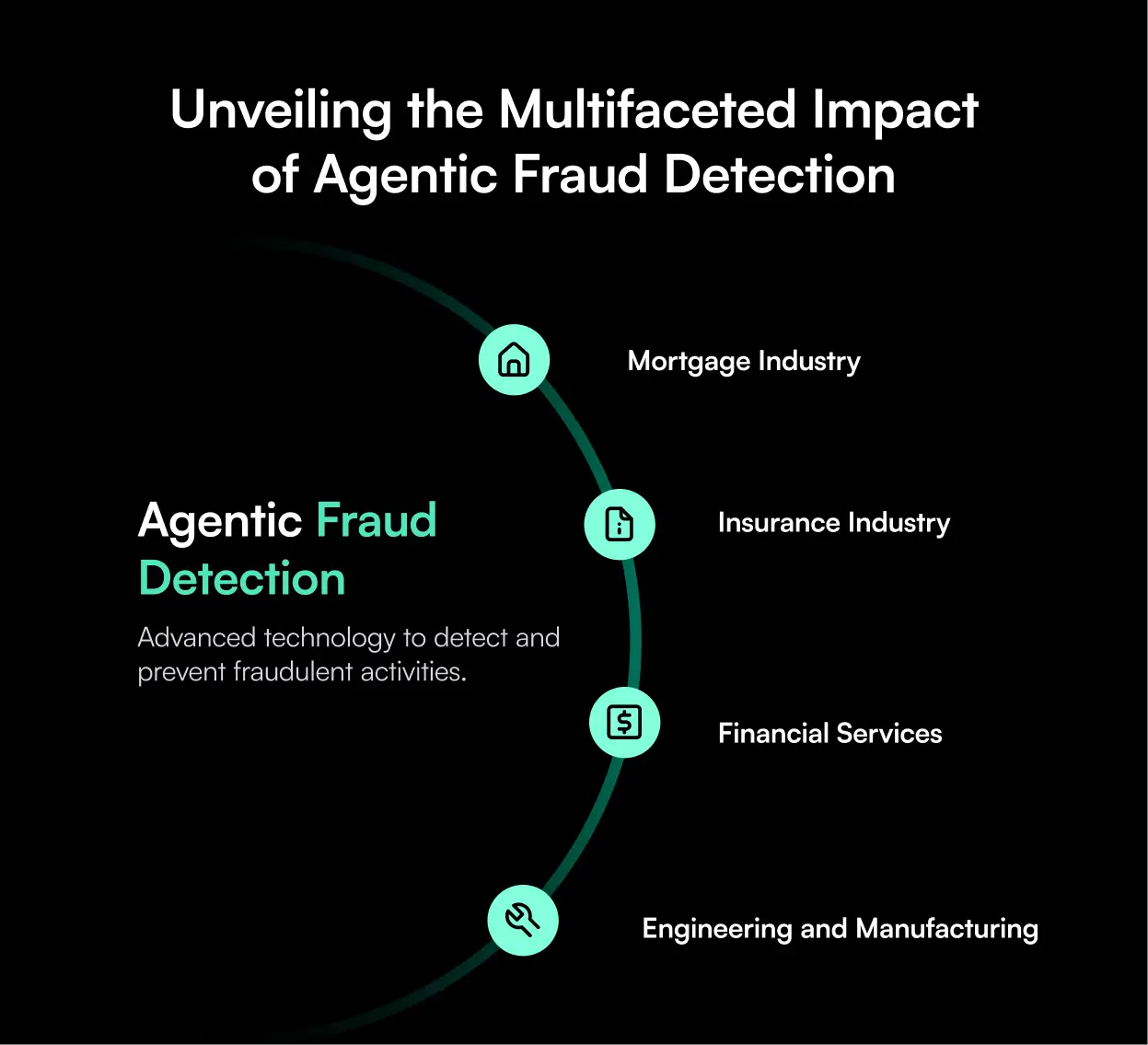
Agentic fraud detection fits where documents carry business risk. In high-volume workflows, it reviews files, compares data, detects tampering, and routes exceptions before fraud affects approvals, claims, payments, or supplier decisions. Its value changes by industry, document type, and use case.
How to Choose Agentic Fraud Detection Software
Choosing agentic fraud detection software requires more than checking AI features. The right platform should understand documents, reduce false positives, explain risk, connect with core systems, support reviewers, and protect sensitive data. These factors decide whether the software helps teams act faster.
Accuracy and false-positive control
The software should find real risk without flooding reviewers with weak alerts. Ask how the model separates document quality issues from fraud signals. A blurry scan, a missing field, or an OCR error should not always become a fraud case. Good software should rank risk, reduce noise, and help teams review the most important cases first.
Document understanding capability
Fraud often hides in the document itself. The software should understand layout, labels, fields, tables, signatures, totals, dates, and relationships between values. It should read the document like a business reviewer would, then go deeper by checking visual and metadata signals.
Integration with LOS, ERP, CRM, DMS, and case systems
Fraud detection should fit into the systems teams already use. For mortgage teams, that may include LOS and QC systems. For finance teams, it may include ERP and AP platforms. For insurance teams, it may include claims and case systems. Strong API support matters because many enterprise workflows do not depend on a separate user interface.
Reviewer workflow and exception handling
The system should make human review faster. Reviewers need clear queues, risk scores, flagged fields, document previews, comments, and approval paths. They should see what changed, why it matters, and what action is needed. The goal is not to replace expert judgment. The goal is to remove low-value review work so experts can focus on real risk.
Audit trail and explainability
Every fraud decision should be traceable. Teams should know what was checked, what was flagged, who reviewed it, what decision was made, and what evidence supported that decision. This matters for internal audits, customer disputes, regulatory reviews, and quality control.
Security, access control, and compliance readiness
Fraud systems often process sensitive financial, insurance, mortgage, and identity data. Look for strong access control, secure data handling, encryption, user-level permissions, and clear logs. The software should support compliance needs without slowing the review process.
Infrrd’s Approach to Agentic Fraud Detection
Infrrd is an Intelligent Document Processing company that helps document-centric enterprises automate work from ingestion to downstream delivery. It captures documents from source channels, extracts data, validates information, and sends audit-ready data into business systems through integrations, with minimal human intervention.
Infrrd’s IDP platform already supports enterprises that deal with high-volume, high-stakes document workflows across mortgage, insurance, financial services, logistics, manufacturing, and other industries. These teams do not need simple OCR. They need document understanding, data validation, exception handling, and workflow-ready outputs.
Infrrd has added a risk detection layer to support document integrity and fraud analysis. This layer helps identify forged or tampered documents by checking duplicate patterns, behavioral anomalies, data consistency, and suspicious document-level signals. Infrrd supports this capability both within its IDP workflow and via APIs.
The approach uses multi-level analysis:
- Content analysis checks whether the data makes business sense. For example, it can flag a receipt where the sales tax does not match the subtotal and total, or a mortgage file where income values conflict across documents.
- Metadata analysis checks document properties and file-level signals that may point to tampering or unusual document handling.
- Visual analysis looks for subtle changes that a human reviewer may miss, including font forgery, pixel changes, copy-move edits, layout changes, and visual manipulation patterns.
Infrrd’s agentic fraud detection approach can also support semantic inconsistency checks, text-based analysis, pixel-level review, and copy-move detection using multistream network techniques. This matters because modern document fraud can hide in many places at once. A field may look normal, but the surrounding layout, file metadata, and related documents may tell a different story.
For enterprises that already use automated document processing, this layer adds another level of protection. It helps teams process documents reliably while keeping document integrity, data consistency, and audit readiness in view.
Conclusion
Agentic fraud detection matters because fraud has changed. It is hard to catch with manual review alone. Traditional rules can still help, but they are not enough when fraud hides across text, metadata, layout, pixels, and document relationships.
The strongest fraud detection systems in 2026 will not just flag cases. They will understand documents, compare evidence, explain risk, route exceptions, and help teams act with confidence. That is especially important for mortgage, insurance, financial services, engineering, and manufacturing teams that depend on document accuracy every day.
Infrrd’s approach brings fraud risk detection into the document workflow itself. It combines IDP, validation, risk signals, audit trails, and API-ready delivery so teams can reduce manual review without losing control. For enterprises that want cleaner data, stronger document integrity, and fewer missed red flags, Infrrd gives agentic fraud detection a practical place to work.
FAQs
What is agentic fraud detection?
Agentic fraud detection is an AI-led approach where software inspects documents, compares data, reasons through risk signals, and sends suspicious cases for review. It goes beyond fixed rules by looking at context across content, metadata, visual signals, and related records.
How is agentic fraud detection different from rule-based fraud detection?
Rule-based fraud detection flags cases when a fixed condition is met. Agentic fraud detection can review multiple signals, connect them, and explain why a case looks risky. It is better suited for fraud that hides across documents and data points.
What data does agentic fraud detection need?
It can use document text, extracted fields, layout, metadata, images, transaction records, customer records, case history, and downstream system data. The exact data depends on the workflow and risk type.
How does agentic AI reduce false positives?
Agentic AI reduces false positives by checking the full context before flagging a case. It can separate weak signals from stronger risk patterns and route only high-priority exceptions to reviewers.
Is agentic fraud detection safe for mortgage workflows?
Yes, if it includes explainability, audit trails, access control, and human review for high-risk decisions. In mortgage, it can help compare income, employment, assets, collateral, and supporting documents across the loan file.
How can insurers use agentic fraud detection?
Insurers can use it to review claims documents, receipts, provider invoices, photos, repair estimates, and duplicate submissions. It can flag tampering, repeated patterns, mismatched values, and unusual document behavior.
What is the role of IDP in agentic fraud detection?
IDP extracts and structures document data so fraud models can analyze it. Without accurate document understanding, fraud detection may miss key signals inside forms, tables, images, and supporting files.
What guardrails are needed for agentic fraud detection?
Teams need clear risk thresholds, human review for sensitive decisions, audit logs, access controls, model monitoring, and explainable outputs. These controls help teams use AI without losing oversight.
How should teams start implementing agentic fraud detection?
Start with one high-risk workflow, such as mortgage income review, insurance claims review, KYC onboarding, or invoice fraud. Measure alert quality, false positives, review time, and missed-risk reduction before expanding.