- Mortgage QC automation reduces repetitive document work so auditors can focus on exceptions and judgment.
- Pre-funding and post-closing automation help lenders catch defects earlier and keep reviews consistent across files.
- Human reviewers remain essential for assessing materiality, confirming defects, approving remediation, and making final decisions.
Mortgage quality control is central to loan quality, compliance, and investor confidence. When defects are missed, the consequences can extend well beyond a correction to the loan file; they can lead to repurchase demands, make-whole payments, regulatory scrutiny, and financial loss.
Freddie Mac reported a 2.3% defect rate for loans using automated collateral, asset, and income tools, compared with 9.6% for loans without them. Its Q1 2026 repurchase data also shows how quickly common issues can become costly, with collateral defects accounting for 28% and income defects 27% of defect categories tied to repurchases.
This is why lenders are paying closer attention to mortgage QC automation. The goal is to catch errors, missing evidence, and rule violations earlier before they become expensive downstream problems. This blog explains how mortgage QC works, where automation fits, and what lenders should automate first.
What Is Mortgage QC Automation?
Mortgage QC automation uses document intelligence, validation rules, workflow logic, and artificial intelligence to perform repeatable quality checks across a mortgage file.
The software reads loan documents, captures key data, compares information across different sources, applies required rules, identifies possible defects, and presents supporting evidence to a reviewer.
Manual mortgage QC needed to change because loan packages can contain hundreds of pages, repeated document versions, linked calculations, changing guidelines, and strict review deadlines. Auditors often spend a large part of their time sorting files, locating source values, entering data, comparing documents, and preparing reports.
Automation moves much of this preparation work to software. Reviewers can then focus on exceptions, borrower circumstances, defect severity, materiality, and final audit decisions.
Manual QC vs. Automated QC: What Actually Changes
Automation changes the workload, but it does not remove human accountability. The final judgment remains with the human reviewer, who confirms defect severity, approves remediation, and owns the audit conclusion.
Why Mortgage QC Automation Is Becoming a Core Lending Requirement
Mortgage QC affects loan eligibility, investor confidence, regulatory compliance, and repurchase exposure. Slow or inconsistent reviews can allow a single issue to become a repeated defect across several loans.
Automation helps lenders bring evidence, calculations, and rule-based checks into the required review window. It also helps QC teams return useful findings to production teams before the same issue appears again.
Fannie Mae and Freddie Mac QC Requirements Explained
Fannie Mae requires lenders to maintain a written quality control program that includes independent pre-funding and post-closing reviews, representative sampling, monthly reporting, corrective action, vendor oversight, and record retention.
Pre-funding reviews must be completed early enough for the lender to correct identified issues before closing. Post-closing loan samples must be selected each month, and the complete review cycle must generally be finished within 90 days of the loan’s closing or acquisition month.
Fannie Mae permits lenders to use a 10% random sample or a statistically valid sample for post-closing QC. Lenders must also conduct separate discretionary reviews based on risks found in loan products, branches, channels, employees, vendors, or production trends.
Freddie Mac also requires lenders to maintain an internal QC program that monitors loan origination quality, tracks findings, and supports corrective action. Its guidance includes post-closing reverification of employment, income, and borrower funds, subject to stated exceptions.
For servicing, Freddie Mac requires written QC policies, internal control reviews, accurate reporting, and documented reconciliation processes.
These requirements exist because a loan that isn't properly reviewed can't be reliably sold to investors. They help lenders confirm that loans are properly underwritten, documented, closed, delivered, and serviced.
The Real Cost of Manual, Late-Stage QC
Late QC leaves lenders with less time to obtain missing documents, correct data, revise disclosures, or stop an ineligible loan before funding.
After closing, delays can push reviews beyond agency timelines and postpone monthly management reporting. Production teams may continue making the same mistakes because QC feedback arrives weeks or months after the original issue occurred.
The cost then spreads across the organization. Auditors spend additional time reconstructing underwriting decisions. Managers lose visibility into defect trends across branches, channels, products, employees, or third-party originators. Compliance teams may struggle to prove that corrective action was completed.
Material defects can also lead to investor remediation, indemnification requests, self-reporting obligations, loan repurchases, or financial losses.
Mortgage QC automation cannot eliminate every defect. However, it can identify issues earlier, link each finding to supporting evidence, and route the issue to the correct person for review and correction.
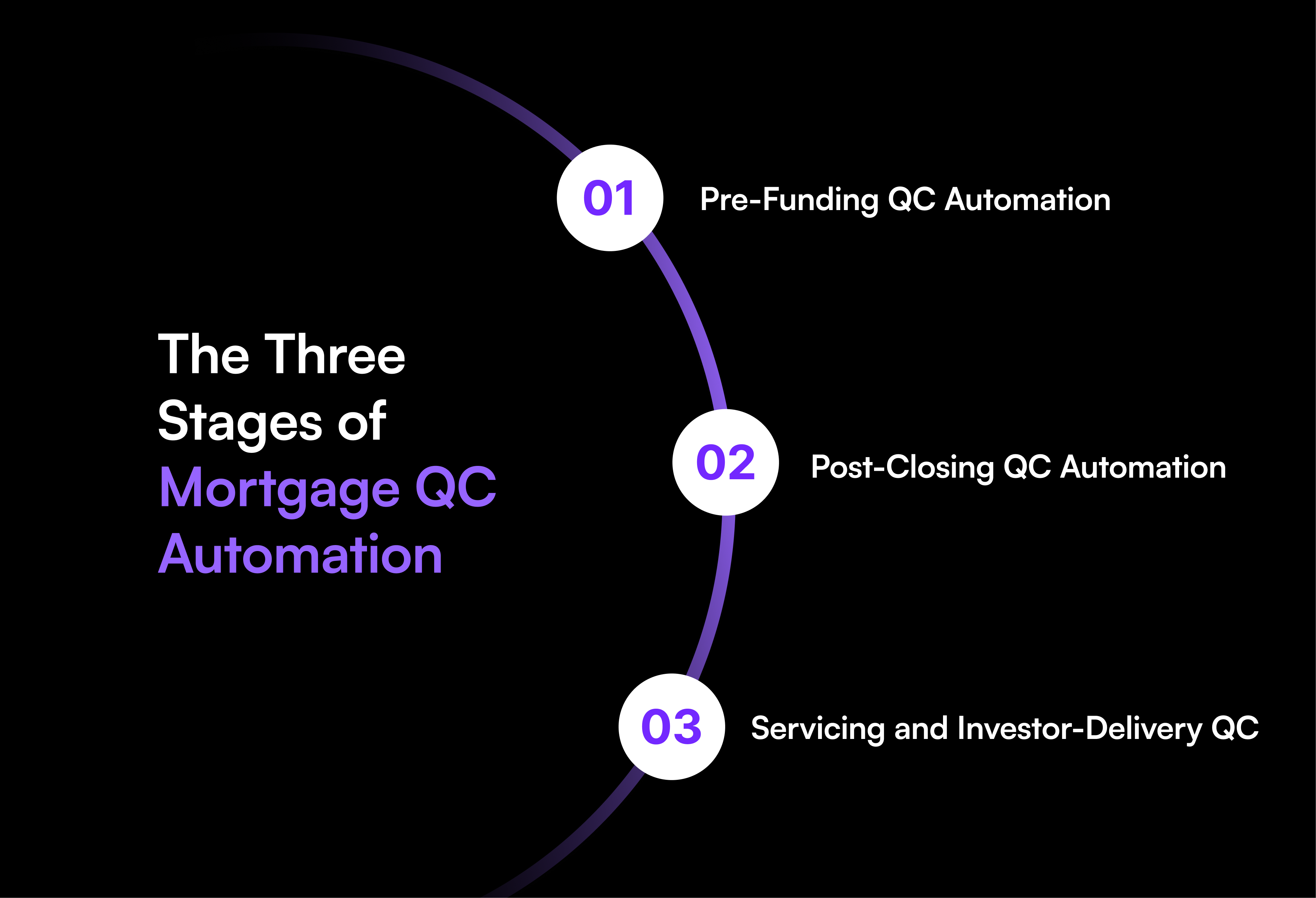
The Three Stages of Mortgage QC Automation
Mortgage QC works best as a connected process across loan production, post-closing review, servicing, and investor delivery.
Each stage has a different goal. Pre-funding QC focuses on correcting defects before closing. Post-closing QC tests whether the completed loan met underwriting and compliance requirements. Servicing and investor-delivery QC confirm that loan records, documents, payments, and reporting remain accurate after the loan is delivered.
All three stages depend on accurate document preparation, consistent checks, traceable evidence, and clear exception routing.
Pre-Funding QC Automation
Pre-funding QC reviews selected loans before funds are released or before a lender acquires a loan from a third party.
Automation can assemble and organize the loan file, identify missing or expired documents, validate borrower and property information, recalculate income, confirm asset balances, compare debt and debt-to-income figures, and review employment records.
It can also compare appraisal information, title records, the Loan Estimate, the Closing Disclosure, and loan origination system data. High-risk files can be routed for deeper review based on loan type, borrower profile, property details, branch, employee, or third-party originator.
The main goal is to identify a defect while the lender can still correct it before closing or funding.
Post-Closing QC Automation
Post-closing QC determines whether a completed loan was eligible, properly underwritten, accurately documented, and compliant at the time of delivery.
Automation can prepare the audit sample, organize the final loan package, repeat underwriting calculations, compare final documents with approved loan terms, support income and employment reverification, and identify possible occupancy or fraud concerns.
It can also classify defects, link findings to supporting documents, track rebuttals, record corrective actions, and prepare monthly management reports.
Human auditors remain responsible for deciding whether an issue is a confirmed defect, how serious it is, and whether remediation or escalation is required.
Servicing and Investor-Delivery QC
Servicing QC reviews payment processing, escrow activity, insurance records, investor reporting, loss mitigation, custodial documents, and other servicing controls.
Investor-delivery QC confirms that the loan data and documents delivered to an investor match the investor’s requirements. Automation can reconcile records, compare balances and loan statuses, validate required documents, identify missing certifications, and apply investor-specific overlays.
Freddie Mac’s servicing guidance also requires regular reconciliation between internal servicing records and investor reporting records, along with periodic QC reviews of the reconciliation process.
What to Look for in a Mortgage QC Automation Platform
A mortgage QC software should reduce manual preparation while giving auditors clear control over findings and decisions. Five capabilities matter most.
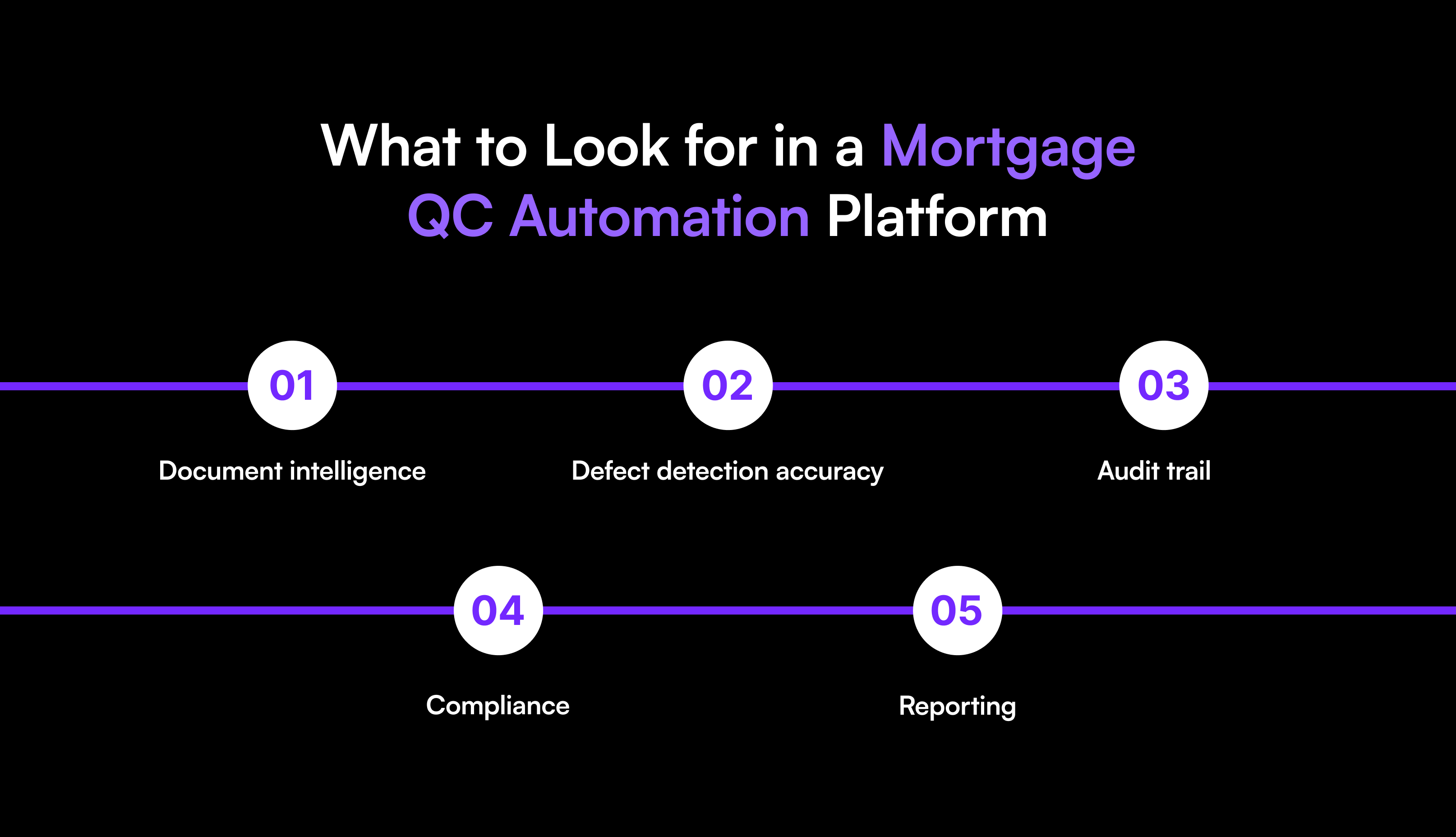
Document intelligence: The platform should classify, separate, index, and read documents found in real mortgage loan packages. It should process scans, long PDFs, repeated versions, schedules, tables, and documents with different layouts. Accurate document preparation supports every later QC check.
Defect detection accuracy: The system should compare data across documents, repeat key calculations, apply agency and lender rules, and distinguish possible mismatches from confirmed defects. Confidence scores and clear exception routing help reviewers focus on the right issues.
Audit trail: Every finding should show the source document, page number, extracted value, comparison, applied rule, reviewer action, and final status. This record supports investor questions, rebuttals, internal audits, and corrective action reviews.
Compliance: The platform should support agency guidance, federal and state requirements, investor rules, and lender overlays. It should also provide access controls, data security, role separation, and configurable record-retention settings.
Reporting: Management teams need visibility into defect rates, severity levels, root causes, review status, repeat findings, remediation time, branches, channels, products, vendors, and employees. The platform should provide both loan-level evidence and portfolio-level reporting.
Lenders should automate repetitive and evidence-heavy work first. This includes document preparation, extraction, missing-document checks, calculations, cross-document comparisons, rule testing, and report creation. Human reviewers should continue to handle uncertain evidence, materiality, exceptions, and final decisions.
How Infrrd Automates Mortgage QC with Agentic AI
Infrrd supports mortgage quality control through two connected products: MortgageCheckai and Ally.
MortgageCheckai creates the organized evidence layer for the audit. It classifies and stacks the loan package, extracts mortgage data, tracks document versions, identifies missing or expired documents, compares values across files, and connects findings to their source documents.
The platform also supports Loan Estimate and Closing Disclosure comparison, title and disclosure checks, document indexing, audit preparation, and lender-ready reporting. It can also support more than 600 mortgage document types and over 20,000 mortgage data points.
Ally works across the organized loan record as an agentic AI mortgage auditor. It applies mortgage-specific audit logic, checks calculations, evaluates loan conditions, follows lender and investor overlays, and prepares possible findings for reviewer approval.
Each mismatch can be traced to its source. Auditors can review the evidence, accept or reject the finding, determine its severity, request remediation, or escalate it for further review. It can handle up to 80% of the audit data workload while human auditors retain control over the final decision. Ally has supported more than $1 billion in loan decisions.
The division of work is clear. MortgageCheckai prepares accurate loan data and supporting evidence. Ally applies mortgage audit logic and prepares possible findings. Human auditors decide what the evidence means and what action should follow.
Conclusion
Mortgage QC automation became necessary because loan quality depends on thousands of connected data points, documents, calculations, rules, and deadlines.
Manual review alone makes it difficult for QC teams to increase audit coverage, complete reviews on time, and provide fast feedback to production teams.
A practical automation program should begin with document preparation and repeatable checks. Lenders can then expand it to calculation reviews, cross-document validation, defect reporting, root-cause tracking, and controls across the loan lifecycle.
Automation does not remove the mortgage auditor. It gives the auditor a better-organized file, faster access to evidence, and more time for judgment-based work.
Infrrd supports this model by combining MortgageCheckAI’s document and data preparation capabilities with Ally’s mortgage audit logic. The platform handles repeatable review work, while qualified auditors remain responsible for findings, defect severity, corrective action, escalation, and final approval.
Frequently Asked Questions
1. What is mortgage QC automation?
Mortgage QC automation uses software and AI to prepare loan files, validate data, run quality checks, identify possible defects, and present evidence for human review.
2. Which mortgage QC tasks should lenders automate first?
Lenders should start with document classification, data extraction, missing-document checks, cross-document comparisons, income calculations, disclosure reviews, evidence linking, and report preparation.
3. Does automation replace mortgage QC auditors?
No. Automation handles repeatable preparation and validation work. Auditors still assess evidence, determine materiality, classify defects, approve remediation, and make final decisions.
4. Can mortgage QC automation support pre-funding reviews?
Yes. It can identify missing documents, calculation errors, inconsistent data, expired records, unsupported conditions, and disclosure differences before a loan closes.
5. How does automation help post-closing QC?
It prepares sampled files, repeats underwriting checks, supports reverifications, links findings to documents, tracks rebuttals, records corrective actions, and speeds up monthly reporting.
6. Is a 10% post-closing sample always required?
Fannie Mae permits either a 10% random sample or a statistically valid sample. Lenders must also conduct separate risk-based discretionary reviews.
7. Can lenders audit more than 10% of closed loans?
Yes. Agency requirements define minimum sampling expectations, not a maximum limit. Lenders may review more loans based on risk, capacity, investor rules, or internal goals.
8. What makes an automated QC finding explainable?
An explainable finding shows the applied rule, compared values, source documents, page references, system action, reviewer response, and final defect status.
9. Can mortgage QC software apply lender overlays?
Yes. A capable platform can apply agency guidelines alongside lender, investor, product, and channel rules, then route related exceptions to the appropriate reviewer.
10. How should lenders measure mortgage QC automation results?
Lenders should track review time, audit volume, defect accuracy, false positives, reviewer agreement, repeat defects, remediation time, cost per review, and repurchase exposure.