- Mortgage automation should combine accurate extraction, cross-document validation, traceability, integrations, and human review for reliability.
- Infrrd stands out for mortgage-specific QC, enterprise scale, multi-LOS integrations, and agentic audit preparation capabilities.
- The right platform depends on document complexity, workflow needs, operational scale, and mortgage-specific requirements overall.
Mortgage lending automation has moved from a back-office efficiency project to a loan-quality check metric. Lenders process large document packages while managing cost pressure, defect risk, investor requirements, and shorter borrower timelines. The value of automation appears in the numbers. Freddie Mac reports that lenders making extensive use of its digital origination capabilities originated loans that were about $1,700 less costly on average. Its analysis also found 40% fewer loan defects among high-usage lenders than among lenders with low usage.
That does not mean every automation platform produces the same result. Mortgage documents vary by borrower, channel, loan type, scan quality, and stage of the loan lifecycle. A platform that performs well on a clean pay stub may still struggle across a 1,000-page closing package. To help lenders navigate these differences, this blog breaks down the best mortgage lending automation for document processing platforms of 2026, comparing the capabilities that matter, from extraction through quality control.
What is Mortgage Lending Automation?
Mortgage lending automation uses software, document AI, workflow rules, and AI agents to reduce repeatable work across the loan lifecycle. It converts mortgage documents into structured data, validates information, routes exceptions, and sends data into the systems used by lending teams.
In origination, it classifies borrower documents and captures application data. During underwriting, it extracts and compares income, asset, credit, and property information. In prefunding QC, it checks files for missing documents, mismatches, and policy exceptions. In post-close QC, it reviews loan packages, identifies defects, and records supporting evidence. In servicing, it processes borrower, payment, escrow, and insurance documents.
The technology has evolved from OCR, which converts images into text, to IDP for classification and extraction, then to workflow automation for routing data and tasks. Agentic AI now coordinates checks and investigates exceptions, while final decisions remain with human reviewers.
10 Capabilities to Compare Before Choosing Mortgage Automation
The best mortgage automation platform is not the one with the longest feature list. These ten capabilities give lenders a practical framework for comparing platforms during evaluation and pilot testing.
1. Mortgage-specific document coverage
A platform should process complete loan packages, not just a few standard forms. Check support for 1008s, W-2s, 1040s, pay stubs, bank statements, VOEs, credit reports, appraisals, title documents, Closing Disclosures, Loan Estimates, notes, deeds, and lender-specific forms.
Coverage should also include document classification and packet splitting. Large mortgage packages may contain hundreds or thousands of pages, so the system must correctly identify document boundaries before extraction or review begins.
2. Accuracy on your actual loan documents
Do not rely only on vendor-selected samples or published accuracy percentages. Test each platform on your own production files.
Include clean PDFs, poor scans, phone images, handwriting, rotated pages, tables, stamps, and self-employed borrower documents. Measure accuracy at the field level and by document type. The goal is to understand how the system performs on the files that currently create the most manual work.
3. Cross-document validation
Mortgage automation should compare information across the entire loan file. The platform should identify mismatches in borrower names, income, employment, assets, liabilities, property data, loan terms, dates, and signatures. For example, income stated on the application may need to match W-2s, pay stubs, VOEs, tax returns, and bank records. This is where document extraction becomes mortgage process automation.
4. Source traceability and explainability
Every extracted value or system finding should lead reviewers back to its source. Look for page references, bounding boxes, confidence scores, timestamps, rule history, and source evidence. If a QC system flags an income mismatch, the auditor should immediately see the two values, the documents they came from, and the rule that triggered the finding. This reduces search time and creates stronger audit records.
5. Low-quality scans, handwriting, tables and complex layouts
Mortgage documents rarely arrive in one clean format. Test faded scans, handwriting, dense tax forms, bank statement tables, signatures, check boxes, fax artifacts, and changing layouts. Pay close attention to tables and repeated sections, where incorrect row relationships or period labels can affect calculations even when basic text extraction looks accurate.
6. Confidence scoring and exception routing
The system should know when human review is required. Field-level confidence scores can help route uncertain values, failed checks, or document mismatches to reviewers while allowing high-confidence data to continue automatically. Thresholds should be configurable by field, document type, loan program, or risk level. The objective is selective review rather than reopening every file.
7. Human-in-the-loop review
Human review should be part of the workflow from the start. Reviewers should see the source document, extracted value, confidence score, related evidence, and reason for the exception in one place. They should be able to approve, correct, reject, or escalate a finding without manually rebuilding the context. Automation handles repeatable work. People remain responsible for interpretation and final decisions.
8. Mortgage QC and audit readiness
A mortgage automation platform should support prefunding and post-close QC, defect identification, evidence capture, reviewer actions, and reporting.
Fannie Mae's post-closing guidance allows lenders to use either a 10% random monthly sample or a statistically valid random sample. This makes traceability, documented review steps, consistent defect handling, and retained QC records important buying criteria.
9. LOS, POS, API and data integrations
Automation only creates value if the output reaches the systems where mortgage teams work. Check connections with your LOS, POS, AUS workflow, CRM, servicing system, document repository, and data platforms. Common environments may include Encompass, Blend, Byte, LendingPad, Empower, and MeridianLink. Also confirm whether the integration simply exports data or can read, write, trigger workflows, and preserve audit history.
10. Security, governance, scalability and total cost
Mortgage files contain sensitive borrower and financial information, so review encryption, access controls, audit logs, retention policies, data residency, model-provider policies, and administrator permissions.
Also test peak volumes, large loan packages, and turnaround requirements. Finally, calculate the full cost of ownership, including implementation, integrations, AI usage, human review, maintenance, support, and internal engineering. A low software price may offer little savings if your team must build the mortgage workflow and governance layer around it.
Best Mortgage Lending Automation Platforms for Document Processing
Choosing the best mortgage lending automation platform depends on more than extraction accuracy. Buyers should compare mortgage-specific workflows, QC capabilities, integrations, traceability, human review, and deployment fit to determine which platform aligns best with their document volumes and operational needs.
Infrrd
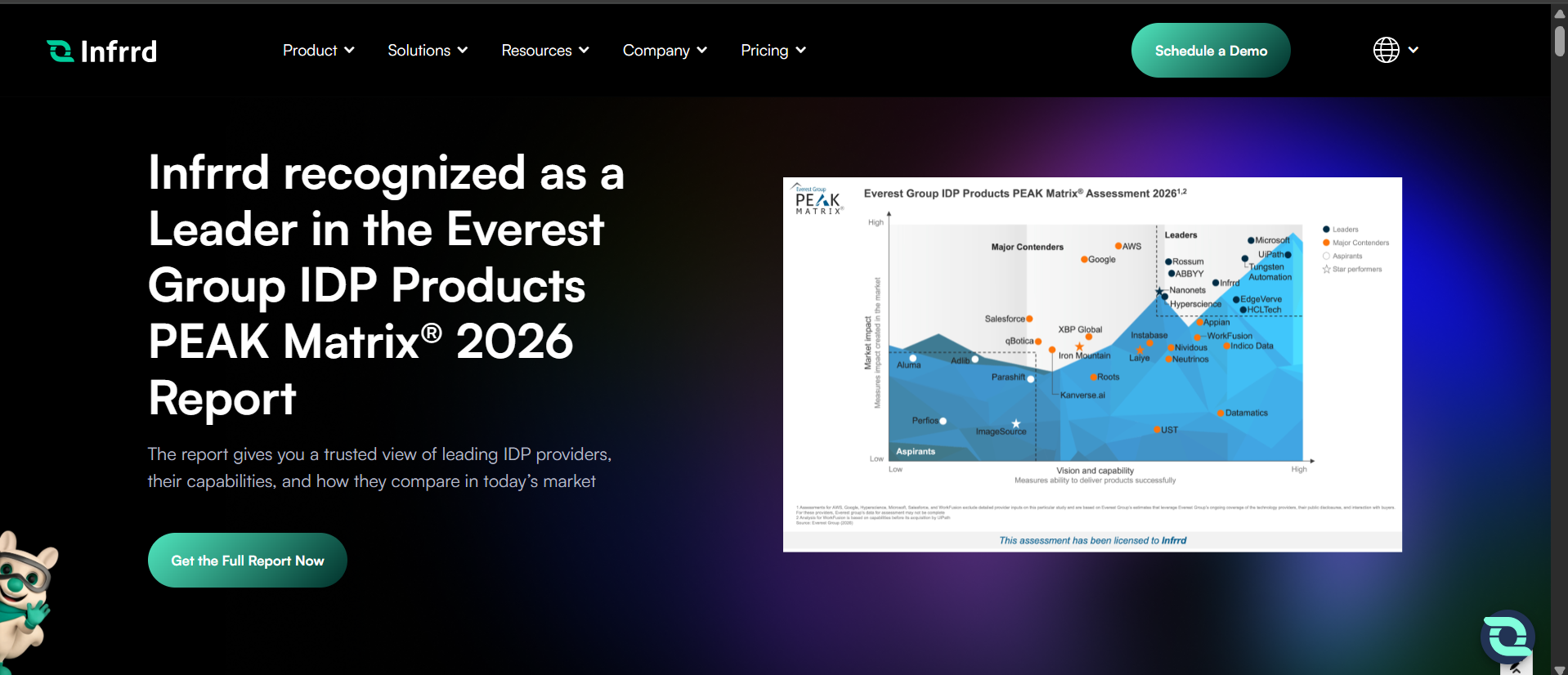
Infrrd is an Intelligent Document Processing platform used across document-heavy industries, with a strong focus on the mortgage industry. Its mortgage capabilities support origination, underwriting, prefunding QC, post-close QC, audit, and servicing.
Features:
- MortgageCheckai: Classifies mortgage documents, extracts field-level data, performs verification and cross-document checks, and prepares loan files for QC.
- Ally: Infrrd's proprietary agentic AI works like an auditor's right hand. It applies configured investor and lender rules, performs income calculations, compares supporting evidence, checks conditions, and prepares exceptions for human review.
- No-Touch Processing: High-confidence documents and fields can move through processing without manual review, while exceptions are routed to reviewers.
- Mortgage integrations: Supports high-volume mortgage operations and connections with major LOS and mortgage systems.
Drawbacks:
- Built primarily for enterprise-scale document operations.
- Smaller lenders processing only hundreds or a few thousand documents annually may find lighter API-based products more economical.
TRUE AI
TRUE is a mortgage-focused automation company. Its Mortgage Operations Service, or MOS, supports document processing across loan setup, income analysis, underwriting, post-close operations, and audit.
Features:
- Mortgage-specific document classification and data extraction.
- Cross-document and loan-data validation.
- Post-close and audit automation.
- Chain of Trust traceability from source documents through AI processing, human edits, and final system values.
Drawbacks:
- Has less long-term third-party validation than some established enterprise IDP vendors.
- Its public integration story is strongest around Encompass, so multi-LOS lenders should verify support for other systems.
Docsumo
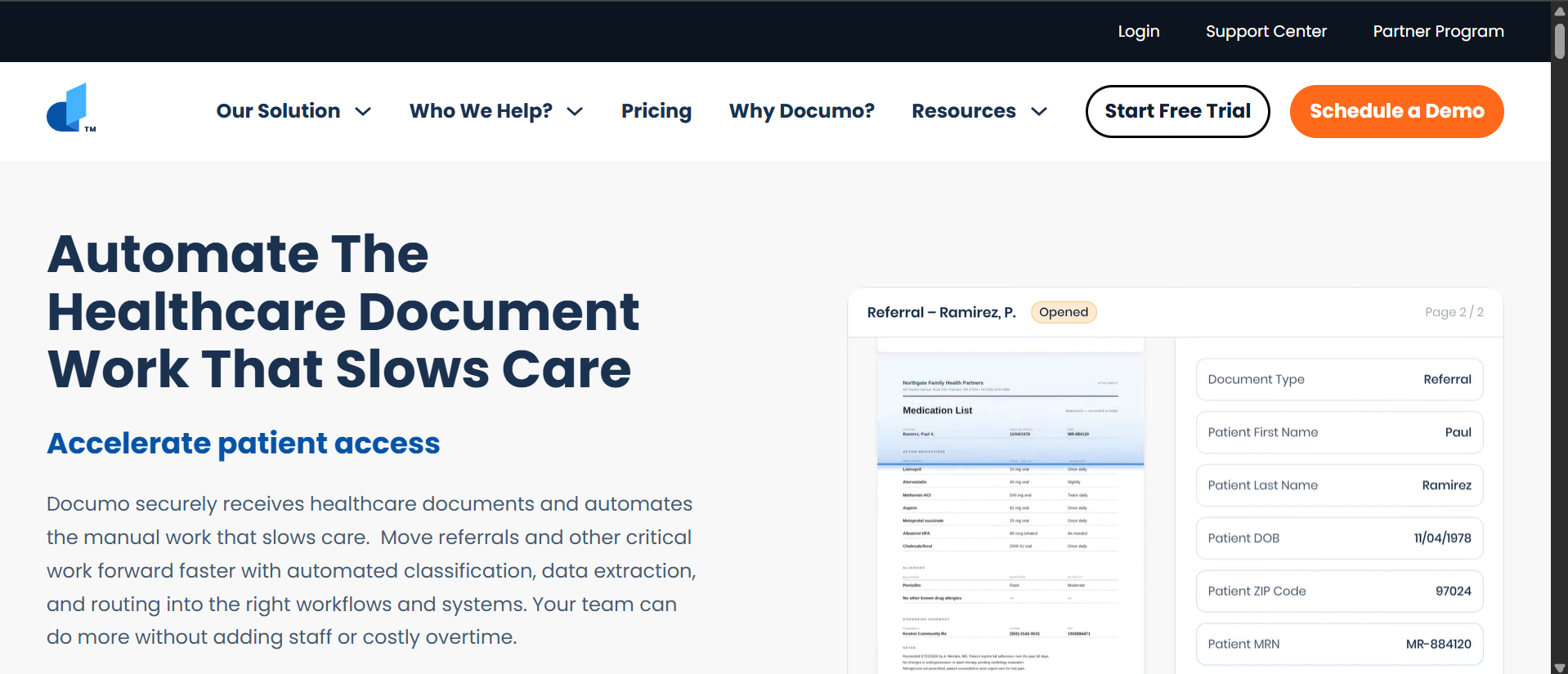
Docsumo is a general document-processing platform with a strong lending use case. It processes documents such as bank statements, W-2s, tax returns, pay stubs, VOEs, and loan applications.
Features:
- Document classification and field extraction.
- Field-level confidence scoring.
- Cross-document validation and exception routing.
- API-based and lending-system integrations.
Drawbacks:
- Mortgage QC is one use case within a broader platform rather than its primary focus.
- Should watch out for edge cases; performance can vary depending on how standardized or complex the underlying documents are.
Nanonets
Nanonets is a general-purpose OCR and IDP platform that supports document extraction and workflow automation across many industries.
Features:
- Extracts data from PDFs, scans, bank statements, tax records, and pay stubs.
- Supports custom workflows and validation rules.
- Provides exception handling and data exports.
- Offers APIs for custom integrations.
Drawbacks:
- Does not offer the same mortgage-specific QC and investor-rule depth as mortgage-focused platforms.
- Mortgage LOS integrations and cross-document validation may require additional configuration.
ABBYY FlexiCapture / Vantage
ABBYY provides enterprise OCR and Intelligent Document Processing through FlexiCapture and Vantage.
Features:
- OCR, ICR, classification, splitting, and data extraction.
- Supports handwriting, signatures, check boxes, and varied document formats.
- Low-code document skills in Vantage.
- Enterprise APIs and workflow integrations.
Drawbacks:
- Mortgage QC logic and investor rules typically require configuration.
- Deployment can require more specialist setup than lighter document APIs.
Hyperscience
Hyperscience is an enterprise IDP platform used across financial services and other document-heavy operations.
Features:
- Classification, extraction, validation, and human review.
- Workflow orchestration and enterprise deployment controls.
- ORCA Vision Language Model support for unfamiliar document layouts.
- Strong support for handwriting, complex documents, and large packet splitting.
Drawbacks:
- Mortgage is one vertical within a broader enterprise platform.
- Mortgage-specific QC, investor-rule, and post-close workflows may require additional configuration.
Use case best fit
For a developer team, broker, smaller lender, or department that only needs to process a few hundred documents or a limited set of mortgage files, a large enterprise platform may be unnecessary.
Infrrd's IDP Forge targets this use case from a different direction. Developers can use it for document ingestion, parsing, extraction, workflow execution, validation, correction workflows, structured output, and model orchestration. It also supports Bring Your Own Key for teams that want document workloads to use their existing LLM accounts and model strategy. That makes it a practical middle ground between building a document stack from scratch and deploying a full enterprise mortgage automation program.
How Infrrd Is the Best Choice Among Most of These Competitors
There is no universal winner for every mortgage team. A lender that needs a simple extraction API has a different buying problem from an enterprise originator running origination, QC, audit, and servicing workflows across millions of pages.
Infrrd becomes the stronger choice when mortgage-specific depth and enterprise document processing need to exist in the same platform. It has worked across mortgage origination, underwriting support, prefunding QC, post-close QC, audit, and servicing rather than stopping at OCR or field extraction. MortgageCheckai provides the document intelligence and QC foundation, while Ally extends that foundation into agentic audit preparation, rule application, income calculation, evidence comparison, and exception investigation.
The difference also shows up in deployment evidence. Infrrd's clients of large mortgage operations processing tens of millions of pages per month, with no-touch processing at material scale, field-level traceability, and cross-document validation. Its public mortgage case studies also report 60% faster loan review, more than 150 million documents processed, and 70% NTP across a featured mortgage originator example.
That combination matters because the best mortgage lending automation for document processing must work after the demo. It must handle bad scans, long loan packages, changing forms, lender rules, LOS integration, human review, and audit evidence together. Infrrd's position is strongest for lenders that want one reliable mortgage document intelligence layer to support those requirements across the loan lifecycle.
Conclusion
Mortgage automation is not a plug that connects to a lender's workflow in one day and performs perfectly. Loan programs, document mixes, rules, LOS setups, reviewer roles, and risk tolerances differ too much for that. The right platform must fit into the operating model, adapt to the lender's documents, and connect each automated action to evidence people can review.
For enterprise mortgage operations, Infrrd brings years of mortgage-specific work across origination, prefunding QC, post-close QC, audit, and servicing, supported by customer results and analyst recognition. The goal is not another automation workflow. It is document confidence: data and evidence that teams can use without reopening every file just to verify what the system found.
*All information presented above is sourced from publicly available materials and is subject to change. For the most accurate and up-to-date details, please contact the individual providers directly.