- Insurance reconciliation catches payment, claim, commission, and reserve mismatches before they disrupt reporting or compliance.
- Clean document data reduces preventable reconciliation exceptions by structuring, validating, and correcting information before matching.
- Reconciliation automation and intelligent document processing work together to reduce manual checks and improve accuracy.
Insurance reconciliation problems often start with small mismatches. A payment may reach the bank but not match the premium ledger. A broker commission may appear twice, or a claim payment may be missing the details needed to verify it. Finding the source of these differences can send teams across policy systems, claims platforms, spreadsheets, bank files, ERA files, and PDFs.
The bigger issue is that many organizations still rely on manual checks to resolve them. That takes time and increases the risk of missed errors, delayed reporting, and revenue leakage. CAQH estimates that the U.S. medical and dental industries have about $1.3 billion in annual savings opportunity from greater adoption of electronic remittance advice workflows.
Insurance reconciliation helps teams correct them before they affect financial reporting or compliance. Intelligent document processing can strengthen this process further by extracting clean data from incoming documents, structuring it for downstream systems, and flagging exceptions earlier.
In this guide, we explain how insurance reconciliation works, where common problems occur, and how better document data can make the process faster and more accurate.
What Is Insurance Reconciliation?
Insurance reconciliation is the process of comparing financial and operational records across systems to confirm that premiums, claims, commissions, payments, reserves, and related transactions agree. Teams identify missing, duplicated, delayed, or incorrect entries, investigate the cause, correct the records, and document the result so financial statements and operational reports reflect the same underlying activity.
Why Insurance Reconciliation Matters for Carriers, MGAs, and TPAs
Carriers, MGAs, and TPAs move money and data through several parties and systems. Insurance reconciliation gives finance and operations teams a control point for finding differences early, protecting revenue, supporting accurate reporting, and reducing unresolved balances before each period close.
Revenue Leakage and Missed Underpayments
Small differences can accumulate across thousands of transactions. A missed premium adjustment, incorrect commission, duplicate payment, or underpayment can sit unnoticed if records are compared late. Regular reconciliation helps teams identify these gaps, assign ownership, and recover amounts that should have been collected or paid.
Regulatory and Compliance Risk (NAIC, Solvency II, IFRS 17)
Reconciliation supports traceable financial reporting. U.S. insurers generally prepare statutory statements under NAIC statutory accounting principles. Solvency II sets reporting requirements for covered European insurers, while IFRS 17 defines accounting requirements for insurance contracts.
CMS payment-integrity data shows why financial controls matter. For FY 2025, CMS reported improper-payment rates of 6.55%, or $28.83 billion, for Medicare Fee-for-Service; 6.09%, or $23.67 billion, for Medicare Part C; and 6.12%, or $37.39 billion, for Medicaid.
Cash Flow and Financial Reporting Accuracy
Unreconciled items make cash positions harder to trust. Finance teams may carry open balances, book revenue in the wrong period, misstate commissions, or spend extra time validating reserves. Timely reconciliation creates a cleaner close because each material difference has a documented source, status, and resolution.
Types of Insurance Reconciliation
Insurance companies reconcile different transaction groups because each group affects a different part of the financial record. The main types cover premium collections, broker payments, reinsurance activity, and reserve reporting, with each requiring its own source records and matching rules.
Premium Reconciliation
Premium reconciliation compares amounts billed, collected, adjusted, refunded, and posted to policy records. Teams check whether payment dates, policy numbers, installments, cancellations, endorsements, and outstanding balances agree across billing platforms, bank records, and policy administration systems.
Commission and Broker Reconciliation
Commission reconciliation checks whether brokers, agents, and distribution partners received the correct amount under their agreements. Teams compare premium data, commission rates, payment schedules, clawbacks, cancellations, and prior-period adjustments to find overpayments, underpayments, or duplicate entries.
Reinsurance and Ceded Risk Reconciliation
Reinsurance reconciliation compares ceded premiums, recoverables, claim payments, treaty terms, bordereaux, and accounting records. Differences can appear when source data arrives late, treaty terms are applied incorrectly, or claim changes are not reflected across both insurer and reinsurer records.
Reserve and Regulatory Reporting Reconciliation
Reserve reconciliation checks whether claim reserves, case reserves, incurred amounts, paid losses, and accounting balances agree before financial or regulatory reporting. This work supports consistent reporting under applicable statutory or accounting frameworks and gives reviewers a traceable link from reported figures back to supporting transactions.
Together, these reconciliation types help insurers keep operational systems and financial records aligned throughout the reporting cycle.
The Insurance Reconciliation Process, Step by Step
Insurance reconciliation follows a repeatable control cycle: collect source records, compare matching fields, investigate exceptions, correct confirmed issues, and validate final balances before formal financial reporting or period close begins.
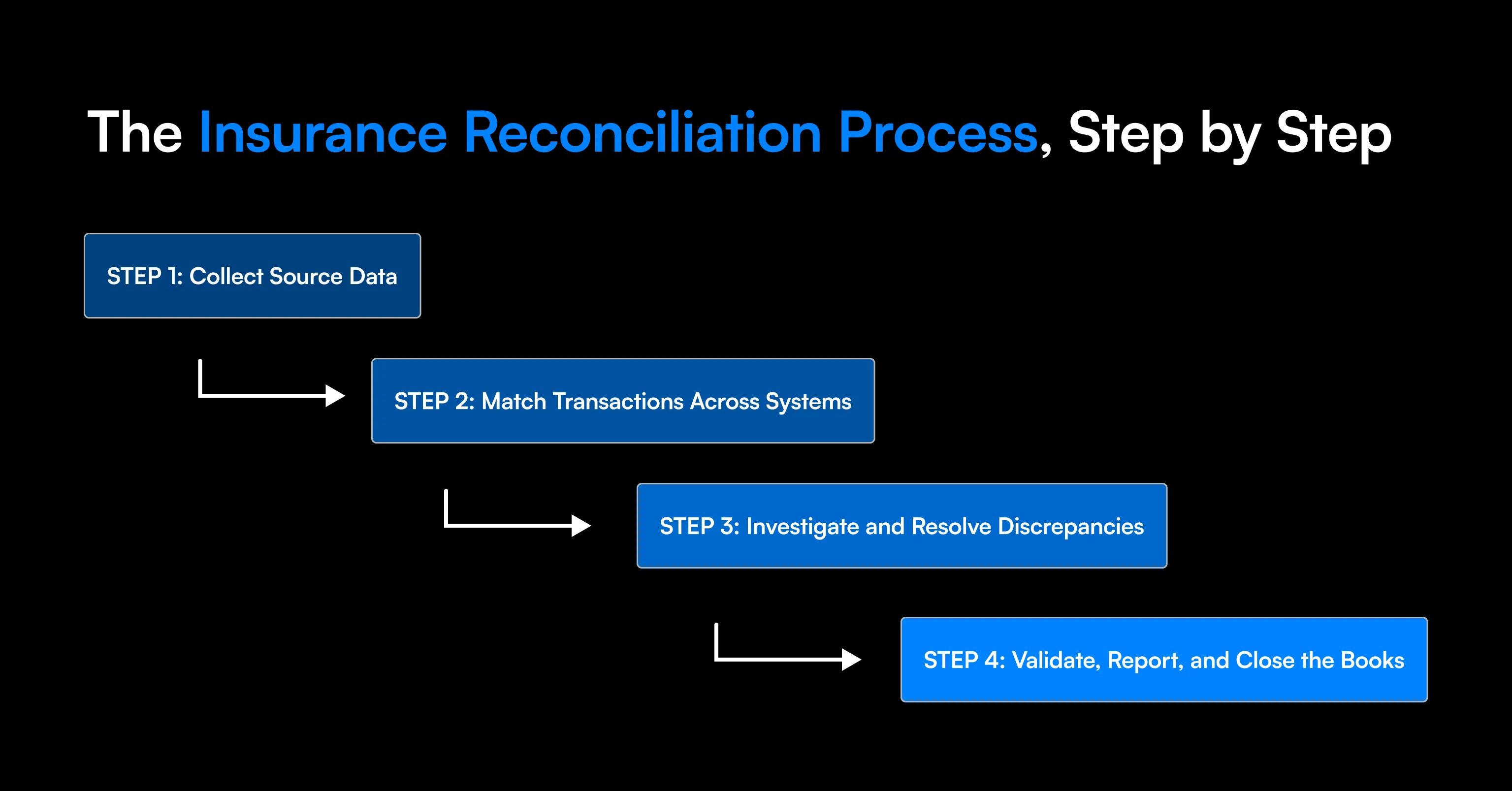
Step 1: Collect Source Data (Claims, Premium, Bank, ERA/EOB Files)
Teams gather data from policy systems, claims platforms, bank statements, payment files, general ledgers, ERA or EOB files, broker statements, and supporting documents. The first requirement is consistent identifiers such as policy number, claim number, payment amount, payment date, customer name, transaction reference, and account details.
Step 2: Match Transactions Across Systems
The team matches records using exact or rule-based logic. A premium payment may be matched by policy number, amount, and date. A claim payment may require claim ID, payee, service details, and adjustment codes. Automated matching handles straightforward records and sends uncertain or incomplete matches to a review queue.
Step 3: Investigate and Resolve Discrepancies
Reviewers examine unmatched, duplicated, short-paid, overpaid, or inconsistent transactions. They trace the source document, confirm the correct amount, identify the reason for the difference, record supporting evidence, and update the relevant system or escalation queue.
Step 4: Validate, Report, and Close the Books
Finance or operations teams confirm that material exceptions have been resolved or documented. They approve final balances, produce reconciliation reports, retain supporting evidence, and close the period with a record of open items that still require action and documented ownership.
Reconciliation Automation vs. Document Data Readiness: Where Each Fits
Reconciliation automation compares transactions after data enters business systems. Document data readiness acts earlier by turning incoming insurance documents into structured fields that downstream reconciliation tools can match reliably and consistently.
The two functions work best together. Clean document data improves match rates, while reconciliation automation identifies the remaining transaction-level differences.
Common Challenges in Insurance Reconciliation
Most reconciliation problems start before matching begins. Data arrives in formats, transaction volumes are high, and teams depend on manual comparison. This creates delays and makes exceptions harder to resolve.
Fragmented and Inconsistent Document Formats
Insurers receive PDFs, scanned forms, spreadsheets, broker statements, EOBs, ERAs, emails, and system exports. The same field may appear under different labels or layouts, so teams can capture the same information differently across documents and business units.
High Transaction Volumes Across Multiple Systems
Claims, premiums, commissions, and payments may flow through policy, claims, billing, banking, and accounting systems. As volume grows, teams must compare more records while tracking timing differences, corrections, reversals, duplicate entries, and data that arrives after the expected processing window.
Manual, Error-Prone Matching Processes
Spreadsheet-based matching depends on staff copying, filtering, and comparing values. Human review remains important for exceptions, but using it for every record increases processing time and raises the chance of missed duplicates, incorrect matches, inconsistent decisions, or differences that remain unresolved at close.
How Document Intelligence Solves Reconciliation’s Root Cause
Document intelligence improves reconciliation by fixing a common upstream problem: inconsistent source data. It converts incoming insurance documents into structured, validated fields that systems can compare before errors spread downstream.
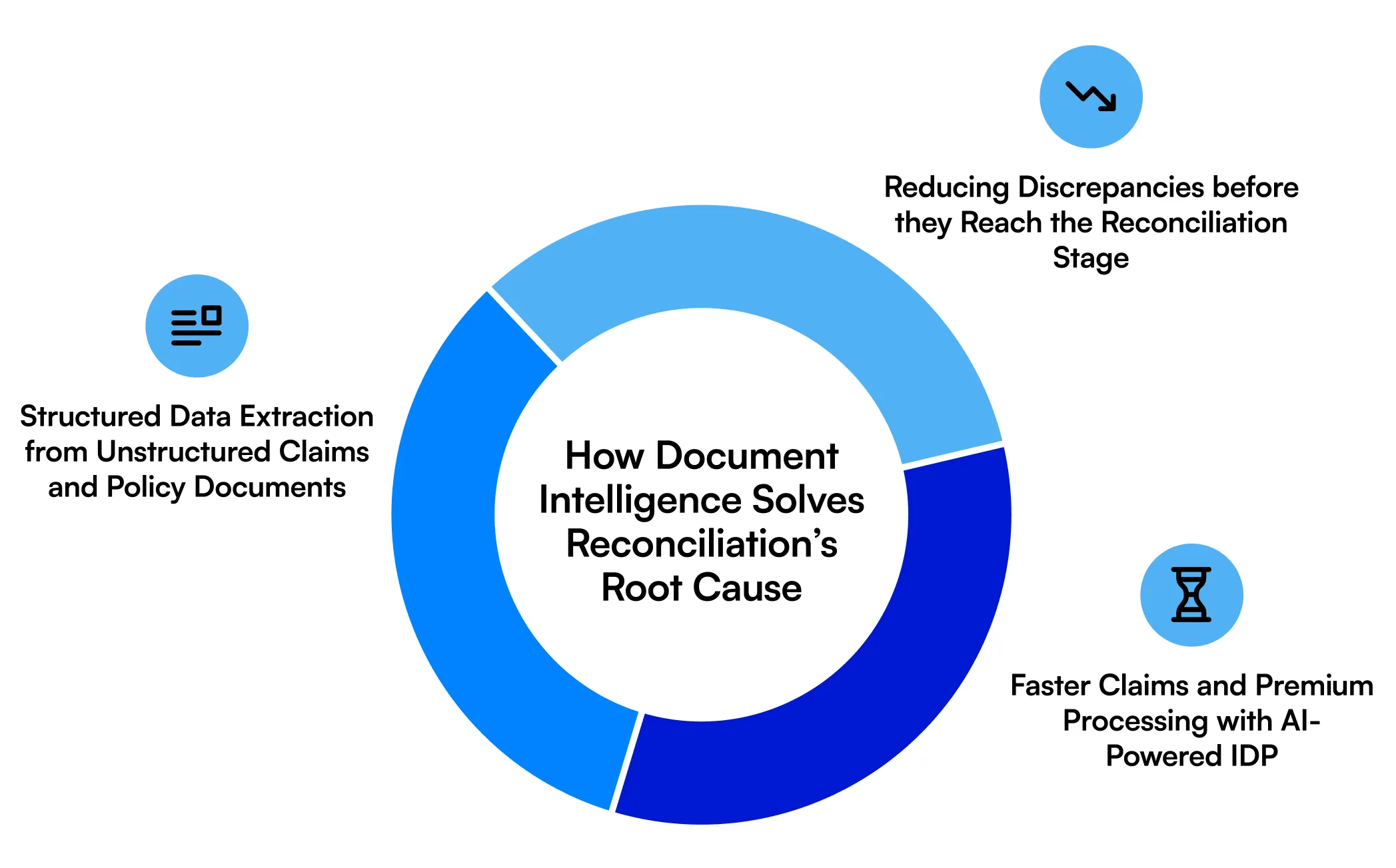
Structured Data Extraction from Unstructured Claims and Policy Documents
An AI-powered intelligent document processing solution can classify insurance documents and extract fields from claims, policy files, forms, statements, and related records. The platform should normalize values such as policy numbers, claim IDs, dates, amounts, names, and payment details so downstream systems receive data in a consistent structure.
This matters because reconciliation logic can only match information it can reliably identify. If a claim number is missing, a premium amount is captured incorrectly, or a payment reference remains inside an unprocessed PDF, the reconciliation system starts with incomplete data.
Reducing Discrepancies Before They Reach the Reconciliation Stage
The platform should validate extracted fields, apply business rules, and flag low-confidence data for review before it reaches finance or operations systems. This moves error detection earlier in the workflow.
Instead of discovering every issue during month-end insurance reconciliation, teams can correct document-level problems closer to intake. Cleaner input data means fewer preventable exceptions, less manual investigation, and a reconciliation queue focused on genuine financial differences rather than data-entry mistakes.
Faster Claims and Premium Processing with AI-Powered IDP
Faster claims and premium processing depends on getting accurate document data into downstream systems quickly and consistently. AI-powered IDP can classify documents, extract key fields, validate values, and prepare structured data for claims, premium, finance, and reconciliation workflows.
Infrrd can handle this work at scale and across varied insurance document types. The platform has automated 2.1M+ document variations, processes 1M+ documents every week, and supports 22+ languages worldwide. For insurers, this can mean less manual entry, fewer data-driven discrepancies, cleaner reconciliation inputs, and faster exception handling across claims and premium operations, while giving teams clearer traceability back to source documents.
Conclusion
Insurance reconciliation problems often begin with small mismatches, duplicate payments, missing claim details, or inconsistent records spread across multiple systems. Left unresolved, these issues can slow reporting, create revenue leakage, and increase compliance risk. Modern automation gives insurers a better way to address them.
Reconciliation tools can match transactions and flag exceptions, while intelligent document processing improves the quality of data before it reaches those systems. Together, they reduce manual checks, catch errors earlier, and give teams cleaner records to work with. As insurance operations become digital, this combined approach can make reconciliation faster, more accurate, and easier to manage.
Frequently Asked Questions About Insurance Reconciliation
What is insurance reconciliation?
Insurance reconciliation compares premiums, claims, commissions, payments, reserves, and related records across systems to find differences, correct errors, and confirm that financial and operational balances agree.
What is the difference between claims reconciliation and premium reconciliation?
Claims reconciliation compares claim payments, reserves, adjustments, and supporting records. Premium reconciliation compares billed, collected, refunded, adjusted, and outstanding premium amounts against policy and payment records.
How does automation improve insurance reconciliation accuracy?
Automation applies consistent matching rules across large transaction volumes, flags exceptions, detects duplicates, and reduces manual data handling so reviewers can focus on records that require judgment.
How does document data quality affect reconciliation outcomes?
Poor document data creates missing identifiers, incorrect amounts, inconsistent dates, and weak matches. Clean structured data improves match rates and reduces exceptions caused by extraction or entry errors.
What documents are typically involved in insurance reconciliation?
Common documents include claims files, policy records, invoices, bank statements, broker statements, commission reports, EOBs, ERAs, bordereaux, reinsurance statements, payment files, and general-ledger records.