- Extraction provides the exact data foundation for compliance, while abstraction interprets that data to provide faster, actionable business insights.
- Choose extraction when verbatim accuracy and audit trails are mandatory; use abstraction when summarizing large volumes for quick decision-making.
- Modern workflows require both: extract structured data first to ensure accuracy, then abstract that verified data for reliable AI-generated summaries.
Document teams handle large volumes of files such as forms, invoices, contracts, reports, and emails. These documents contain data that drives decisions, compliance checks, and workflows. A key choice shapes how this data is used: whether to extract it as-is or abstract it into insights.
Data extraction and data abstraction both process document content and reduce manual work, but they serve different purposes. Extraction captures exact values, while abstraction interprets data to generate meaning.
This distinction affects accuracy, compliance, and efficiency. As document automation grows across industries, understanding when to use each approach becomes critical for building reliable workflows.
This article explains the core difference between data abstraction and data extraction in clear terms. It also outlines where each approach fits, when to use them, and why modern document workflows often require both.
What is Data Abstraction and Data Extraction?
Data extraction captures exact data from documents without altering meaning. It pulls fields such as names, dates, and amounts and stores them in structured formats.
Data abstraction interprets document content to generate summaries or insights. It simplifies information for faster understanding, but may introduce variation.
In simple terms, extraction answers what the document says, while abstraction explains what it means.
Data Extraction
Data extraction is the process of capturing exact data from a document without changing its meaning. The system identifies fields such as names, dates, and amounts and stores them in a structured format like a table or database. This approach keeps a direct link to the source, which supports validation and audits. It is widely used in finance, mortgage, and insurance workflows where accuracy and traceability are critical.
Data Abstraction
Data abstraction is the process of interpreting document content to generate summaries or insights. Instead of copying exact values, the system analyzes the data and presents a simplified view for faster understanding. This approach helps decision-makers review large volumes of information quickly. However, since it involves interpretation, the output may not always match the source exactly, which makes it less suitable for accuracy-critical workflows.
Extraction vs Abstraction: Where The Real Difference Lies?
Data extraction and data abstraction are often confused because both involve processing document content using similar technologies. Both approaches rely on machine learning models and natural language processing to read and understand text.
Understanding this distinction helps teams design workflows that balance accuracy and usability. It also helps avoid errors that can occur when abstraction is used in place of extraction in regulated environments.
Types of Extraction And Abstraction
Different methods exist for extracting and interpreting document data. These include structured and unstructured extraction, along with extractive and abstractive summarization, each suited to specific document types and business needs.
Structured Data Extraction (Forms, Tables, Invoices)
Structured data extraction works on documents that follow a predictable layout. These documents usually contain clearly defined fields, labels, and tables. Examples include tax forms, invoices, bank statements, and application forms.
In this approach, the system identifies predefined fields such as invoice number, total amount, or due date. It then captures these values and stores them in a structured format. Because the layout is consistent, accuracy tends to be higher compared to other document types.
This type of extraction is widely used in financial operations, accounts payable, and compliance workflows. It allows organizations to process large volumes of documents quickly while maintaining data consistency.
Unstructured Data Extraction (Emails, Contracts, Reports)
Unstructured data extraction deals with documents that do not follow a fixed layout. These documents include emails, contracts, reports, and free-text documents. The challenge here is that the same information can appear in different formats and locations.
The system must first understand the context of the content before identifying relevant data points. For example, a contract may contain clauses about payment terms, obligations, and penalties. The system needs to locate and extract these details even when they are written in different ways.
This type of extraction requires more advanced models because it relies on language understanding rather than fixed positions. It is commonly used in legal, insurance, and enterprise document workflows.
Extractive Summarization
Extractive summarization is a method that selects key sentences or phrases directly from the original document. The system identifies the most important parts of the content and compiles them into a shorter version.
This approach does not change the wording of the original text. As a result, it maintains a strong link to the source content. It is useful when accuracy is important, and the goal is to reduce the length of the document without altering meaning.
However, extractive summarization may not always produce a smooth or coherent summary because it relies on existing sentences rather than generating new ones.
Abstractive Summarization
Abstractive summarization generates new sentences based on the content of the document. The system reads the text, understands the key ideas, and then creates a summary in its own words.
This approach allows for more flexibility and readability. It can combine information from different parts of the document and present it in a concise format. For example, instead of listing multiple clauses, the system may produce a single sentence that captures the overall intent.
While this method improves readability, it also introduces a risk of variation. Since the output is generated, it may not always match the source exactly. This makes it less suitable for workflows that require strict accuracy.
When to Use Data Extraction?
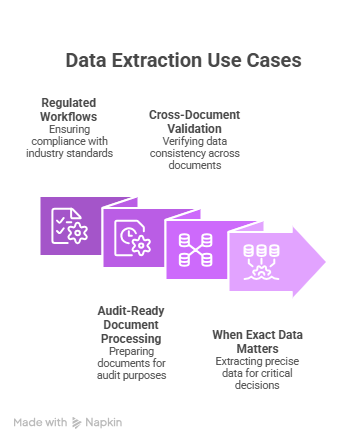
Data extraction becomes important in workflows that depend on exact values and traceability. It is commonly used in regulated environments, audit processes, and validation tasks where accuracy directly impacts outcomes.
Regulated Workflows
Regulated industries rely on exact data to meet compliance requirements. In mortgage processing, for example, lenders must verify income, assets, and loan details against multiple documents. Any mismatch can lead to compliance issues or financial risk.
Data extraction supports these workflows by capturing values exactly as they appear. This allows systems to validate information across documents and maintain a clear audit trail. It also reduces the risk of human error, which is common in manual processes.
Audit-Ready Document Processing
Audit workflows require full traceability. Every data point must link back to its source document so auditors can verify accuracy and ensure regulatory compliance.
Data extraction enables this by mapping each value to its exact location in the document. This supports validation, simplifies reviews, and makes extraction the preferred approach for audit-ready systems.
Cross-Document Validation Use Cases
Many workflows involve comparing data across multiple documents. For example, a loan file may include a borrower application, bank statements, and tax forms. The system must check whether the information matches across these documents.
Data extraction enables this comparison by converting document content into structured data. Once the data is structured, it can be validated across sources. This helps detect inconsistencies and reduce risk.
When Exact Data Matters
Data extraction is the right choice when precision is critical. This includes scenarios such as financial calculations, compliance checks, and reporting.
Manual processes often fail in these scenarios due to high error rates. Manual data entry can result in errors ranging from 18% to 40%. Automated extraction reduces this risk by applying consistent rules across documents.
At the same time, abstraction introduces its own risks because it relies on interpretation. A pilot study found that incorrect abstraction rates reached 24% with inexperienced reviewers, and even after partial correction, the error rate remained at 12%.
This highlights a clear way in which extraction reduces variation by capturing exact values, while abstraction improves understanding but requires validation to avoid incorrect conclusions.
When to Use Data Abstraction?

Data abstraction is useful when the goal is to understand large volumes of information quickly. It supports summaries, prioritization, and decision-making by presenting key insights instead of raw data.
Executive Summaries And Insights
Leaders often need a quick understanding of large documents. Reading every page is not practical, especially when dealing with hundreds of files. Data abstraction helps by generating summaries that highlight key points.
For example, instead of reviewing an entire loan file, a decision-maker can read a summary that explains the borrower’s financial position and risk level. This saves time and supports faster decision-making.
Large-Volume Document Triage
Organizations often receive large volumes of documents that need to be sorted and prioritized. Data abstraction can help by summarizing each document and identifying key themes.
This allows teams to quickly determine which documents require immediate attention and which can be processed later. It improves efficiency without requiring a full review of every document.
Knowledge Retrieval And Decision Support
Data abstraction supports systems that answer questions or provide insights based on document content. For example, a system may analyze a set of contracts and identify common risks or obligations.
This type of functionality is useful in legal, financial, and enterprise environments where decision-making depends on understanding large amounts of information.
When Speed Matters More Than Verbatim Accuracy
In some workflows, speed is more important than exact wording. For example, early-stage reviews or internal analysis may not require precise data points.
In these cases, data abstraction provides a faster way to understand the content. It allows teams to move quickly while still gaining useful insights. However, it should be used carefully in workflows that require strict accuracy.
Why Most Workflows Need Both Extraction And Abstraction?
Modern document workflows rely on both extraction and abstraction to balance precision and usability. Using them together allows systems to capture accurate data while also making it easier to interpret and act on.
Extract First, Then Abstract
Most modern document workflows follow a two-step approach. The system first extracts structured data from documents and then uses that data to generate summaries or insights. This sequence reduces risk and improves consistency.
Extraction creates a reliable data layer. It captures values such as names, amounts, dates, and identifiers in a structured format. Once this layer exists, abstraction can operate on top of it with better context.
For example, in a mortgage workflow, the system extracts income details, loan amounts, and credit scores from multiple documents. It then uses this data to generate a summary that explains the borrower’s financial position. This approach reduces the chance of incorrect interpretation because the abstraction step relies on verified data.
Combining Accuracy With Usability
Extraction and abstraction serve different but complementary purposes. Extraction provides accuracy and traceability. Abstraction improves usability by simplifying information for decision-makers.
When both approaches are used together, teams can access structured data for validation while also receiving summaries that are easier to interpret. This combination supports both operational workflows and strategic decisions.
For example, a compliance team may use extracted data to validate regulatory requirements. At the same time, a manager may use abstracted summaries to review overall trends. Both outputs come from the same document set, but they serve different needs.
Industry Use Cases For Extraction And Abstraction
Different industries apply extraction and abstraction in distinct ways depending on their requirements. These approaches support workflows across mortgage, insurance, financial services, engineering, and healthcare environments.
Mortgage Document Processing
Mortgage workflows involve multiple documents, such as loan applications, income statements, credit reports, and appraisal reports. Each document contains data that must be verified against others.
Data extraction captures values like income, loan amount, and employment details. The system then compares this data across documents to identify mismatches. Data abstraction adds value by summarizing the borrower’s financial profile and highlighting potential risks.
This combination allows lenders to process files faster while maintaining compliance standards.
Insurance Claims And Policy Workflows
Insurance workflows require accurate data from claim forms, policy documents, and supporting evidence. Data extraction captures claim details, policy limits, and coverage information.
Data abstraction helps adjusters understand the claim by summarizing key points. It can highlight whether the claim falls within policy coverage and identify potential issues.
This reduces the time required to review claims and supports faster decision-making.
Financial Services And Compliance
Financial institutions process large volumes of documents for reporting and compliance. Data extraction captures transaction details, account information, and financial metrics.
Data abstraction supports reporting by summarizing trends and insights. It allows teams to analyze data at a higher level without reviewing each document individually.
This combination improves both operational efficiency and strategic analysis.
Engineering Drawings And Technical Documents
Engineering workflows involve diagrams, schematics, and technical documents. Data extraction identifies components, measurements, and annotations from these documents.
Data abstraction explains the relationships between components and provides context for how systems function. This helps engineers and decision-makers understand complex designs more quickly.
Healthcare Services
Healthcare systems process patient records, lab reports, and clinical notes. Data extraction captures structured information such as patient details, test results, and medication data.
Data abstraction summarizes clinical notes and highlights key observations. This helps medical professionals review patient information more efficiently while maintaining access to detailed data when needed.
Challenges in Extraction And Abstraction
Using extraction and abstraction introduces challenges that affect accuracy, context, and scalability. These challenges must be addressed to maintain reliable and efficient document processing workflows.
Hallucination Risks In Abstraction
Data abstraction relies on generating content based on interpretation. This creates a risk where the system may produce statements that are not fully supported by the source data.
This issue is often referred to as hallucination. It can lead to incorrect conclusions if not properly managed. To reduce this issue, systems often combine abstraction with validation steps that reference extracted data.
Data Loss In Extraction
While extraction focuses on accuracy, it may miss context. It captures specific fields but does not explain relationships between them.
For example, extracting income values does not explain whether the income is stable or variable. This limitation means that extraction alone may not provide enough insight for decision-making.
Version Mismatch Across Documents
In many workflows, multiple documents contain related information. These documents may not always match. For example, a loan application may list one income value, while a bank statement shows another.
Extraction helps identify these differences, but resolving them requires additional logic. Abstraction can help explain these mismatches, but it must rely on accurate data to do so.
Scaling Workflows Without Increasing Effort
As document volumes grow, manual processing becomes difficult to scale. Teams cannot increase headcount at the same rate as document inflow.
Automation addresses this challenge, but it must balance accuracy and efficiency. Extraction handles structured data processing, while abstraction helps reduce review time. Combining both approaches allows organizations to scale without increasing manual effort.
How to Choose Between Extraction And Abstraction?
Choosing the right approach depends on business goals, data requirements, and workflow design. Clear evaluation helps determine whether accuracy, speed, or insight should take priority.
Decision Framework Based On Business Goals
Choosing between data abstraction and data extraction starts with a clear understanding of business goals. Each approach supports a different outcome, so the decision depends on what the workflow needs to achieve.
If the goal is to capture exact values for validation, reporting, or compliance, then data extraction is the right approach. It provides structured outputs that can be verified and audited. This is critical in industries where even small errors can lead to financial or regulatory issues.
If the goal is to understand patterns, generate insights, or support decision-making, then data abstraction becomes more useful. It helps simplify large volumes of information and presents it in a format that is easier to interpret.
In most real-world scenarios, workflows require both approaches. Extraction builds the data foundation, while abstraction builds understanding on top of that foundation.
Questions To Ask Before Implementation
Before selecting an approach, teams should ask a few key questions. These questions help clarify requirements and reduce the risk of choosing the wrong method.
- Does the workflow require exact values from documents?
- Will the output be used for audits or compliance checks?
- Do users need summaries or insights instead of raw data?
- How important is traceability to the original document?
- What level of accuracy is acceptable for the use case?
Clear answers to these questions guide the design of the workflow. They also help determine where extraction ends and abstraction begins.
Key Metrics To Track
To evaluate performance, teams should track a set of core metrics. These metrics provide a clear view of how well the system performs across both extraction and abstraction.
Accuracy measures how correctly the system captures or generates information. Extraction accuracy focuses on field-level correctness, while abstraction accuracy focuses on how well the generated output reflects the source content.
Speed measures how quickly documents are processed. Automation often reduces turnaround time significantly. Studies show that automated document workflows can reduce processing time by up to 70% while lowering costs by up to 40%.
Usability measures how easily teams can use the output. Structured data supports system integration, while summaries support human decision-making. A strong workflow balances both.
How Does Document Automation Combine Extraction And Abstraction?
Modern document automation combines extraction and abstraction within a single workflow. It uses advanced processing, validation, and automation to handle both structured data capture and insight generation.
From OCR to Intelligent Document Processing
Traditional systems relied on OCR to convert documents into readable text. While OCR can extract characters, it does not understand context or relationships between data points.
Modern systems use Intelligent Document Processing (IDP) to go beyond text recognition. These systems combine machine learning and language understanding to identify data, classify documents, and interpret content.
This shift allows organizations to move from simple data capture to complete workflow automation.
Validation And Cross-Checking Layers
Modern document automation systems include validation layers that verify extracted data. These layers compare values across multiple documents and check them against predefined rules.
For example, a system may compare income data from a pay stub with values in a loan application. If there is a mismatch, the system flags it for review. This reduces errors and improves confidence in the output.
Validation also supports abstraction. When summaries are generated from verified data, the risk of incorrect interpretation decreases.
Exception-First Workflows
Exception-first workflows focus on handling only the cases that require human attention. The system processes most documents automatically and flags only those with issues.
This approach improves efficiency by reducing the amount of manual work. Teams spend their time reviewing exceptions instead of processing every document.
Both extraction and abstraction benefit from this model. Extraction handles routine data capture, while abstraction supports quick understanding of flagged cases.
Human Oversight
Human involvement is limited to reviewing exceptions or validating critical decisions. This approach increases efficiency while maintaining control over important processes.
By combining extraction and abstraction, modern systems deliver both accuracy and usability at scale.
Benefits of Combining Extraction And Abstraction
Using both approaches together improves how document data is processed and used. It allows organizations to gain accurate data while also making that data easier to understand and act on.
Faster Processing Time
Combining both approaches reduces the time required to process documents. Extraction captures data quickly, while abstraction reduces the time needed for review.
Automation further improves efficiency by handling repetitive tasks without human input. This allows teams to process more documents in less time.
Improved Decision-Making
Decision-making improves when teams have access to both structured data and clear insights. Extraction provides the raw data needed for validation, while abstraction presents that data in a form that supports understanding.
This combination allows decision-makers to act quickly without losing access to detailed information.
Reduced Manual Effort
Manual document processing requires significant time and effort. It also introduces errors, especially when data must be entered repeatedly.
Automation reduces this burden by handling both extraction and abstraction. Teams can focus on higher-value tasks instead of repetitive work.
Better Compliance And Audit Readiness
Compliance requires accurate and traceable data. Extraction provides this by linking outputs directly to source documents.
Abstraction adds value by summarizing key findings, which helps auditors and reviewers understand the context quickly. Together, they support both verification and interpretation.
How Infrrd Enables Extraction
Infrrd supports both extraction and abstraction within a unified platform. It enables accurate data capture, insight generation, validation across documents, and complete workflow automation.
High-Accuracy Data Extraction
Infrrd provides data extraction capabilities that capture structured and unstructured data from documents with high accuracy. The system identifies relevant fields across different document types and converts them into structured outputs.
This supports workflows that require precision, such as compliance checks and financial validation.
Cross-Document Validation
Infrrd compares data across multiple documents to identify inconsistencies. This validation step improves accuracy and reduces risk in document workflows.
End-To-End Automation Workflows
Infrrd combines extraction and validation into a single workflow. This allows organizations to automate document processing from start to finish.
The result is a system that delivers both structured data and actionable insights while reducing manual effort.
Final Takeaway
Data abstraction and data extraction are not competing approaches. They solve different problems within the same workflow. Extraction provides a reliable data foundation that supports validation and compliance. Abstraction builds on that foundation to deliver insights and improve usability. Organizations that combine both approaches can process documents faster, reduce errors, and support better decision-making.
FAQs about Abstraction vs Extraction
What Is The Main Difference Between Abstraction And Extraction?
Data extraction captures exact values from documents, while data abstraction generates meaning or summaries based on that data. Extraction focuses on accuracy, while abstraction focuses on understanding.
Is Abstraction The Same As Summarization?
Abstraction often includes summarization, but it can also generate insights or conclusions. Summarization is one form of abstraction, but not the only one.
Which Is More Accurate: Extraction Or Abstraction?
Extraction is more accurate because it captures data without interpretation. Abstraction introduces interpretation, which can lead to variation in output.
Can Both Be Used Together?
Yes, most modern workflows use both approaches. Extraction provides the data, and abstraction builds insights on top of that data.
Which Is Better For Regulated Industries?
Extraction is better suited for regulated industries because it provides traceable and verifiable data. Abstraction can still be used for summaries, but it should not replace extraction in compliance workflows.
How Do AI Models Handle Abstraction Vs Extraction?
AI models use different techniques for each task. Extraction models focus on identifying and capturing fields from documents. Abstraction models focus on understanding content and generating text based on that understanding.