- TRID compliance requires accurate loan disclosures, timely delivery, fee tolerance checks, and complete documentation throughout mortgage closing.
- Common TRID violations include LE-to-CD mismatches, undocumented fee changes, missed disclosure deadlines, and inaccurate cash-to-close calculations.
- Automated CD balancing helps lenders detect fee discrepancies, validate tolerance limits, and reduce manual mortgage QC errors.
Mortgage closing errors are more than administrative setbacks. They can delay settlements, raise compliance concerns, and leave borrowers questioning their loan terms.
In 2025, FDIC examiners cited 462 violations of the Truth in Lending Act (TILA) and Regulation Z, which govern TRID disclosures. Separately, the CFPB reported approximately 2,000 mortgage-closing complaints closed with an explanation or relief.
These figures highlight the importance of accurate disclosures. For lenders, compliance involves checking fees, tracking changes, and balancing Closing Disclosures (CDs) against Loan Estimates (LEs).
This guide explains TRID requirements, common violations, audit checkpoints, and how automated CD balancing helps lenders reduce errors before and after closing.
What Is TRID Compliance?
TRID compliance means following the TILA-RESPA Integrated Disclosure Rule, which requires mortgage lenders to provide accurate loan terms, closing costs, and required disclosures within specific deadlines. The rule combines federal disclosure requirements under the Truth in Lending Act (TILA) and Real Estate Settlement Procedures Act (RESPA), helping borrowers understand and compare mortgage costs before closing.
How the TRID Rule Integrated TILA and RESPA Disclosures
Before TRID, lenders used four main disclosure forms. The Good Faith Estimate (GFE) and initial Truth-in-Lending statement explained estimated loan costs. The HUD-1 Settlement Statement and final Truth-in-Lending disclosure presented closing details.
On October 3, 2015, TRID replaced these with two standardized documents:
- Loan Estimate (LE): Combines the GFE and initial TIL.
- Closing Disclosure (CD): Combines the HUD-1 and final TIL for covered transactions.
The CFPB introduced further amendments in 2017 to clarify disclosure requirements. In 2018, additional changes addressed how lenders could use corrected Closing Disclosures to reset fee tolerances.
Which Loans Are Covered and Which Are Exempt
TRID generally applies to closed-end consumer mortgage loans secured by real property or a cooperative unit, including conventional purchase loans, refinances, and certain construction loans.
Common exemptions include home equity lines of credit (HELOCs), reverse mortgages, and chattel loans secured only by manufactured housing without real property.
Certain housing assistance loans also qualify for exemptions. Lenders should assess coverage based on the loan structure and applicable regulatory exceptions, not the product name alone.
The Two Core TRID Disclosures
TRID compliance centers on two documents: the Loan Estimate and the Closing Disclosure. The LE communicates expected borrowing costs early in the application process, while the CD presents final loan terms and settlement charges. Both must follow standardized formatting, accuracy, and delivery requirements.
Loan Estimate Requirements
The three-page Loan Estimate outlines the interest rate, monthly payments, projected closing costs, cash to close, and key loan features. Lenders must use the prescribed format and provide estimates based on the best information reasonably available.
Closing Disclosure Requirements
The five-page Closing Disclosure presents final loan terms, itemized fees, taxes, prepaid charges, and cash-to-close calculations. The creditor must deliver it to the borrower, while settlement agents may provide it on the creditor's behalf. In purchase transactions, the settlement agent generally provides the seller's disclosure.
Lenders can use Closing Disclosure balancing to identify differences between estimated and final costs.
TRID Timing Requirements
TRID timing requirements determine when lenders must issue initial disclosures, when borrowers can proceed with closing, and when corrected documents require additional waiting periods. These deadlines protect borrowers from unexpected loan changes and give them time to review mortgage terms before becoming legally obligated.
The Three-Business-Day Loan Estimate Deadline
Lenders must deliver or mail the Loan Estimate within three business days after receiving the six required application details. Before the borrower receives the LE and indicates an intent to proceed, lenders generally cannot charge fees other than a bona fide, reasonable credit report fee.
For this deadline, business days generally mean days the lender is open for substantially all business functions.
The Seven-Day and Three-Day Waiting Periods
The Loan Estimate must be delivered or mailed at least seven business days before consummation. Borrowers must receive the Closing Disclosure at least three business days before consummation. For these waiting periods, business days include Saturdays but exclude Sundays and federal legal holidays.
A borrower may waive a waiting period for a bona fide personal financial emergency through a properly documented written request after receiving the required disclosures.
When a Corrected Closing Disclosure Resets the Waiting Period
A new three-business-day waiting period applies when:
- The APR becomes inaccurate under Regulation Z.
- The loan product changes.
- A prepayment penalty is added.
Other changes generally require a corrected CD by consummation, without restarting the waiting period.
The Most Common TRID Violations Found in Loan QC
TRID violations often arise from inaccurate disclosures, missed delivery deadlines, unsupported fee changes, and incomplete closing records. These errors can remain unnoticed until post-closing audits or investor reviews. Identifying them early helps lenders correct borrower charges, document decisions, and prevent repeated compliance failures.
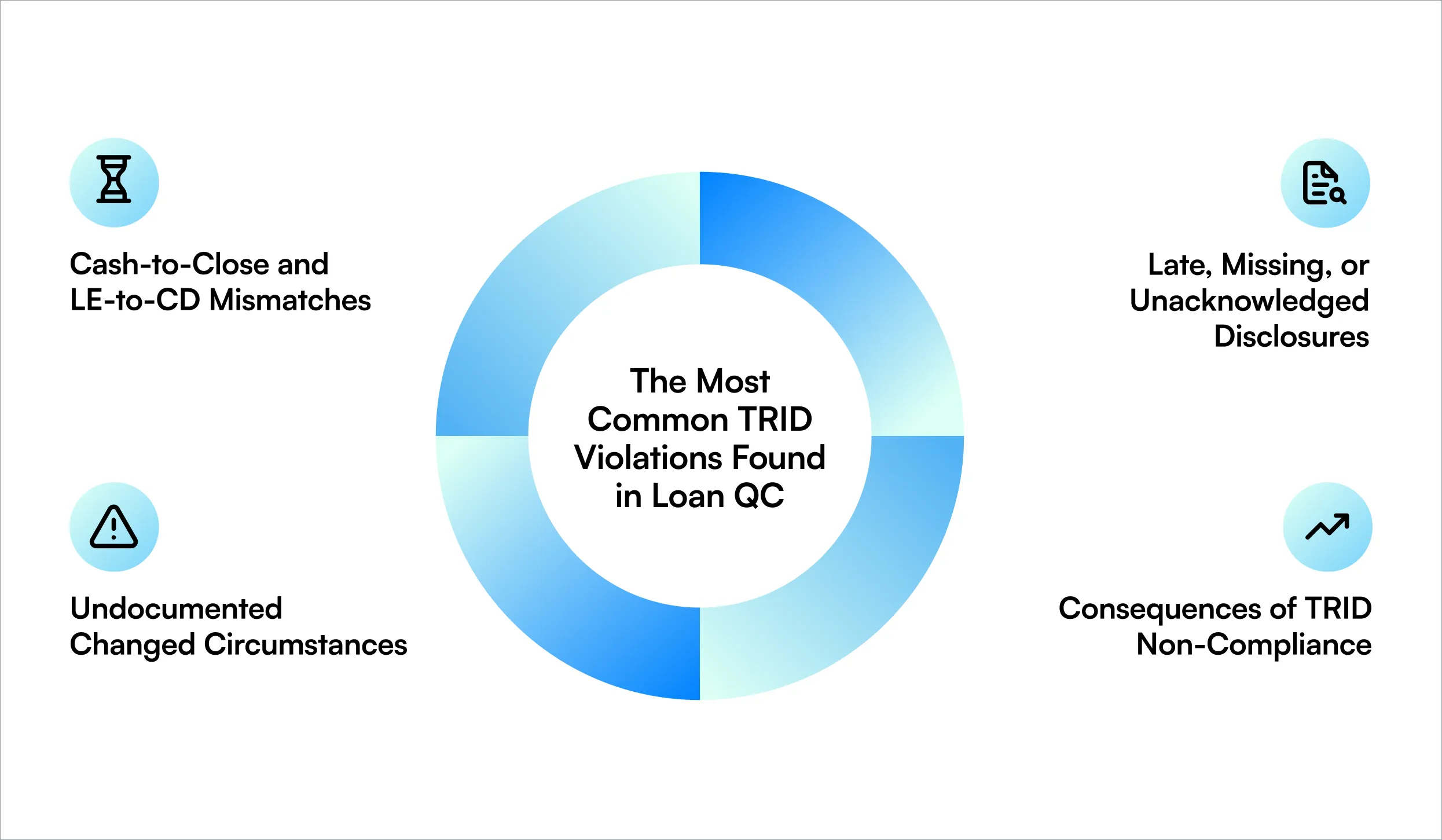
Cash-to-Close and LE-to-CD Mismatches
A borrower's final cash-to-close amount must reflect applicable credits, deposits, fees, and adjustments. Problems arise when the Closing Disclosure does not reconcile with the Loan Estimate or settlement records.
For example, a lender might disclose a $12,000 cash-to-close amount while the settlement worksheet calculates $12,500. The $500 difference may result from an omitted credit, changed prepaid charge, incorrect deposit, or data-entry error. Not every difference is a TRID violation. Auditors must establish whether the change was accurate, properly disclosed, and permitted.
CD balancing helps identify these differences by comparing amounts across the LE, lender CD, title CD, and related settlement records.
Undocumented Changed Circumstances
A revised Loan Estimate cannot automatically justify higher closing costs. Lenders must establish why the revision was permitted and retain supporting evidence.
For example, a borrower may request a different loan product, affecting pricing or settlement charges. The lender must document that request and apply the applicable revision rules.
Without supporting records, an auditor may have to evaluate the increased fee against an earlier tolerance baseline. This can turn an otherwise explainable charge into a compliance finding.
Late, Missing, or Unacknowledged Disclosures
Disclosure timing problems include a late Loan Estimate, a Closing Disclosure received too close to consummation, or a missing seller disclosure. Auditors should also investigate missing acknowledgments and delivery evidence.
A missing signature does not automatically prove a TRID violation. However, lenders must demonstrate that required disclosures were delivered or received within the applicable deadlines. If a lender relies on earlier electronic receipt, the file should contain reliable evidence supporting that date.
Consequences of TRID Non-Compliance
TRID non-compliance can lead to borrower refunds, corrective disclosures, regulatory findings, delayed settlements, and increased audit costs. The business impact can extend beyond the individual loan. Repeated defects may expose weaknesses in fee calculations, disclosure management, employee training, or closing workflows.
CFPB Enforcement and Civil Money Penalties
Under the Consumer Financial Protection Act, civil money penalties can vary according to the severity and nature of the violation. The CFPB's published 2025 adjusted maximums under its three-tier framework are:
These are statutory penalty limits for qualifying violations, not automatic fines for individual TRID errors. The legal basis, required findings, applicable periods, and available remedies determine actual exposure.
Repurchase Risk and Secondary Market Impact
TRID defects can also create problems when lenders sell loans to investors.
Investors and government-sponsored enterprises (GSEs) review loan quality, required documentation, and compliance with contractual delivery requirements. Material defects may trigger additional due diligence, requests for correction, pricing adjustments, or repurchase demands where applicable agreements support those remedies.
A TRID finding does not automatically require a buyback. Its impact depends on the defect, investor requirements, available cures, and whether the issue affects the loan's eligibility or marketability. For lenders, preventing recurring defects protects both compliance performance and secondary market relationships.
How to Audit a Loan File for TRID Compliance
A TRID compliance audit verifies whether mortgage disclosures were accurate, delivered within regulatory deadlines, and supported by complete documentation. Auditors must review the loan's disclosure history, compare estimated and final charges, evaluate tolerance violations, and confirm that the lender retained sufficient evidence of compliance.
Pre-Funding TRID Review
A pre-funding TRID review identifies potential violations before the lender releases funds. Auditors should verify that the Loan Estimate was delivered on time, compare the latest valid LE against the Closing Disclosure, and review the cash-to-close calculation.
They must also examine changed circumstances, supporting records, and any corrected disclosures that affect closing dates. Fee tolerance testing is particularly important because unresolved differences can result in borrower overcharges.
Pre-funding mortgage QC automation helps lenders identify these discrepancies before consummation, reducing the need for later corrections.
Post-Closing TRID Review
Post-closing TRID reviews examine completed loan files to identify errors missed before funding. Auditors typically review loans selected under the applicable QC sampling requirements, validate final disclosures, check refund records, and classify findings by severity.
They should also investigate root causes. If multiple loans contain the same title fee discrepancy, the problem may originate in a fee mapping rule rather than individual employees.
Post-close mortgage QC tools support document comparison, exception reporting, and evidence collection. Infrrd's Ally post-close audit workflow also illustrates how automated checks can support auditors while keeping final decisions under human review.
Record Retention and Audit Trail Requirements
Regulation Z generally requires lenders to retain evidence of compliance with the TRID Loan Estimate and disclosure requirements for three years after the applicable triggering date.
Completed Closing Disclosures and related documents must be retained for five years after consummation. An effective audit trail should include disclosure versions, delivery timestamps, changed circumstance records, fee calculations, tolerance cures, and reviewer decisions. These records help auditors reconstruct how a loan progressed from application to closing.
TRID Compliance Checklist for Mortgage QC Teams
A structured TRID compliance checklist helps mortgage QC teams evaluate disclosure accuracy, timing, and supporting evidence.
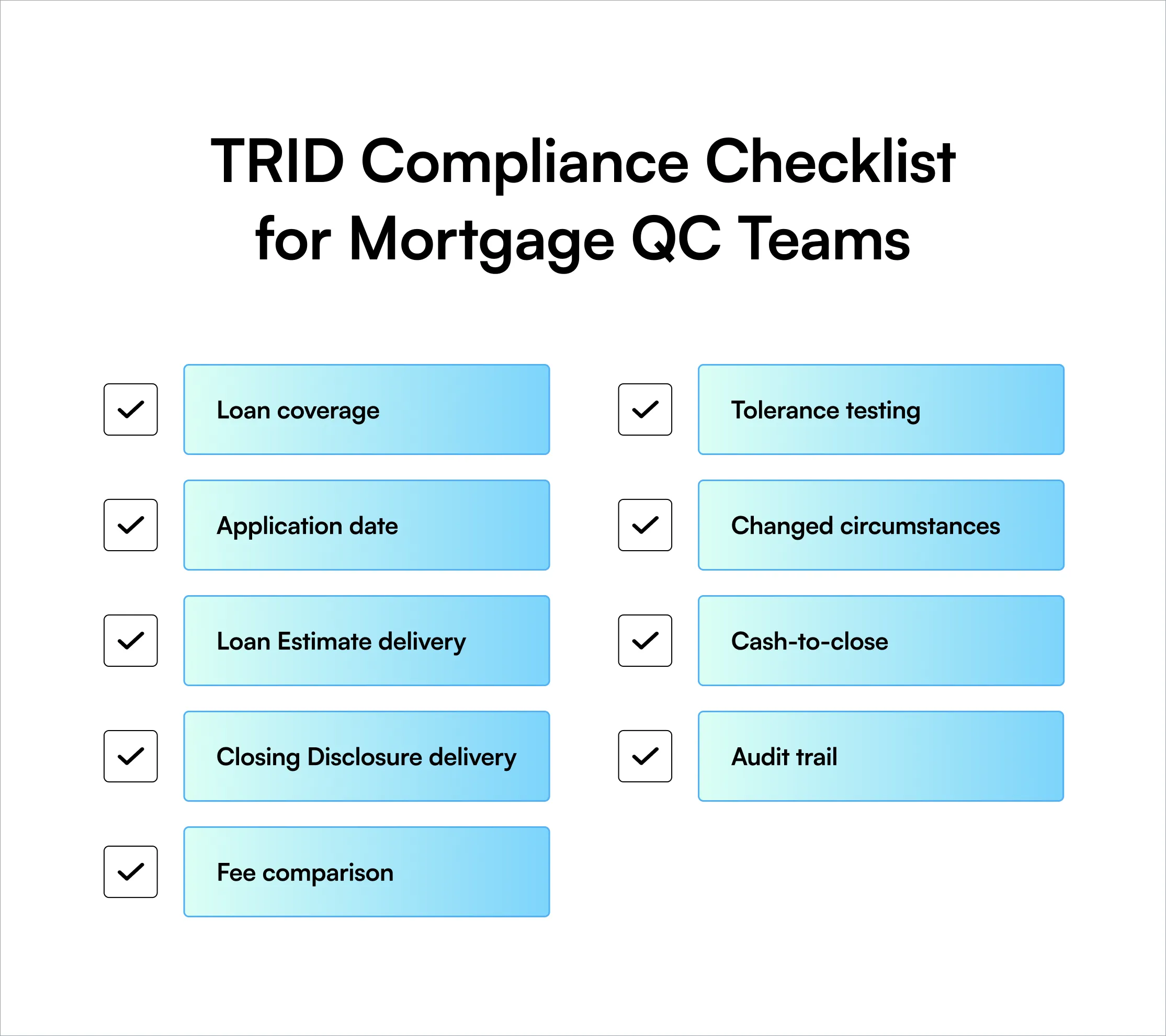
- Loan coverage: Confirm the transaction falls under TRID.
- Application date: Verify when all six required application details were received.
- Loan Estimate delivery: Validate delivery dates and evidence.
- Closing Disclosure delivery: Check the three-business-day waiting period.
- Fee comparison: Reconcile LE, CD, and settlement charges.
- Tolerance testing: Verify permitted increases and required cures.
- Changed circumstances: Confirm valid reasons and supporting records.
- Cash-to-close: Recalculate borrower funds and credits.
- Audit trail: Preserve disclosure versions, calculations, and decisions.
Evaluate in TRID Compliance Software
Select software based on extraction accuracy, automated fee testing, CD balancing, version tracking, audit trails, configurable rules, and loan origination system (LOS) integration.
The software should explain flagged discrepancies and allow auditors to review evidence before approving findings.
Automating TRID Compliance Checks with AI
TRID compliance depends on accurate data across several mortgage documents. Yet loan files often contain multiple Loan Estimates, corrected Closing Disclosures, title statements, and settlement records that auditors must compare.
Infrrd automates mortgage document processing through AI-powered classification, data extraction, and validation. Its mortgage QC platform, MortgageCheckai, supports pre-funding audits and post-closing reviews by identifying document discrepancies and applying configurable checks. Instead of manually locating every field, auditors can examine flagged differences and supporting evidence.
Automated LE-to-CD Comparison and Tolerance Testing
Infrrd's MortgageCheckai compares loan data across disclosures and supporting mortgage documents.
It helps auditors identify:
- Changes in lender fees and third-party settlement charges.
- Differences between estimated and final loan amounts.
- Missing or inconsistent borrower credits.
- Potential fee tolerance violations.
- Discrepancies requiring further investigation.
MortgageCheckai's built-in CD balancing capability supports fee validation and comparison. Configurable tolerance checks can help auditors identify potential breaches, while reviewers validate changed circumstances and determine whether a cure is required.
This reduces repetitive comparisons and directs auditor attention to exceptions.
Closing Disclosure Balancing and Version Control
A Closing Disclosure balancer compares the financial details across the Loan Estimate, lender Closing Disclosure, and title or settlement documents.
This matters because a loan may contain several revised disclosures before consummation. Comparing only the first LE with the final CD can produce misleading findings if a valid revised disclosure changed the tolerance baseline.
Infrrd's MortgageCheckai supports automated document comparison, CD balancing, and version-related checks. The platform helps auditors identify mismatched charges, review changes across disclosures, and verify the supporting data.
For example, when a title company updates a settlement fee, automated balancing can flag the difference for review rather than relying on an auditor to find it manually. Auditors still need to confirm which disclosure establishes the valid tolerance baseline and whether supporting documentation permits the change.
This combination of automated comparison and human review helps lenders improve closing accuracy without losing control over compliance decisions.
Conclusion
TRID compliance depends on accurate numbers, timely disclosures, and a clear record of every change made before closing. A small difference in fees, borrower credits, or cash-to-close calculations can create compliance concerns if lenders fail to identify and resolve it. Automation makes these checks easier to manage. AI-powered document processing can compare disclosures, detect inconsistencies, and reduce repetitive review work.
A CD balancer adds another layer of control by reconciling closing figures and identifying potential tolerance violations. The outcome is fewer avoidable disclosure errors, faster QC reviews, better audit readiness, and greater confidence in the final loan figures.
TRID Compliance FAQs
1. Does TRID apply to HELOCs?
No. Home equity lines of credit are exempt from TRID. However, they remain subject to other applicable disclosure requirements under Regulation Z.
2. Can a borrower waive the TRID waiting period?
Yes, but only for a bona fide personal financial emergency, with a properly documented written waiver after receiving the required disclosures.
3. Who is liable when a mortgage broker issues the Loan Estimate?
The creditor remains responsible for the Loan Estimate's accuracy and timely delivery, even when a mortgage broker prepares or provides the disclosure.
4. Does TRID apply to investment property loans?
TRID generally applies to consumer-purpose loans. Business-purpose investment property loans are typically exempt, but lenders must evaluate the actual loan purpose.
5. Can lenders issue a Closing Disclosure electronically?
Yes. Electronic Closing Disclosures are permitted when applicable electronic disclosure and consumer consent requirements are satisfied, including delivery and receipt timing rules.
6. Does every corrected Closing Disclosure require another three-day waiting period?
No. A new waiting period applies only to specified changes involving APR accuracy, loan product changes, or an added prepayment penalty.