- Mortgage compliance automation detects document errors, validates loan data, and flags exceptions before investor reviews.
- Automated mortgage compliance checks help lenders reduce manual workloads, improve loan quality, and control costs.
- Choosing reliable automation software requires proven extraction accuracy, regulatory checks, system integrations, and audit trails.
A mortgage loan can pass through several reviews, get approved, and reach an investor before a critical error surfaces. It could be an incorrect disclosure, a mismatch in borrower information, or a missing document. What seems like a minor oversight can quickly turn into a compliance violation, financial penalty, or repurchase demand.
In 2025, FDIC examiners reported 462 Truth in Lending Act (TILA) violations and 72 Home Mortgage Disclosure Act (HMDA) violations. Fannie Mae's selected QC sample also reported a 1.65% eligibility defect rate, highlighting the need for better loan-level quality control.
This is where mortgage compliance automation can make a difference. But with so much at stake, lenders need more than faster reviews. They need technology that delivers accuracy they can verify and results they can trust. This blog talks about what compliance auditors should look for in their compliance automation workflow.
What Is Mortgage Compliance Automation?
Mortgage compliance automation uses software, document intelligence, and rule-based checks to identify potential regulatory violations and loan defects. It extracts information from mortgage documents, validates data across sources, applies compliance requirements, and flags exceptions for review. The goal is to reduce manual work, improve loan quality, and identify compliance risks before they lead to costly findings.
Why Manual Mortgage Compliance Breaks Down at Scale
A mortgage loan file can contain hundreds of pages. Compliance teams review borrower information, verify loan disclosures, track deadlines, and check whether loan details meet applicable regulatory requirements. As loan volumes grow, manual mortgage reviews become harder to scale. Reviewers re-enter data, compare document versions, and resolve inconsistencies.
Even experienced auditors can miss an incorrect fee, expired disclosure, or unsupported income calculation. A missing document may go unnoticed until an investor requests the file.
The Real Cost of Non-Compliance: Penalties, Buybacks, and Repurchase Risk
Mortgage compliance failures cost more than the time required to fix an error.
Regulatory violations can lead to penalties, remediation, additional examinations, and reputational damage. Investor eligibility defects may result in repurchase demands, pricing adjustments, or other contractual remedies.
The financial impact depends on the violation, loan characteristics, and applicable investor agreement. Early detection helps lenders correct problems before they become harder and more expensive to resolve.
The Sampling Gap: Why Reviewing 10% of Loans Isn't Enough
Reviewing a sample of loans helps lenders measure quality, but it cannot identify every defective loan outside that sample.
A fixed 10% review also should not be confused with a universal agency requirement. Fannie Mae requires documented random and discretionary post-closing QC selections, with statistical sampling options and specific review requirements.
Automation allows lenders to screen a wider share of loan files for defined risks while preserving required sampling and human QC reviews.
Rules Engines vs. Document Intelligence: The Two Layers of Compliance Automation
Mortgage compliance automation works best when document intelligence and rules engines operate together. Each addresses a different part of the compliance proc
Document intelligence creates the data foundation. It reads information that traditional compliance systems may struggle to access, including scanned forms, handwritten fields, and documents with different layouts.
A rules engine then applies defined requirements to that information. For example, it can compare disclosure dates against applicable waiting periods or test whether fees exceed permitted tolerances. However, a rules engine cannot identify a problem hidden in a document it never reads. Similarly, document extraction alone does not establish whether a loan meets regulatory requirements.
Combining these capabilities allows lenders to detect document errors, validate information, run compliance checks, and send uncertain findings to qualified reviewers.
This distinction matters during software evaluation. Lenders should establish which checks are included, which require external compliance systems, and how exceptions are handled.
Which Mortgage Regulations Can Be Automated?
Mortgage compliance automation can support checks across federal regulations, investor guidelines, and internal lending policies. The scope depends on the system's document coverage and configured rules. Here are the main regulatory areas where automated data validation and exception detection can reduce manual work.
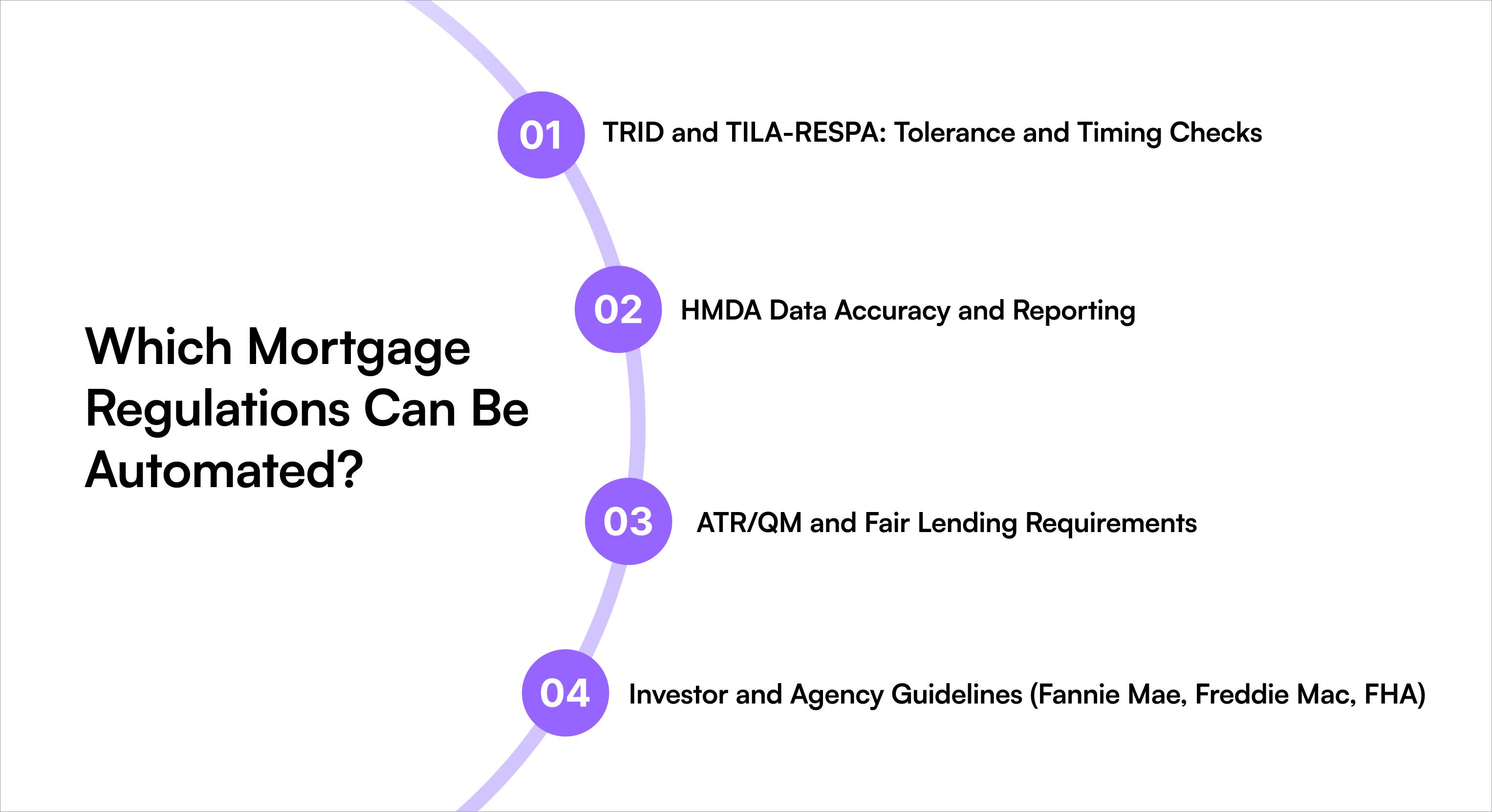
TRID and TILA-RESPA: Tolerance and Timing Checks
TRID compliance requires accurate Loan Estimates, Closing Disclosures, and disclosure timing.
Automation can compare disclosed costs, identify fee differences, verify applicable tolerance categories, and flag possible timing violations. It can also detect missing disclosures or incorrect document versions. Compliance engines must still account for valid tolerance resets, changed circumstances, and other regulatory exceptions.
HMDA Data Accuracy and Reporting
HMDA requires covered institutions to collect and report defined mortgage application and loan information.
Automation can extract relevant values, compare them against the loan origination system (LOS), and identify missing or conflicting reporting fields. These checks reduce transcription errors and help compliance teams investigate discrepancies before submitting Loan Application Register data.
ATR/QM and Fair Lending Requirements
Ability-to-Repay (ATR) and Qualified Mortgage (QM) requirements involve evaluating documented income, assets, debts, and other relevant loan information.
Automated checks can verify supporting documents, recalculate defined ratios, and flag incomplete information. Fair lending reviews can use automated data checks to identify reporting inconsistencies and support statistical monitoring. Potential discrimination findings still require appropriate analysis and human judgment.
Investor and Agency Guidelines (Fannie Mae, Freddie Mac, FHA)
Investor and agency requirements introduce additional documentation, underwriting, eligibility, and quality control checks. Automation can identify missing income evidence, inconsistent liabilities, incomplete appraisal records, and other loan-level exceptions.
Configurable rules help lenders assess loans against applicable program requirements, while qualified reviewers resolve findings that require interpretation. These controls also support more consistent documentation of investor eligibility decisions.
How Mortgage Compliance Automation Works Across the Loan Lifecycle
Mortgage compliance automation follows a connected workflow, from reading loan documents to reporting exceptions. Each stage prepares information for the next compliance check. This approach helps lenders identify errors early, maintain supporting evidence, and reduce repeated manual verification across loan operations.
Document Classification and Data Extraction
The process begins when the system receives a mortgage loan package.
Document intelligence identifies forms such as the
- Uniform Residential Loan Application
- Loan Estimate
- Closing Disclosure
- Paystubs
- Bank statements
It extracts relevant data, including borrower details, loan amounts, fees, and disclosure dates. The system also identifies document versions and missing records, preparing structured information for further checks.
Cross-Document Data Validation
Next, the system compares information across documents and connected sources.
For example, it checks whether the loan amount on the Closing Disclosure matches the LOS. It may also compare borrower income across paystubs, W-2 forms, and verification records. Conflicting values are flagged before they affect compliance decisions.
Rule Checks and Exception Flagging
Validated data moves into the compliance rules engine. The engine evaluates configured regulatory requirements, investor guidelines, and internal policies. Failed checks create exceptions with supporting information.
Lenders can assign exceptions based on severity, such as a missing signature, fee tolerance violation, or unsupported income figure. Authorized reviewers investigate and resolve these findings.
Audit Trails and Exam-Ready Evidence
Every compliance decision needs supporting evidence. Automation can retain source documents, extracted values, rule results, exception histories, and reviewer actions.
This record helps teams explain what was checked, which issues were identified, and how they were resolved. It also makes information easier to retrieve during investor reviews, regulatory examinations, and internal audits.
Where Automation Fits: Pre-Funding, Post-Closing, and Servicing QC
Mortgage compliance does not end when a loan closes. Different stages introduce different risks, from incorrect disclosures before funding to investor defects after closing and servicing errors later. Automation helps teams prepare accurate information, conduct reviews, and maintain records throughout the loan lifecycle.
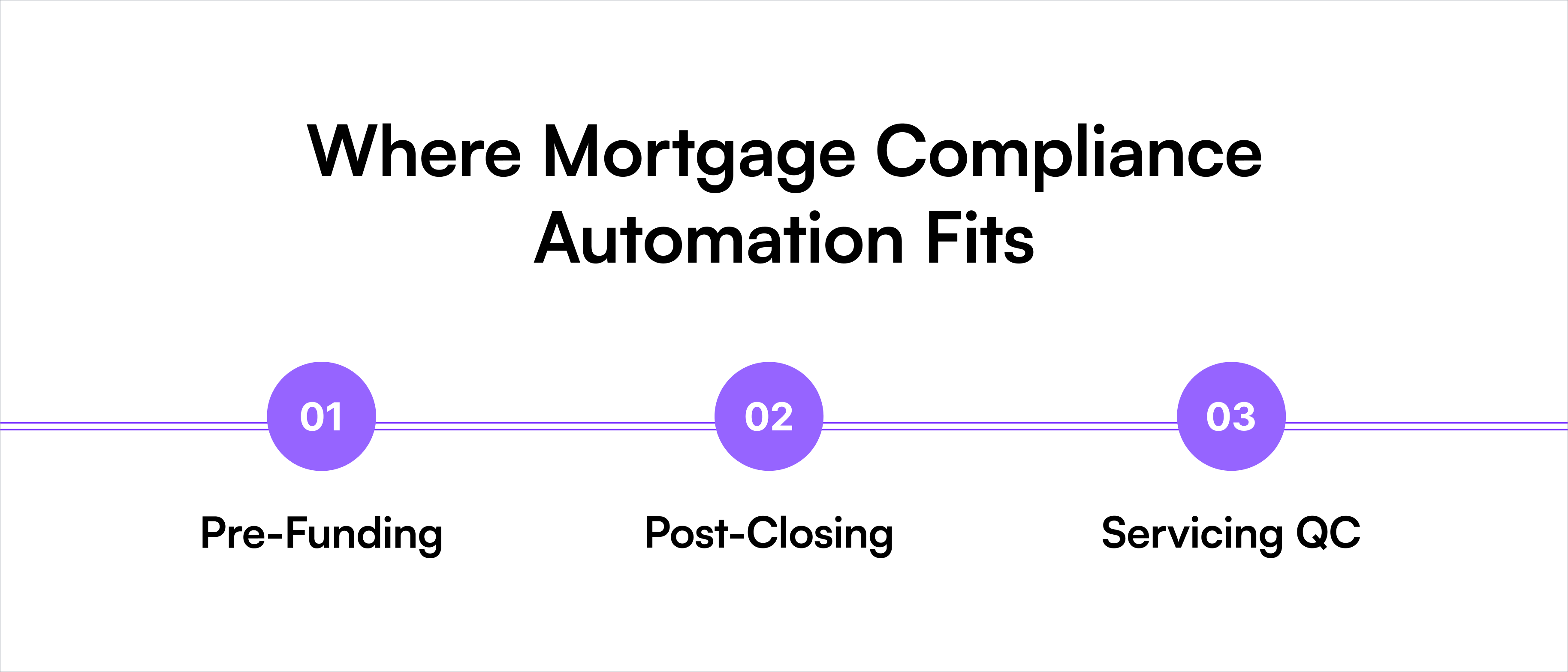
Pre-Funding
Pre-funding quality control identifies documentation gaps, data inconsistencies, and potential eligibility or compliance issues before the lender disburses funds. Reviewers check borrower information, supporting income documents, loan terms, disclosures, and applicable closing requirements.
Infrrd's MortgageCheckai helps prepare mortgage files for faster pre-funding reviews.
It classifies and stacks loan documents, extracts relevant information, identifies document versions, and supports comparisons between loan records and connected data sources.
This reduces the time auditors spend searching for documents and manually collecting information.
Post-Closing
Post-closing QC examines funded loans for underwriting, documentation, regulatory, and investor eligibility defects. Auditors review the completed loan package, compare financial information, investigate exceptions, and document findings. These reviews help lenders identify problems before investor examinations or repurchase requests.
Infrrd's proprietary AI agent, Mortgage Ally, is built to support post-closing QC through a 10-stage review workflow.
Its review coverage includes income, credit, assets, appraisal, loan terms, title, fraud, underwriting compliance, closing, and final quality control.
Ally uses organized loan information to perform calculations, compare supporting evidence, flag potential defects, and prepare findings for auditors. Instead of manually repeating every check, reviewers can focus on exceptions that require investigation or judgment.
The final audit decision remains with the lender's authorized QC professionals.
Servicing QC
Servicing quality control examines how loans are managed after closing. Reviews may cover payment histories, escrow accounts, insurance records, loan modifications, delinquency notices, and servicing documentation. These checks help servicers identify data errors, missing records, and potential compliance issues.
Infrrd's Mortgage Servicing IDP solution processes servicing documents, including mortgage statements, payment histories, modification agreements, default notices, and tax records.
It converts document information into structured data that servicing teams can use for reconciliation, reporting, and audit preparation. When connected to servicing and compliance systems, that information can support defined checks and faster exception reviews.
Infrrd's document processing capabilities support servicing QC, while the servicing platform and compliance teams remain responsible for executing regulatory controls and resolving findings.
Measurable Benefits of Automating Mortgage Compliance
The value of mortgage compliance automation goes beyond reducing manual reviews. It helps lenders detect defects earlier, control operational costs, accelerate loan processing, and reduce financial exposure. Here are five measurable areas where automation and digital mortgage technology can make a difference.
1. Improved Loan Quality
Identifying missing documents, inconsistent borrower information, and calculation errors before loans reach investors helps improve loan quality. Automated data validation allows lenders to catch potential defects earlier and focus manual reviews on exceptions. Freddie Mac research found that lenders with higher adoption of digital solutions experienced 40% fewer loan defects than those with lower adoption.
2. Reduced Loan Production Costs
Manual document reviews, repeated data entry, and error corrections increase mortgage origination costs. Automation reduces repetitive tasks and allows teams to process more loans without proportionally increasing staffing. Freddie Mac research found that lenders with greater digital adoption had $1,700 lower average origination costs per loan, approximately 14% less.
3. Faster Loan Processing
Compliance checks can delay loan processing when teams must manually locate documents, verify information, and resolve discrepancies. Automated document processing and validation help reduce these delays. FHFA cited Freddie Mac research indicating that digital mortgage technologies could shorten closing cycles by up to 18 days in certain workflows.
4. Lower Repurchase Risk
Loans with unsupported income, inaccurate asset information, or eligibility defects can lead to investor repurchase requests. Automated validation helps lenders identify discrepancies before loans reach investors. Fannie Mae reported 64% lower repurchase risk when lenders used all four Day 1 Certainty validation components.
5. Lower Digital Closing Costs
Paper-based closings require document handling, storage, shipping, and manual verification. Digital closing technologies, including eNotes, reduce these administrative costs while improving access to loan records. MISMO reported estimated savings of $200-300 per loan for organizations implementing eNotes.
Together, these benefits show how digital mortgage technology can improve operational efficiency and loan quality. However, lenders should measure mortgage compliance automation through specific outcomes such as defect detection rates, exception resolution time, audit costs, and compliance review accuracy.
How to Evaluate Mortgage Compliance Automation Software
A mortgage compliance automation solution must do more than extract information quickly. Lenders need evidence that it works on real loan files, integrates with existing systems, and supports defensible decisions. These four evaluation criteria help separate reliable production capabilities from vendor claims.
Accuracy on Real, Messy Loan Files
Test the solution using actual loan packages with scanned pages, handwritten entries, missing documents, and multiple versions.
Measure field-level accuracy, document-level accuracy, and how often files require manual intervention. Ask vendors to demonstrate how the system handles uncertain values. High extraction accuracy alone does not prove that compliance checks are accurate.
Integration with Your LOS and Compliance Engine
Compliance automation must exchange information with existing loan origination systems, document repositories, and compliance platforms.
Verify API support, data mapping, exception synchronization, and audit data availability. Ask vendors to demonstrate the complete workflow using your existing technology environment.
Explainability and Human-in-the-Loop Review
Every flagged exception should show the relevant document, extracted value, and rule result.
Reviewers must be able to investigate findings, correct errors, and record decisions. Test whether the system can explain why a check failed without requiring auditors to reconstruct the entire loan review.
Security, Data Privacy, and SOC 2
Mortgage files contain sensitive borrower and financial information.
Evaluate encryption, access controls, data retention policies, and third-party security assessments. Request the vendor's current SOC 2 report, verify its scope, and examine how borrower information is protected during processing.
Conclusion
Mortgage compliance errors can remain hidden until an investor review, regulatory examination, or repurchase request exposes them. By then, correcting the problem may already be expensive.
Mortgage compliance automation helps lenders identify issues earlier by combining accurate document processing, data validation, configurable rules, and human review.
The right solution should make compliance teams more effective without taking away their control over important decisions. For lenders evaluating automation, the priority is clear: choose technology that performs reliably on real mortgage files, supports existing compliance processes, and provides evidence behind every finding.
Catch the error while you can still correct it.
Frequently Asked Questions
Can AI replace mortgage compliance officers?
No. AI can automate document checks, data validation, and exception detection. Compliance officers remain responsible for interpreting regulations, investigating findings, and making final compliance decisions.
How is compliance automation different from LOS compliance checks?
LOS compliance checks typically validate structured loan data. Broader compliance automation also examines source documents, compares information across systems, and identifies discrepancies that structured data checks may miss.
How long does implementation take?
Implementation depends on document volume, integrations, rule configuration, and testing requirements. A limited pilot may take weeks, while enterprise deployment can require several months.