- Data entry automation involves using technology to replace manual data entry tasks, reducing errors and improving efficiency.
- Understanding how data entry automation actually functions under the hood helps teams make better decisions about where and how to deploy it.
- The shift toward data entry automation is no longer a matter of "if" but "when" for mortgage, insurance, and engineering leaders.
If your team works in mortgage processing, insurance underwriting, or engineering documentation, chances are a significant chunk of the workday disappears into repetitive data tasks.
Research shows the typical office worker spends 10% of their time on manual data entry into business applications like ERPs, CRMs, and spreadsheets, and this number becomes even more striking in context: the same workers spend over 50% of their total work time simply creating or updating documents such as PDFs, spreadsheets, and Word files. That's the majority of a workday consumed by tasks that add process, not value.
Data entry automation is changing that equation. In this guide, we'll break down how mortgage, insurance, and engineering teams are using automation to reclaim that time and what practical steps you can take to get started.
What is Data Entry Automation?
Data entry automation uses software to extract, digitize, and transfer information into databases without manual typing. By leveraging OCR and AI, it reduces human error, accelerates processing speeds, and streamlines repetitive administrative workflows for greater organizational efficiency.
At its core, data entry automation replaces manual data entry by using technology to read and process information from documents, emails, or forms. This data is then automatically entered into systems like ERPs, CRMs, or databases. Think of it as quietly handling the repetitive, copy-paste work in the background, so your team can focus on decisions that actually require human judgment.
How Automation Fits in Document-Heavy Workflows
In industries like mortgage, insurance, and engineering, large volumes of documents are simply part of the job. When that volume is managed manually, data entry quickly becomes a bottleneck, slowing down processing times and introducing errors that compound downstream. Automation addresses this directly by extracting relevant data from forms, contracts, and reports and routing it into the right systems automatically. The result is a faster, more reliable workflow that doesn't depend on human bandwidth to keep moving.

Why Data Entry Automation Matters in 2026?
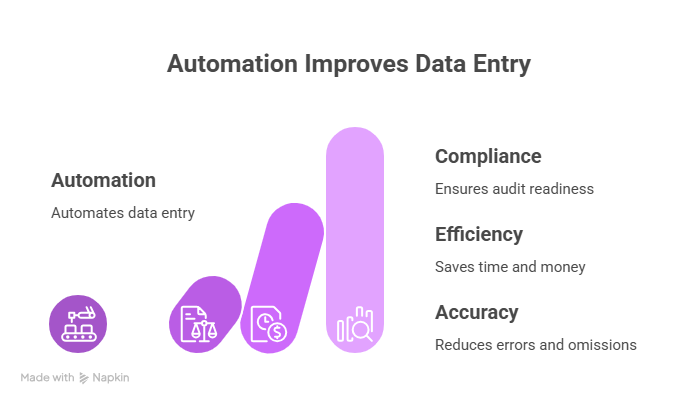
As document volumes grow and compliance requirements tighten, businesses that still rely on manual processes are feeling the pressure in lost time, rising costs, and avoidable errors. Here's why making the shift in 2026 is no longer optional for teams that want to stay competitive.
Time, Cost, and Accuracy Impacts
Manual data entry is slow, expensive, and error-prone, as the scale of the problem is bigger than most teams realize. Automating data entry directly addresses this by cutting processing time, lowering operational costs, and reducing the risk of mistakes that require expensive correction later. Businesses that make the shift find they're not just saving hours, they're freeing up people to contribute in ways that manual data tasks never allowed.
Compliance & Audit Readiness
For mortgage and insurance teams in particular, accuracy isn't just an efficiency concern; it's a regulatory one. Automation brings consistency to data entry that manual processes simply can't guarantee at scale. Beyond that, automated systems naturally generate a clear, timestamped audit trail, making it far easier to demonstrate compliance and surface the right documentation quickly when an audit arises.
Real-World Examples
Consider a large mortgage company handling thousands of loan applications each day. In the past, employees would manually input applicant information from paper documents into the system. With automation, the process becomes much faster. The software extracts key details like income, credit scores, and property information from scanned documents and automatically populates the system. This not only speeds up the process but also reduces the chances of human error.
How Data Entry Automation Works?
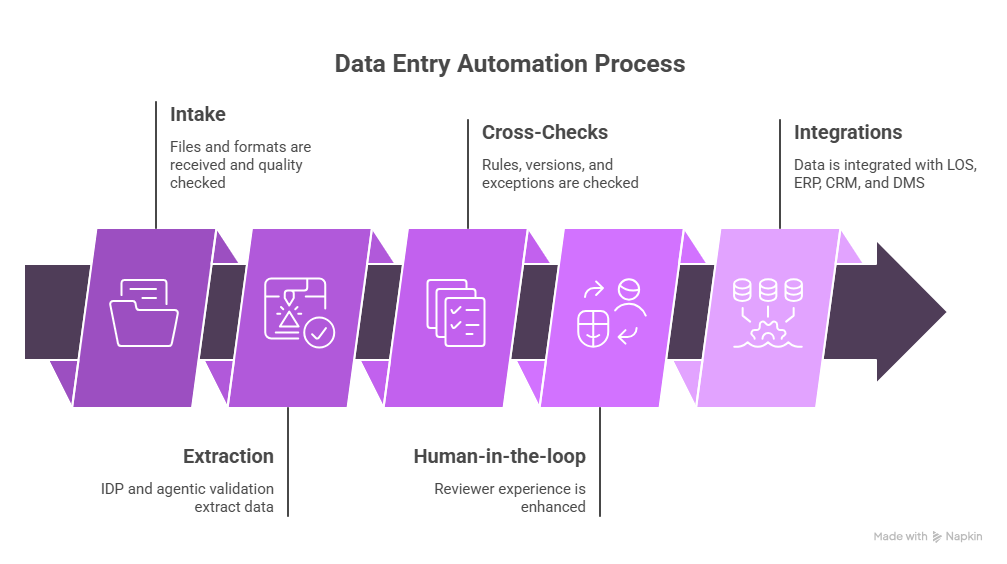
Understanding how data entry automation actually functions under the hood helps teams make better decisions about where and how to deploy it. While the specifics can vary by platform, most modern automation systems follow a consistent sequence, from the moment a document enters the pipeline to the point where clean, validated data lands in your business systems.
Intake: Files, Formats, and Quality Checks
The first step in data entry automation involves intake. Automation tools scan incoming documents, whether they are PDFs, images, or scanned forms. The system then performs quality checks to ensure the document is legible and formatted correctly, ensuring no data is lost during processing.
Extraction: IDP + Agentic Validation
Once a document clears intake, the extraction phase begins. This is where Intelligent Document Processing (IDP) does the heavy lifting, reading the document and pulling out relevant data points like names, dates, monetary figures, and reference numbers.
What makes modern systems more reliable than older rule-based tools is the addition of agentic AI, which doesn't just extract data but actively validates it. Before anything gets written to a system of record, the AI checks that the extracted values are internally consistent, correctly formatted, and within expected ranges.
Cross-Checks: Rules, Versions, Exceptions
After values are pulled, automation systems run them through a layer of cross-checks based on predefined business rules. These checks might verify that required fields aren't missing, that date formats are consistent, or that figures in one document align with related entries elsewhere. When the system detects a discrepancy, a mismatched value, an unexpected format, or a field that falls outside acceptable parameters, it flags the record for review rather than silently passing bad data downstream.
Human-in-the-loop: Reviewer Experience
While automation handles most of the work, some cases require human intervention. In situations where the system encounters an exception or a complex document, a human reviewer steps in to make the final call. This hybrid approach combines the efficiency of automation with the accuracy and judgment of human expertise.
Integrations: LOS/ERP/CRM/DMS
Data entry automation can integrate seamlessly with existing business systems, such as Loan Origination Systems (LOS), Enterprise Resource Planning (ERP) systems, Customer Relationship Management (CRM) platforms, or Document Management Systems (DMS). This allows data to flow smoothly between different parts of the business, further reducing manual tasks and potential errors.
Key Challenges
No automation system is without its friction points, especially when it's processing the kind of complex, varied documents common in mortgage, insurance, and engineering workflows. The good news is that most challenges are well understood and there are proven ways to address them.
Missing Pages & Version Drift
Incomplete documents are one of the more common headaches in automated pipelines. A missing page, an outdated form version, or a document that wasn't fully scanned can cause the system to extract incomplete data or fail to process the file altogether. The most effective defense is building version control and document validation into the intake stage, ensuring that files are checked for completeness before they enter the pipeline, rather than discovering gaps after extraction has already run.
Low-Quality Scans, Handwriting, Stamps
Not every document that enters a workflow is clean and digital. Faded scans, handwritten annotations, and overlapping stamps are regular occurrences in industries that still handle physical paperwork. Optical Character Recognition (OCR) technology has improved significantly in handling these scenarios, and modern IDP platforms go further by training models on domain-specific document types over time. The more the system is exposed to the variations in your document library, the better it gets at processing them accurately.
Multi-Doc Relationships & Data Mismatch
Some data entry tasks can't be completed by looking at a single document in isolation. A mortgage application, for example, may require pulling and reconciling data from a credit report, tax returns, and bank statements simultaneously. When figures don't align across these sources, it creates a data mismatch that needs to be caught before it causes downstream problems. Rule-based validation combined with AI-driven cross-document checks allows automation systems to flag these inconsistencies automatically, rather than leaving them for a reviewer to catch manually.
Scaling Without Scaling Headcount
One of the most compelling arguments for data entry automation is its ability to absorb volume growth without a corresponding increase in staffing. In document-heavy industries, workload can spike dramatically during high application seasons in mortgage, for instance, or following a surge in insurance claims. Automation scales to meet that demand without requiring businesses to hire, train, and manage additional staff. Teams stay lean, processing capacity expands as needed, and the cost per document processed stays predictable even as volumes climb.

ROI & Business Case
Investing in data entry automation is ultimately a business decision, and like any significant operational change, it requires a clear understanding of where the returns materialize and how to measure them. For organizations in mortgage, insurance, and engineering, the financial case is well-supported both in terms of direct cost reduction and the longer-term value of improved data quality.
Where Savings Show Up
The most immediate and measurable savings from data entry automation are found in labor efficiency. By reducing the volume of manual input required, organizations can process significantly more documents within the same timeframe and without expanding their workforce. This directly lowers the cost per transaction and allows existing staff to be redirected toward higher-value responsibilities that better utilize their expertise.
Beyond labor, the financial impact of error reduction should not be underestimated. Manual data entry is inherently susceptible to human error, and in regulated industries, even minor inaccuracies can escalate into compliance violations, rework cycles, or customer-facing mistakes that carry reputational and financial consequences. Automation mitigates this risk by applying consistent validation logic at every stage of the process, reducing the likelihood of errors reaching downstream systems in the first place.
Measuring Accuracy & Throughput
Quantifying the return on investment from automation requires tracking two core performance metrics: throughput and accuracy. Throughput measures the volume of documents the system can process within a given period, providing a clear indicator of operational capacity and efficiency gains over time. Accuracy measures the rate at which data is extracted and entered correctly, reflecting how effectively the system is reducing the error rates associated with manual processes.
Together, these metrics give organizations a reliable basis for calculating ROI. When throughput increases and error rates decline, the downstream effects are tangible: faster turnaround times, lower correction costs, and a more defensible compliance posture. Establishing baseline measurements before implementation and tracking performance consistently afterward ensures that the business case for automation remains grounded in evidence rather than estimation.
Infrrd’s Approach
Infrrd offers a compelling and practical solution. Built on an Intelligent Document Processing (IDP) platform powered by advanced AI and machine learning, Infrrd’s IDP doesn't just read documents; it understands them. Through smart classification, cross-document validation, and agentic AI that completes the majority of processing before a reviewer even logs in, the platform delivers clean, structured, and compliance-ready data with minimal human intervention.
It handles high volumes across a wide range of formats, from scanned images and PDFs to emails and complex forms, while continuously learning and improving with each document processed. With flexible deployment options across both cloud and on-site environments, Infrrd’s IDP integrates seamlessly into existing workflows, making it a scalable and reliable choice for enterprise teams that can no longer afford the cost of manual data handling.
Conclusion
The shift toward data entry automation is no longer a matter of "if" but "when" for mortgage, insurance, and engineering leaders. As we move through 2026, the cost of maintaining manual, document-heavy workflows measured in lost hours, human error, and compliance risks has become too high to ignore. By implementing Intelligent Document Processing (IDP) and agentic AI, your team can finally move past the friction of copy-paste tasks and focus on the high-value decision-making that actually drives growth. Transitioning to an automated pipeline doesn't just clear the bottleneck; it builds a scalable, audit-ready foundation that turns your data from an operational burden into a competitive advantage.
FAQs About Data Entry Automation
Q. What is data entry automation?
Data entry automation involves using technology to replace manual data entry tasks, reducing errors and improving efficiency.
Q. How can data entry automation improve business efficiency?
Automation saves time, reduces human errors, and ensures faster processing of documents, enabling businesses to scale without increasing headcount.
Q. What are the main challenges of implementing data entry automation?
Challenges include handling low-quality documents, version control, and managing complex document relationships. However, these can be solved with the right tools and processes.
Q. How does data entry automation work in the mortgage industry?
Automation in mortgage involves extracting data from loan applications, credit reports, and property documents and entering it into the system for review and approval.
Q. What are the benefits of automating data entry in insurance?
Automation streamlines policy issuance, claims processing, and underwriting by accurately extracting data from forms and documents, reducing errors and processing time.
Q. Can data entry automation be integrated with existing systems?
Yes, most data entry automation systems can integrate with existing business systems such as ERPs, CRMs, and DMS.
Q. What industries can benefit from data entry automation?
Industries like mortgage, insurance, healthcare, legal, and manufacturing can all benefit from data entry automation by improving efficiency and reducing costs.
Q. How does automation handle multi-document relationships?
Automation uses rule-based systems and AI to cross-reference data from multiple documents and ensure accuracy and consistency.
Q. What’s the ROI on automating data entry?
The ROI includes savings on labor costs, improved data accuracy, faster processing times, and the ability to handle larger volumes without increasing headcount.