- Banking document management centralizes records, strengthens access controls, and makes critical information easier to retrieve.
- AI and IDP automate document classification, data extraction, validation, and routing across complex banking workflows.
- Banks should prioritize security, compliance, integration, scalability, and traceability when choosing document management systems.
Banks process thousands of documents across every core banking function. Each customer relationship can generate identity records, applications, statements, tax forms, disclosures, approvals, correspondence, and audit evidence.
At industry scale, that information adds up quickly.
A 2025 Federal Register notice estimated that FDIC-supervised institutions would spend 442,621 burden hours per year filing quarterly Call Reports.
This makes banking document management more than a storage problem. Banks need to know what each document is, who can access it, how long it must be retained, which customer or account it belongs to, and whether its data matches information held in other systems.
Document management in banking brings those tasks into one controlled process. It helps banks capture documents, organize them, apply access and retention rules, retrieve records quickly, and connect document data with banking workflows.
What Is Document Management in Banking?
A document management system, or DMS, gives banks a controlled way to capture, organize, store, retrieve, track, and govern documents. Files can enter through uploads, email, scanners, mobile apps, portals, or connected systems. The DMS assigns metadata, permissions, retention rules, and links to the related customer, account, or case.
Its core functions are simple: capture the file, classify its type, store it with the right controls, and retrieve it when needed.
Types of Documents Banks Manage (Loans, KYC, Compliance, Statements)
Why Document Management Matters for Banks
Bank documents support lending, customer service, fraud review, regulatory reporting, and audits. If records are missing, duplicated, hard to find, or disconnected from core systems, staff spend more time locating evidence and less time making decisions.
Regulatory Compliance (AML, KYC, GDPR, Audit Trails)
Banks face strict recordkeeping duties. Under 31 CFR Chapter X, records required by the Bank Secrecy Act framework generally must be retained for five years. Banks must also keep a filed SAR and its supporting documentation for five years from the filing date.
Customer Identification Program rules can require identifying information to be retained for five years after an account closes, while other verification records are kept for five years after creation.
Banks subject to GDPR also need controls for data minimization, storage limits, confidentiality, and documented processing.
Operational Efficiency and Cost Reduction
Document work creates a large administrative load. U.S. consumers and businesses made 236.6 billion noncash payments in 2024, according to the Federal Reserve, more than three times the volume recorded in 2000
A DMS reduces avoidable work by centralizing files, controlling versions, applying indexing, and making records searchable. Automation can route documents and reduce repeated entry, search time, rework, and handling.
Customer Experience and Faster Onboarding
Customers feel document problems as repeated upload requests, slow verification, or requests for information they already supplied. Better document management helps banks retrieve files, verify fields, and move clean data into onboarding workflows faster.
J.D. Power's 2025 U.S. Direct Banking Satisfaction Study reported checking-account satisfaction of 692 out of 1,000 for direct banks, 24 points above regional banks and 35 points above national banks.
Key Challenges in Banking Document Management
Bank records arrive from branches, portals, email, third parties, customers, internal teams, and older archives. The challenge is keeping those files usable, secure, connected, and searchable as systems and volumes grow.
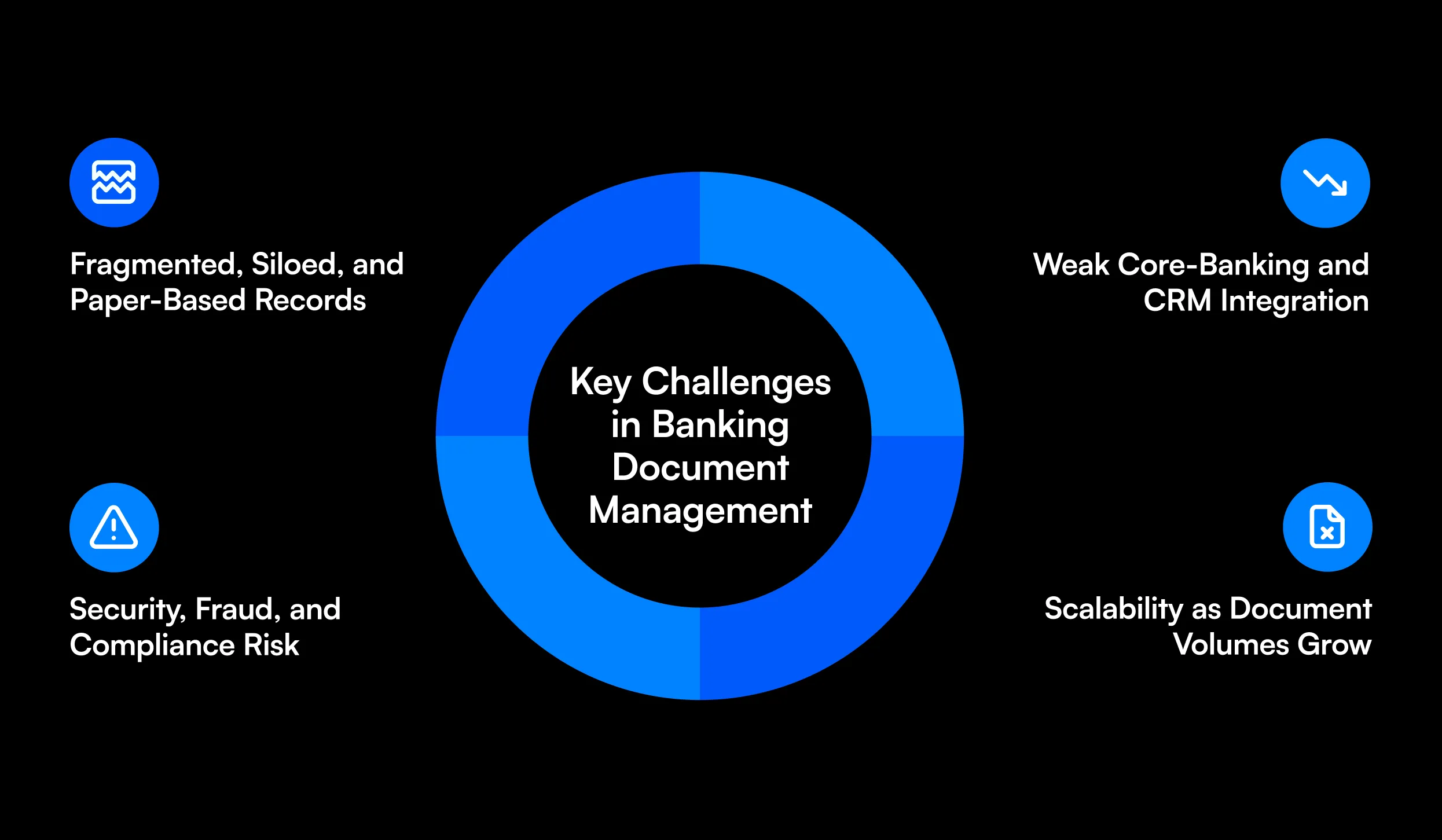
Fragmented, Siloed, and Paper-Based Records
Documents may sit across shared drives, branch systems, inboxes, imaging platforms, physical archives, and employee folders. That fragmentation creates duplicate records, inconsistent versions, and slower retrieval. Paper also adds scanning, transport, storage, and indexing work.
Weak Core-Banking and CRM Integration
A DMS has limited value if staff still copy document data into core banking, CRM, KYC, or loan systems by hand. Weak integration creates duplicate entry, mismatched records, and delays between document receipt and downstream action.
Security, Fraud, and Compliance Risk
Bank documents contain identity data, financial information, signatures, account details, and compliance evidence. Poor access controls can expose sensitive records. Weak version history can make it harder to prove which document supported a decision and who reviewed it.
Scalability as Document Volumes Grow
Growing account, loan, payment, and compliance activity increases document volume. Systems that depend on manual naming, folder selection, and field entry usually add labor as volume rises. Banks need workflows that classify, index, retain, and route larger file sets efficiently.
How AI and Intelligent Document Processing Are Changing Banking Document Management
Traditional DMS platforms focus on storage and retrieval. AI and Intelligent Document Processing, or IDP, add a layer that reads documents, extracts data, validates information, and sends results into banking workflows.
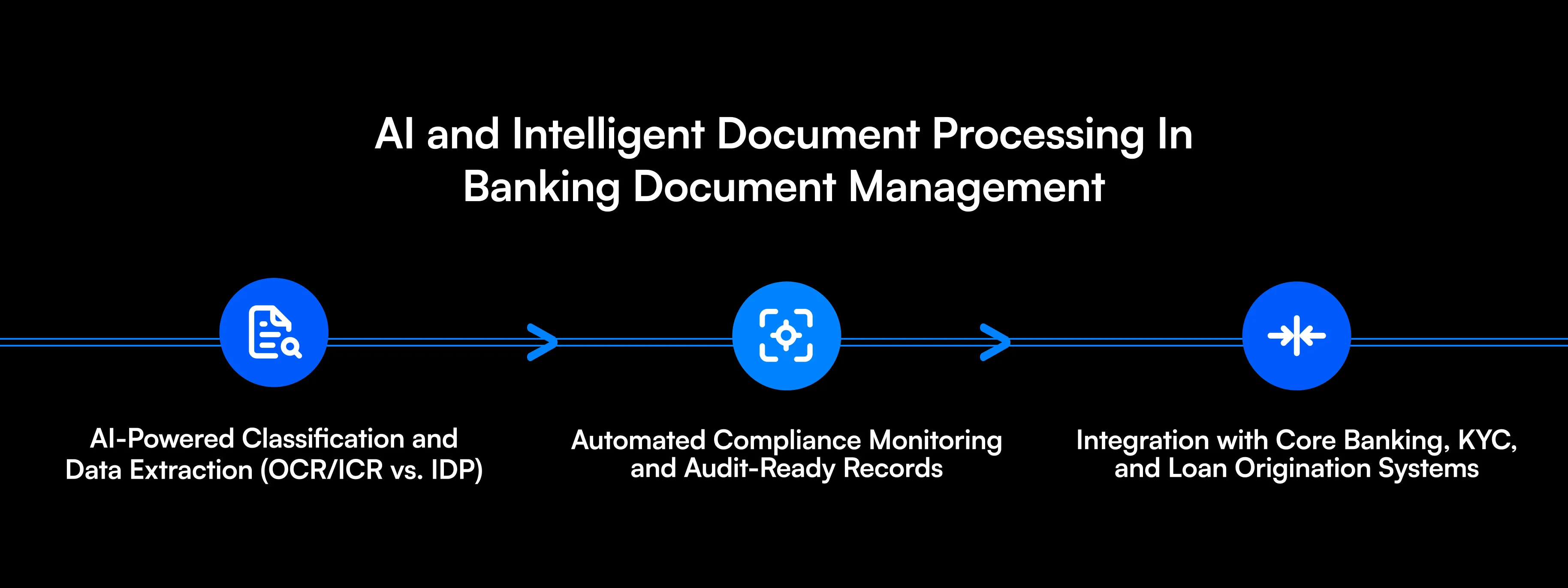
AI-Powered Classification and Data Extraction (OCR/ICR vs. IDP)
OCR or Optical Character Recognition can look like the cheapest starting point because it converts printed or typed text into machine-readable text. But it does not tell the bank what a document means, which fields matter, whether values are correct, or where the data should go.
ICR or Intelligent Character Recognition extends recognition to handwriting and less predictable text. IDP adds classification, field extraction, contextual interpretation, validation, business rules, review, and system integration.
Infrrd's financial document processing approach combines OCR with AI-based classification, extraction, validation, and integration. Its IDP also supports multi-format extraction and audit-focused processing.
OCR can return text. IDP can classify a statement, extract balances, validate fields, flag uncertain data, preserve review evidence, and pass approved values onward.
Automated Compliance Monitoring and Audit-Ready Records
AI-based workflows can check required files, compare values across records, flag missing signatures or dates, and apply review rules. The system can preserve the source, extracted field, confidence result, reviewer action, and final decision as linked evidence.
That structure helps audit and compliance teams trace findings to their source. Human review still matters for exceptions, policy judgments, and suspicious activity.
Integration with Core Banking, KYC, and Loan Origination Systems
APIs and workflow connectors can send verified data into core banking platforms, move KYC results into compliance tools, and pass loan data into origination systems.
Strong integration removes rekeying and should support status tracking, access controls, error handling, and a clear record of data exchanged between systems.
How to Choose a Document Management Solution for Your Bank
The right system depends on data sensitivity, regulation, architecture, volume, integration needs, and IT capacity. Banks should evaluate deployment, security, automation, governance, and integration together.
On-Premise, Cloud, and Hybrid Deployment Models
Must-Have Features Checklist (Security, AI, Integration, Compliance)
- Role-based access, encryption, authentication, and activity logs
- AI classification, extraction, validation, confidence scoring, and exception review
- Connectors for core banking, CRM, KYC, LOS, and reporting systems
- Retention policies, legal holds, version control, audit history, and searchable metadata
- High-volume processing, monitoring, backup, recovery, and service levels
Common Mistakes to Avoid When Evaluating Vendors
Do not test only clean samples. Use real scans, handwriting, tables, missing pages, varied layouts, and low-quality files. Test integration and governance before comparing extraction scores.
Ask vendors:
- How is field-level accuracy measured on our documents?
- What happens when confidence is low?
- Can reviewers trace extracted values back to the source?
- How does the platform handle document variation?
- Which banking, CRM, KYC, and loan systems can it connect to?
- Where is data stored, encrypted, backed up, and processed?
- How are retention, deletion, access, and audit policies configured?
- How does pricing change as document volume grows?
Conclusion
Document management in banking has moved far beyond digital storage. Banks need systems that can capture documents, organize records, protect sensitive data, support compliance, and connect information with core banking workflows. As document volumes grow, manual processes create delays, errors, and unnecessary review work. AI and Intelligent Document Processing can help banks classify files, extract data, validate information, and prepare records for faster decisions and audits. The right solution should fit the bank’s security model, integration needs, regulatory duties, and scale. A strong document strategy gives teams faster access to reliable information while keeping every record traceable, controlled, and accessible.
Frequently Asked Questions
What is a document management system (DMS) in banking?
A banking DMS securely captures, classifies, stores, retrieves, tracks, and governs documents while linking them with customers, accounts, permissions, retention rules, workflows, and audit records.
What documents does a bank need to manage digitally?
Banks commonly manage KYC records, loan files, account applications, statements, transaction records, tax documents, disclosures, compliance evidence, SAR support, correspondence, approvals, and service records digitally.
How does AI improve document management in banking?
AI classifies incoming files, extracts important fields, validates data, identifies missing information, routes exceptions, supports search, and sends approved information directly into connected banking systems.
Is cloud-based document management secure for banks?
It can be if the service meets the bank's requirements for encryption, identity, access, data residency, monitoring, backup, incident response, compliance, governance, and third-party risk.
How long should banks retain documents?
Retention depends on the record and applicable rule. Many BSA records require five years, while customer identification, lending, tax, privacy, and state rules may differ.
What is the difference between a DMS and IDP?
A DMS mainly stores, organizes, retrieves, and governs files. IDP reads document content, extracts structured data, validates values, handles exceptions, and feeds information into workflows.
Can document management integrate with core banking systems?
Yes. A capable platform can use APIs or connectors to exchange documents, metadata, validated fields, workflow status, and review results with core banking and related systems.