- Faster Underwriting: IDP automates document classification, data extraction, and validation, reducing manual work and accelerating mortgage underwriting workflows.
- Better Loan Quality: Cross-document validation identifies discrepancies, reduces rework, and helps underwriters maintain accurate, audit-ready mortgage records throughout processing.
- Beyond Data Extraction: Agentic AI extends mortgage automation into post-close QC, handling repetitive checks while auditors retain final control.
Every mortgage approval depends on one thing: whether the lender can trust the information behind the loan.
According to Fannie Mae's June 2025 Loan Quality Report, lenders that validate income, employment, assets, and collateral through all four components of Day 1 Certainty reduce their repurchase risk by 64%.
This shows how accurate document validation directly affects loan quality. Yet mortgage underwriters still spend hours reviewing income statements, comparing financial records, checking for missing documents, and verifying borrower information across multiple systems.
Intelligent document processing (IDP) for mortgage underwriting reduces this manual workload by automatically classifying documents, extracting mortgage data, validating information across loan files, and flagging discrepancies.
This guide explains how mortgage lenders can evaluate IDP solution for underwriting, where it delivers the greatest value, and how to measure its impact on underwriting performance, with a special mention to what to expect beyond IDP for mortgage underwriting in 2026.
What Is Intelligent Document Processing in Mortgage Underwriting?
Intelligent document processing (IDP) for mortgage underwriting uses AI, machine learning, and document recognition to classify loan documents, extract borrower information, and validate financial data. It converts scanned and digital mortgage files into structured information that underwriters can review, verify, and use within their existing underwriting systems.
Why Manual Document Review Slows Mortgage Underwriting
Mortgage underwriters must confirm that every loan meets the lender's credit, income, asset, and collateral requirements. However, much of their time goes toward preparing and checking information rather than evaluating borrower risk.
The Document Burden in a Typical Loan File
A mortgage loan file contains pay stubs, W-2 forms, tax returns, bank statements, credit reports, appraisal documents, and employment records. These documents arrive in different formats, often across multiple submissions. A borrower may submit updated statements, scanned copies, or additional income records during underwriting.
Without automated document processing, underwriters must identify each document, locate required information, compare versions, and manually enter data into the loan origination system.
The Cost of Errors, Re-Requests, and Rework
A missing bank statement, incorrect income figure, or inconsistent borrower name can delay underwriting. When discrepancies appear, underwriters must revisit documents, contact processors, request supporting evidence, and repeat earlier checks.
Corrections add processing time and create more opportunities for loan defects. Unresolved errors can also affect investor eligibility, quality control findings, and repurchase exposure.
Where IDP Fits Alongside DU, LPA, and Your LOS
Intelligent document processing works alongside a lender's existing loan origination system (LOS) and automated underwriting system (AUS). It does not replace either.
The LOS, such as Encompass, Byte, or Blend, manages borrower applications, loan data, workflow stages, and underwriting conditions. Automated underwriting systems such as Fannie Mae's Desktop Underwriter (DU) and Freddie Mac's Loan Product Advisor (LPA) evaluate loan applications against applicable eligibility and credit requirements.
IDP supports both systems by preparing the document data needed for underwriting.
For example, a borrower uploads pay stubs, W-2 forms, and bank statements. The IDP platform identifies each document, extracts income and asset information, checks for inconsistencies, and sends validated data to the LOS through configured integrations.
The lender can then use this information to prepare or update an AUS submission. DU or LPA returns its underwriting findings, while the LOS continues managing conditions and loan status. IDP can also compare extracted document values against existing LOS fields to identify mismatches before submission. This creates a connected mortgage workflow where document preparation, data verification, and underwriting decisions operate together.
Underwriters still review exceptions, apply lending policies, evaluate risk, and make decisions that require professional judgment.
How IDP Works in the Underwriting Workflow
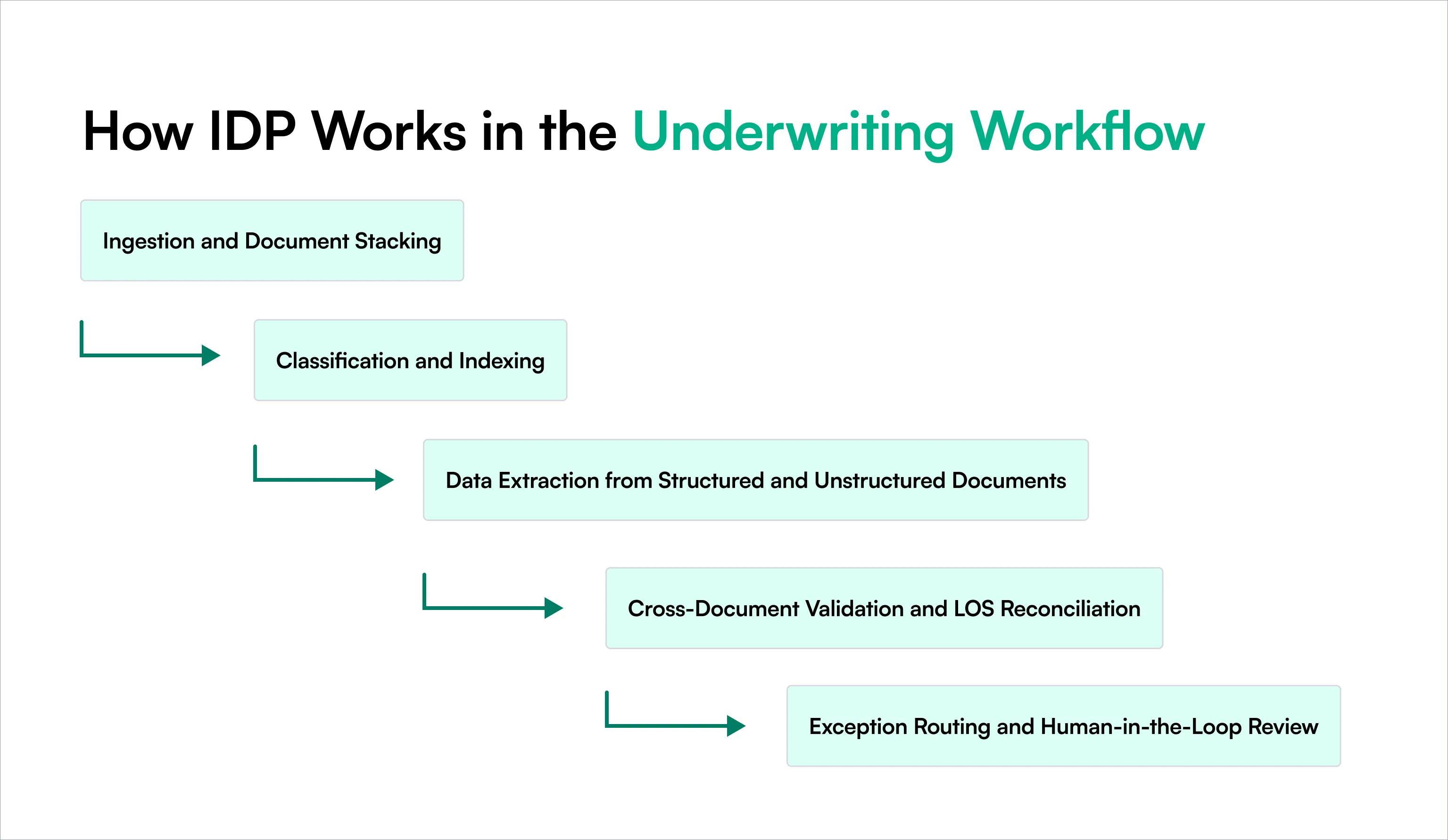
Mortgage IDP follows a series of connected steps that turn unorganized loan packages into verified, structured information. Each stage removes a specific manual task, helping underwriters access the documents and data they need without repeatedly searching through loan files.
Ingestion and Document Stacking
IDP receives mortgage documents from borrower portals, email, document repositories, or the LOS. The system splits combined PDFs, identifies document boundaries, and organizes files into a predefined stacking order. It can also preserve document versions for subsequent review.
Classification and Indexing
AI models identify document types, including W-2s, tax returns, bank statements, and appraisal reports. Each document receives a label and index so underwriters can locate supporting evidence without manually reviewing every page.
Data Extraction from Structured and Unstructured Documents
IDP extracts borrower names, income figures, account balances, property values, employment details, and other underwriting fields. It processes structured forms and less predictable documents, including scanned records, complex tables, and handwritten content where supported.
Cross-Document Validation and LOS Reconciliation
Extracted information is compared across related documents and existing LOS records. For example, IDP can flag differences between income reported on a loan application and amounts shown in supporting financial documents.
Exception Routing and Human-in-the-Loop Review
When information is missing, inconsistent, or below a confidence threshold, IDP routes the affected field or document for manual review. Underwriters or designated reviewers inspect the source, correct errors, and approve the information before it enters subsequent workflows.
High-Impact Underwriting Use Cases for IDP
Intelligent document processing supports underwriting tasks that require repeated data extraction, comparison, and verification. The greatest value comes from workflows involving multiple documents, frequent discrepancies, and high manual review effort. The following use cases show where lenders can apply IDP during mortgage underwriting.
IDP identifies and prepares evidence for these checks. Final income calculations, condition acceptance, fraud determinations, and underwriting decisions remain subject to lender rules and human approval.
Benefits of IDP for Underwriters and Lenders
Implementing IDP for mortgage underwriting can improve processing speed, document accuracy, and quality control. The business value comes from reducing repeated manual work while giving underwriters more reliable information, fewer unresolved discrepancies, and a clearer record of every verification step.

Faster Turn Times and Higher Underwriter Capacity
Freddie Mac's 2025 Cost to Originate Study found that lenders optimizing their digital underwriting capabilities shortened mortgage production timelines by five days.
IDP contributes to this efficiency by automating document preparation, data extraction, and validation. Underwriters can process more loan files without spending the same amount of time reviewing individual documents.
Fewer Defects and Better Loan Quality
The same Freddie Mac study reported 40% fewer loan defects among lenders extensively using its digital capabilities compared with lenders with low usage.
These figures reflect how IDP supports loan quality by identifying missing records, conflicting values, and extraction errors before they affect downstream decisions.
Audit Trails and Regulatory Compliance
Mortgage underwriters must demonstrate that loan decisions rely on accurate documentation and applicable lending requirements. IDP supports this process by maintaining records of extracted values, source documents, validation results, reviewer corrections, and approval history.
For example, if an auditor questions a borrower's qualifying income, the lender can trace the reported figure to its supporting documents and review the changes made during processing. These records support internal quality control, investor reviews, and regulatory examinations. They also help lenders identify recurring errors and improve underwriting controls.
How to Evaluate an IDP Platform for Mortgage Underwriting
Choosing an IDP platform requires more than comparing extraction speed and accuracy claims. Mortgage lenders should evaluate how the platform handles real loan packages, connects with existing systems, supports complex borrower scenarios, and gives underwriters control over exceptions and final decisions.
Document Coverage and Accuracy Benchmarks
Evaluate the platform using actual mortgage loan packages, including scanned documents, handwritten records, complex income files, and combined PDFs. Measure field-level accuracy, document classification accuracy, exception rates, and manual correction time. Test results should reflect the lender's document mix.
LOS and AUS Integration
Check whether the platform supports integration with Encompass, Byte, Blend, DU, LPA, and related mortgage systems through compatible APIs or connectors. Verify data mapping, synchronization, exception handling, and workflow compatibility before deployment.
Security, Explainability, and Underwriter Control
Look for encryption, role-based access, audit logging, document retention controls, and clear data handling policies. Underwriters should be able to trace extracted values to their original documents, review flagged discrepancies, and approve corrections before information enters critical lending workflows.
From IDP to Agentic AI in Mortgage Underwriting
For years, the primary goal of mortgage document automation was straightforward: extract accurate information and transfer it into the LOS.
But what happens after the data arrives?
Underwriters still need to calculate qualifying income, reconcile liabilities, verify assets, review loan conditions, and compare information against underwriting guidelines.
During post-close quality control, the workload continues. Auditors may switch between multiple documents, spreadsheets, and system tabs just to verify a single income calculation. They must repeat similar checks across credit, assets, property, closing disclosures, and investor requirements. Accurate extraction solves the data problem. It does not complete the review.
Infrrd addresses this gap by combining MortgageCheckai with Ally.
MortgageCheckai classifies, organizes, extracts, and validates mortgage data. Ally adds an agentic AI layer that performs repeatable checks across the 10 stages of post-close QC, including income, credit, assets, appraisal, loan terms, title, fraud, underwriting compliance, closing, and final quality control.
Ally is designed to handle up to 80% of repetitive audit work, preparing calculations, flagging discrepancies, and linking findings to supporting evidence. Auditors review exceptions, investigate material findings, and retain final approval authority.
Conclusion
Intelligent document processing for mortgage underwriting works best when it becomes part of the lender's existing workflow rather than another standalone system.
The goal is to give underwriters accurate, verified, and accessible loan information without repeated document searches, manual data entry, or unnecessary rework.
Lenders can start with document-heavy underwriting tasks, establish clear accuracy benchmarks, and connect IDP with their LOS and underwriting systems.
As automation advances, agentic AI can extend these benefits beyond extraction into mortgage review and quality control.
The result is a faster, more consistent underwriting process where technology handles repetitive work and lending professionals retain control over decisions.
Frequently Asked Questions
How does IDP improve mortgage underwriting?
IDP automates mortgage document classification, data extraction, and validation, helping underwriters reduce manual work, identify discrepancies, and review loan files faster.
Is IDP the same as an automated underwriting system?
No. IDP prepares and validates mortgage document data, while automated underwriting systems evaluate borrower eligibility and credit risk against lending guidelines.
How accurate is IDP on mortgage documents?
Accuracy varies by document type, scan quality, field, and model. Lenders should evaluate field-level accuracy using representative mortgage files before deployment.
Can IDP handle handwritten or scanned documents?
Yes. Advanced IDP platforms can process scanned and handwritten mortgage documents, although extraction accuracy depends on image quality, handwriting clarity, and model capabilities.