- Commercial real estate data extraction is the process of pulling structured information from property documents and organizing it.
- Commercial real estate industry is investing in data infrastructure because manual extraction cannot scale with transaction volume.
- Commercial real estate data extraction is one of the most document-intensive challenges in enterprise operations.
Commercial real estate relies on documents such as lease agreements, rent rolls, property appraisals, environmental reports, and title deeds. These documents contain critical data that supports investment decisions, compliance reporting, and asset management.
However, much of this data is still extracted manually. Commercial real estate data extraction refers to identifying, capturing, and structuring this information so it can be used in downstream systems and workflows.
When the process works well, it runs in the background without disruption. When it fails, deals slow down, errors increase, and teams spend time on manual tasks that do not add strategic value.
Commercial real estate data extraction is the process of pulling structured information from property documents and organizing it for use in downstream systems. This includes fields like tenant names, lease terms, square footage, rental rates, escalation clauses, and expiration dates. The source documents are rarely clean or consistent; they range from scanned PDFs and handwritten notes to legacy spreadsheets, email attachments, and multi-page contracts built to no standard format.
That variability is the core challenge. Lease agreements do not follow a standard layout, and property reports present information in different formats and structures.
As a result, what seems like a simple extraction task becomes complex. Each document requires a different approach, and errors in extraction can lead to real financial and legal risks.
Why Commercial Real Estate Data Extraction Matters
Every real estate decision runs on data. Acquisitions teams rely on accurate rent rolls to evaluate deals. Asset managers track lease expiration schedules to protect portfolio income. Compliance teams depend on precise legal descriptions and regulatory filings to avoid penalties. The data needs to be current, clean, and in the right system before any of that work can happen reliably.
When extraction breaks down, the effects are immediate and specific. A missed lease renewal costs negotiating leverage. An incorrect valuation distorts an acquisition model. A regulatory filing built on outdated figures creates compliance exposure. These are not edge cases that only hit poorly run firms. They are routine risks for any team that still processes property documents by hand.
The real estate software market reflects just how urgent this problem has become. The market was valued at $12.79 billion in 2025 and is projected to reach $31.96 billion by 2033, growing at a CAGR of approximately 12.2%. That growth is being driven directly by the need for automation, structured data extraction, and digital workflows, not just portfolio management tools.
The industry is investing in data infrastructure because manual extraction cannot scale with transaction volume.
What Types of Documents Require Data Extraction in Commercial Real Estate?
Commercial real estate teams work across a wide variety of document types. Each presents its own extraction challenges.
Each of these document types arrives in a different format, from a different counterparty, with a different internal structure. Building a reliable extraction workflow that handles all of them consistently is the core operational challenge.
How Commercial Real Estate Data Extraction Works
Understanding the extraction workflow helps teams identify where breakdowns happen and where automation can deliver the most value.
Step 1: Document Ingestion
The process begins as documents stream in from fragmented sources, including email attachments, secure deal portals, and scanned physical mail. A robust ingestion layer acts as a centralized clearinghouse, digitizing and indexing these files immediately upon arrival. By implementing a structured intake pipeline, firms prevent the common pitfalls of document loss, duplicate entries, or the processing of outdated file versions.
Step 2: Document Classification
Before the data can be analyzed, the system must recognize the document's DNA, as a lease agreement requires vastly different extraction logic than a title policy or an appraisal. Advanced classification models categorize each file to ensure the appropriate metadata schema and processing rules are applied. This categorical sorting prevents logic errors and ensures that complex legal documents are routed to the correct AI specialized for that format.
Step 3: Data Extraction
This core phase utilizes extraction engines, often a hybrid of OCR, rule-based logic, and Large Language Models, to identify and isolate specific data points. While structured forms might rely on fixed templates, complex commercial contracts require NLP to interpret variable clause positioning and nuanced legal terminology. These AI models "read" the context of the text, successfully pulling critical dates, financial obligations, and termination rights from non-standard layouts.
Step 4: Validation and Review
Reliability is established by checking extracted outputs against predefined formats and cross-referencing them with existing property records. If the system’s confidence score falls below a certain threshold, the data is flagged for human-in-the-loop (HITL) verification to ensure precision. This rigorous quality control layer acts as a critical filter, preventing the propagation of upstream errors and ensuring that downstream systems are not compromised by low-fidelity or misclassified information.
Step 5: Data Delivery
In the final stage, the validated data is seamlessly integrated into downstream ecosystems, such as lease management platforms, ERP systems, or sophisticated financial models. This delivery typically occurs via structured JSON, CSV files, or direct API pushes, ensuring the information is formatted for immediate consumption. By automating this handoff, teams eliminate manual data entry, significantly reducing the "time-to-insight" for critical investment and management decisions.
Key Challenges in Commercial Real Estate Data Extraction
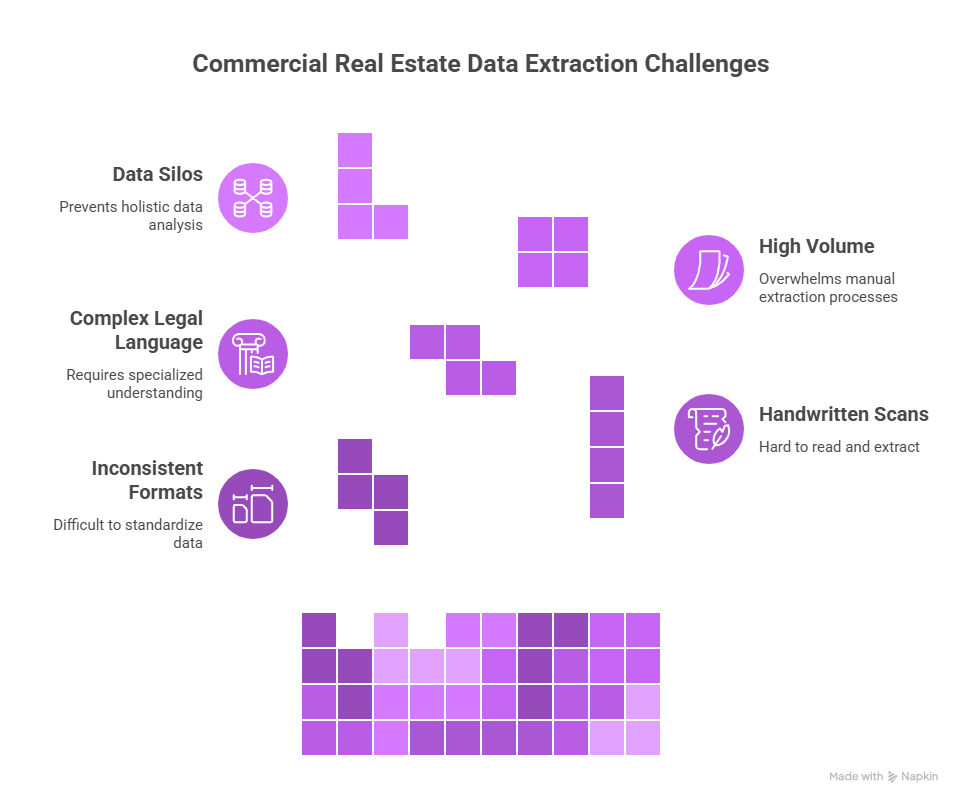
The documents that matter most in commercial real estate are often the hardest to process. Here is where most extraction workflows break down.
Inconsistent Document Formats
There is no industry standard for lease formatting. A lease from a national developer looks nothing like one from a regional landlord. Clause order changes. Field names vary. Key terms are buried in paragraph text rather than labeled fields. Extraction systems that rely on fixed templates fail as soon as they encounter a document that does not match the expected layout.
Handwritten and Low-Quality Scans
Older property records, annotated documents, and correspondence frequently arrive as low-resolution scans or include handwritten amendments. Standard OCR tools struggle with these inputs. The result is garbled text, missed fields, and extraction results that require more manual correction than a fully manual process would have.
Complex Legal Language
Lease agreements are dense legal documents. A single clause may contain multiple conditions, exceptions, and cross-references that all affect how a data field should be interpreted. Simple keyword extraction misses this nuance entirely. Understanding what a clause actually means, not just what words appear, requires more sophisticated extraction logic.
High Volume During Due Diligence
Portfolio acquisitions and large transactions compress extraction timelines dramatically. Due diligence windows routinely require teams to process hundreds or thousands of documents in days, not weeks. Manual workflows collapse under this pressure. Data quality degrades when reviewers are working under time constraints at high volume.
Data Silos Across Systems
Extracted data often needs to land in multiple systems simultaneously: a lease management platform, a financial model, and a compliance database. Without structured extraction outputs and clean system integrations, teams end up re-entering the same data in multiple places, reintroducing the manual errors they were trying to eliminate.
Why Teams Still Rely on Manual Extraction For Commercial Real Estate?
Manual extraction persists in commercial real estate for understandable reasons. Legal teams are cautious about automation handling documents with contractual implications. Many firms have invested heavily in analyst workflows that are difficult to change. And early-generation extraction tools did not perform well enough on complex documents to justify the transition costs.
The hesitation is not irrational. It is a reasonable response to tools that were not good enough. But the capabilities have shifted. Modern AI-powered extraction handles complex legal language, adapts to variable document layouts, and flags uncertainty rather than guessing. The risk profile has changed even if the perception has not.
How AI-Powered Data Extraction In Commercial Real Estate Is Changing the Equation?
The move toward AI-powered extraction in commercial real estate is not a future trend. It is already happening. Surveys indicate that approximately 65% of respondents were using generative AI in at least one business function in 2026. Real estate document workflows are a natural fit for this shift, given the document intensity of the industry.
The performance data support the transition. Case studies report up to 50% faster processing when AI-powered extraction replaces manual review workflows. For teams handling due diligence on large acquisitions or managing lease portfolios with hundreds of active agreements, that speed difference translates directly into capacity and cost.
Think of it this way: if your analysts are spending half their time pulling data from documents, AI extraction does not just make them faster. It frees them to do the work that actually requires judgment.
Benefits of Automated Commercial Real Estate Data Extraction
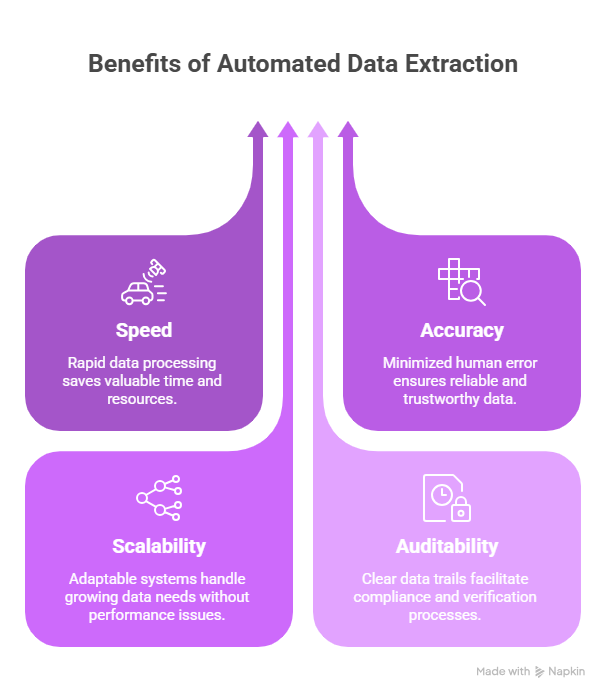
Teams that implement structured, AI-powered extraction workflows see consistent improvements across three dimensions.
Speed
Automated workflows accelerate the transition from raw documentation to actionable intelligence, compressing tasks that once required hours into mere minutes. This rapid turnaround significantly shrinks due diligence timelines, allowing investment committees to make data-backed decisions faster. By delivering comprehensive lease abstracts on the same day documents are received, firms eliminate the typical week-long processing lag, creating a distinct competitive advantage in high-velocity markets.
Accuracy
AI-powered models maintain a high level of precision by applying standardized extraction logic consistently across thousands of pages, effectively removing the fatigue-related errors common in manual data entry. These systems utilize integrated validation rules to identify and flag anomalies or outliers before they can migrate into downstream financial systems. Consequently, firms achieve a higher degree of data integrity, ensuring that critical investment valuations are based on flawless information.
Scalability
Unlike manual processes, where output is strictly limited by headcount and work hours, automated extraction decouples operational capacity from staffing costs. The system can effortlessly absorb sudden spikes in transaction volume or the onboarding of massive new portfolios without requiring proportional hiring or overtime. This elasticity allows commercial real estate firms to scale their assets under management aggressively while maintaining a lean, high-efficiency back-office infrastructure.
Auditability
Automated extraction generates a robust, digital paper trail that links every data point back to its specific source document and timestamp. This granular level of transparency simplifies compliance reporting and strengthens internal governance by providing an indisputable record of the data’s provenance. In the event of a regulatory audit or internal review, teams can instantly verify the "who, what, and when" of their data, replacing informal manual notes with institutional-grade accountability.
How Infrrd Helps With Commercial Real Estate Data Extraction?
Infrrd is an Intelligent Document Processing (IDP) platform built to handle the document complexity that commercial real estate teams deal with daily.
Handling Variable Document Layouts
Infrrd's AI models are trained to extract data from documents that do not follow fixed templates. Rather than relying on positional rules that break when a field moves, Infrrd understands document context, identifying relevant information based on meaning, not just location. Lease agreements from different counterparties are processed with the same reliability regardless of their formatting.
High-Accuracy Extraction
Infrrd applies a combination of OCR, natural language processing, and domain-trained models to extract accurate data from complex legal language. For commercial real estate documents, where a single clause can affect multiple downstream fields, this contextual understanding is critical.
Human-in-the-Loop Validation
Not every extraction decision should be fully automated. Infrrd flags low-confidence extractions for human review, ensuring that edge cases and ambiguous clauses get the attention they need without slowing down the processing of straightforward documents. The result is accuracy without sacrificing speed on the volume that does not require manual attention.
System Integration
Extracted data needs to land in the right systems immediately. Infrrd integrates with lease management platforms, ERP systems, and custom data environments through standard API connections. Data does not stop at extraction. It flows into the systems where decisions are actually made.
Summary
Commercial real estate data extraction is one of the most document-intensive challenges in enterprise operations. The documents are complex, the volume is high, the stakes are significant, and the tolerance for error is low.
Manual extraction cannot sustainably meet those requirements at scale. AI-powered extraction has reached the capability level where it can handle variable layouts, complex legal language, and high-volume due diligence workflows with accuracy and speed that manual processes cannot match.
The firms that build reliable extraction infrastructure today will process deals faster, manage portfolios more accurately, and scale without the staffing constraints that manual workflows impose. The document problem is solvable. The question is when to start.
FAQs About Commercial Real Estate Data Extraction
What is commercial real estate data extraction?
It is the process of identifying and capturing structured data fields, such as lease terms, rent rates, tenant names, and expiration dates, from unstructured property documents like leases, rent rolls, and title deeds. Extraction can be manual, rule-based, or AI-powered.
Why is data extraction in commercial real estate so difficult?
Commercial real estate documents lack standardized formats. Lease agreements, appraisals, and title documents all follow different structures depending on the counterparty, jurisdiction, and transaction type. Complex legal language, scanned documents, and high transaction volumes compound the difficulty.
What documents require data extraction in commercial real estate?
The most common include lease agreements, rent rolls, property appraisals, environmental reports, title documents, and loan agreements. Each contains different data fields and presents different extraction challenges.
How does AI improve commercial real estate data extraction?
AI-powered extraction models can interpret variable document layouts, understand legal language in context, and process high volumes of documents with consistent accuracy. Case studies report processing speeds up to 50% faster compared to manual review workflows.
What is lease abstraction, and how does it relate to data extraction?
Lease abstraction is the process of summarizing key terms from a lease agreement into a structured format. Data extraction is the technical process that powers lease abstraction, identifying and capturing the relevant fields that go into the abstract.
How accurate is automated data extraction on commercial lease documents?
Accuracy depends on the extraction method and document quality. AI-powered IDP systems trained on commercial real estate documents can achieve high accuracy rates, particularly when combined with validation rules and human-in-the-loop review for low-confidence extractions.