- Over the past 10 years, Infrrd has achieved 12+ patents, 30+ analyst recognitions, and a 100% customer retention rate.
- Analyst firms like Gartner®, Deep Analysis, Everest Group, and IDC evaluate IDP vendors on what enterprise buyers care about: accuracy, scalability, document coverage, implementation effort, cost, and vendor relationship quality.
- Exploring Intelligent Document Processing software in 2026? Read analyst reports, review customer stories, and learn from buyers who have already made the decision.
You may not have seen Infrrd’s name dominating Google Ads or ranking at the top of search results the way some other vendors do. And we're completely fine with that. Don’t get us wrong, we do invest in marketing and believe in its importance, but what we prioritize above it is letting the analysts speak, letting our clients’ use cases speak, and focusing on building something that does the talking rather than talking about ourselves.
That approach, turns out, has a way of compounding. Over the past 10 years, it's led to 12+ patents, 30+ analyst recognitions, and a 100% customer retention rate. Numbers we don't lead with because we're proud of them, but because they tell you something real about what working with us actually looks like.
This year, Infrrd turns TEN. And instead of writing the kind of anniversary post that talks about how far we've come, we wanted to write something more grounded in reality: a clear, honest look at what we do, how we do it, and what we genuinely believe about the right way to build and deliver intelligent document processing.
We believe “Nothing is impossible”, not as a slogan, but as an operating principle that has driven every product decision we've made. We have spent a decade building an Intelligent Document Processing Software that actually delivers true automation. We believe that true automation means never having to double-check everything, that AI should teach itself, and that data extraction is never the finish line; it's rather the starting point for what happens next.
This write-up walks through all of it: Infrrd’s recognition and results over the last decade, how Infrrd's approach differs, and what to expect if you decide to explore it with us. Take what's useful. We hope it earns the time you spend on it.
What Analysts And Customers Say: Recognition And Results
We said at the start that we'd rather let others speak for us. So here's what they've said.
30+ Analyst Recognitions: What They Evaluated And Why It Matters To You
Analyst firms like Gartner ®, Deep Analysis, Everest Group, IDC, and others evaluate IDP vendors on criteria that matter to enterprise buyers: accuracy, scalability, breadth of document types supported, implementation complexity, total cost of ownership, and the quality of the vendor relationship.
Over ten years, Infrrd has been recognised in more than 30 analyst reports and industry evaluations. These aren't paid placements or sponsored mentions. Analyst recognition is earned through independent evaluation, which is precisely why it carries more weight than vendor-produced content, including this blog.
If you're building a vendor shortlist, analyst evaluations are one of the most reliable inputs you have. Infrrd's consistent presence across them reflects what clients and evaluators keep finding: the technology performs, and the relationship holds.
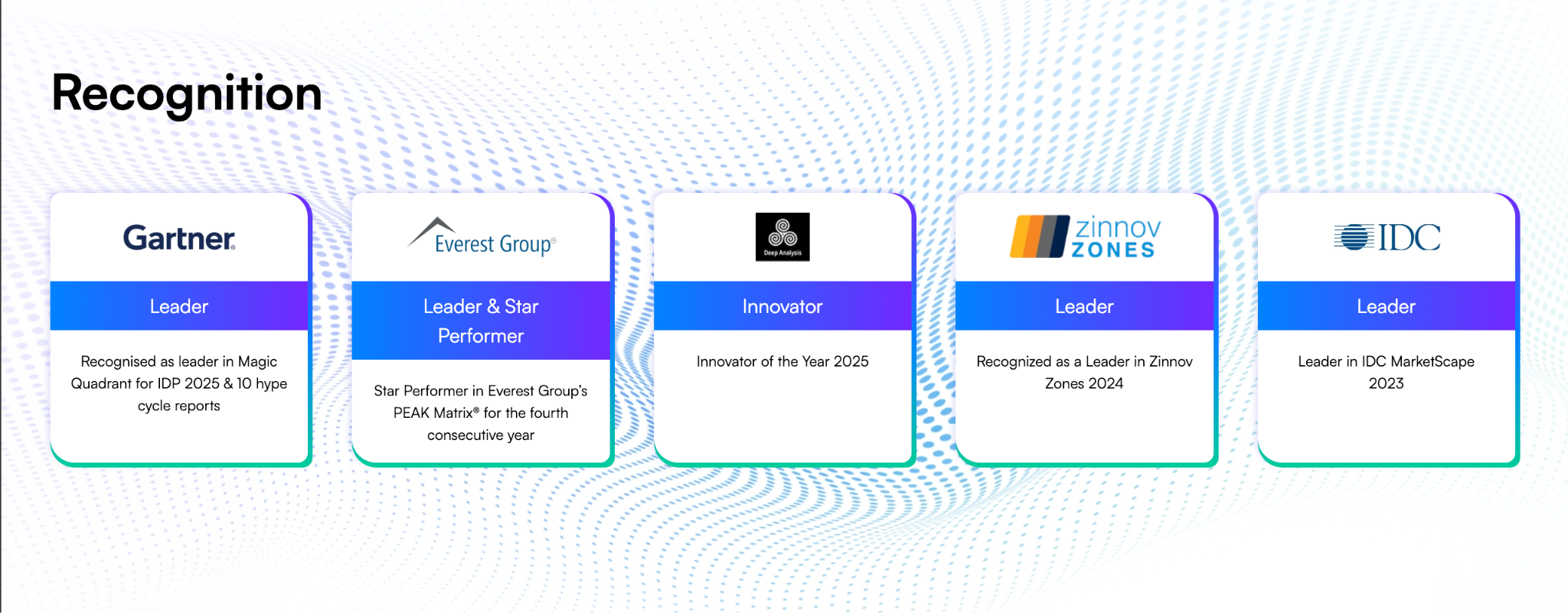
Check out all of Infrrd’s awards and recognitions here.
Authority-Forward 12+ Patents: The Innovation Engine Powering Infrrd's Technology
Infrrd's 12 patents reflect real technical problems we encountered in production, solved in ways the industry hadn't solved before, and protected because the solutions genuinely advance what's possible. They cover areas including multi-agentic learning frameworks, No-Touch Processing methodology, and approaches to document variability that enable the kind of accuracy rates our clients rely on.
For an enterprise buyer, patents matter for two reasons. There's evidence that the technology is real and differentiated, not a thin layer over commodity components. And they protect the continuity of the capability you're buying, the IP belongs to Infrrd, and it's not going anywhere.
100% Customer Retention And What That Number Actually Represents
This is the one we're most careful about, because it's easy to read as a sales claim and dismiss.
So here's what it actually means: every client that has gone live with Infrrd's IDP has continued working with us. Not a single one has left.
In a market where IDP implementations can be painful, where accuracy doesn't always match the pre-sales promise, and where support drops off after go-live, that number reflects something specific. It reflects what happens when a vendor builds for long-term outcomes rather than short-term deals.
We're not the cheapest option in the market. We're not the flashiest. But the clients who work with us tend to stay, and they tend to expand the scope of what we do together over time. That's the relationship we aim for with every new client we take on.
Why "Extract And Deliver" Is No Longer Enough
For a long time, the promise of IDP was simple: extract the data accurately, deliver it cleanly, and you're done. That was the finish line.
But in 2026, that isn’t enough.
The data being extracted doesn't exist in isolation. It feeds decisions. It triggers workflows. It needs to connect to downstream systems, pass compliance checks, inform approvals, and drive next actions. When you hand clean data to a human and ask them to figure out what to do next, you haven't automated the work; you've just automated the first step and left everything else unchanged.
The real opportunity in document processing isn’t just in extraction, it’s in what happens after. That’s where the most forward-thinking IDP implementations are now focused, including Infrrd.
From Mere Extraction to Insight: How We Extended our IDP into Agentic AI
For a long time, the role of an IDP system ended at extraction. Pull the data, send it forward, and the job was considered done.
Then we started paying closer attention to what our customers were actually dealing with. The data wasn't the real problem. What came after the data was: the handoffs, the decisions, the back-and-forth between systems and teams. People still had to step in, read the output, and figure out what to do next.
That's what led to Infrrd building an Agentic AI layer, Ally, on top of its Intelligent Document Processing software.
Instead of stopping at data extraction, it carries the work forward. It takes the processed document data and moves it through the next steps automatically: routing approvals, updating downstream systems, flagging issues, and completing the actions that would otherwise require someone to interpret the output and decide what to do with it.
But it's important to be clear about what agentic AI in document processing actually does and what it doesn't.
Infrrd’s Agentic AI doesn't replace human decision-making. It removes the repetitive data work that sits in front of it.
Take Ally, Infrrd's agentic AI built specifically for mortgage document workflows for example. Once document processing is complete, Ally handles the post-extraction tasks that typically consume auditor time: cross-document checks, field-level validations, and compliance reviews against regulatory requirements. When that work is done, anything that needs a human call gets flagged and handed to an auditor, with full context, not just a raw output.
Ally doesn't replace auditors. It clears the path so they can focus on what actually requires their judgment: reviewing exceptions, making decisions, and signing off with confidence.
That's the distinction that matters when evaluating agentic AI for document workflows. The goal isn't to automate human judgment. It's to make sure human judgment is spent on the work that genuinely needs it.
What To Do Next If You're Exploring Document Automation
Over the years, we have made a space for ourselves in the document automation, not by being the loudest in the room, but by doing the work, year after year, for ten years straight. So if you are exploring an Intelligent Document Processing Software in 2026, you do not have to take our word for it. Read the analyst reports. Go through the customer stories. Let the people who have already made the decision help you make yours.
Happy automating!
FAQs About Intelligent Document Processing Software
Q. What is intelligent document processing software?
Intelligent Document Processing software is an AI-powered system that automates the extraction, classification, and validation of data from documents. Unlike basic OCR, IDP understands context, handles variable document formats, and integrates with downstream business systems to enable straight-through processing at scale.
Q. How is IDP different from OCR?
OCR converts document images into machine-readable text. IDP goes further: it understands what that text means, extracts specific fields based on context rather than position, validates extracted data, flags exceptions, and routes information into business workflows. OCR is a component within IDP — it's not the same thing.
Q. What features should the best IDP software have?
The capabilities that separate strong IDP software from the rest include: high accuracy on variable and complex documents, clear confidence scoring on every extracted field, exception handling that surfaces useful information rather than generic errors, a straight-through processing rate that increases over time, integration flexibility with downstream systems, and a feedback loop that improves the system based on human review corrections.
Q. Can IDP handle handwritten documents?
Yes, the best IDP systems can. Handwriting variability is one of the harder problems in document processing, and it's where many OCR-based systems fail. Infrrd's models handle handwritten fields with over 95% accuracy in production deployments, including on financial and operational documents where that accuracy directly affects business outcomes.
Q. Which industries benefit most from IDP?
Any industry that processes high volumes of documents with business-critical information benefits from IDP. In practice, the highest-impact deployments are in financial services (mortgage origination, accounts payable, loan processing), insurance (claims processing, policy management), and industries with complex technical documents (engineering, procurement, construction).
Q. How do I choose the right IDP software?
Evaluate on four dimensions: accuracy on your specific documents (not vendor samples), straight-through processing rate in a realistic pilot, integration depth with your existing systems, and the quality of the vendor relationship. Analyst evaluations and reference customer conversations are the most reliable external inputs — more reliable than vendor-produced benchmarks.
Q. Is human review still necessary in IDP?
For most deployments, yes, but at a fraction of the volume you'd review without IDP. The goal isn't to eliminate human judgment. It's to focus human judgment on the cases that genuinely need it, while processing everything else automatically. A well-implemented IDP system should reduce your review volume significantly, while making the review that remains faster and more efficient.
Q. How long does IDP implementation take?
It depends on document complexity, integration requirements, and the scope of the deployment. Simple, structured document types with standard integrations can go live in weeks. Complex, multi-format deployments with custom integrations typically take two to four months. A realistic vendor should be able to give you a timeline based on your specific requirements, and should be transparent about what affects it.
Q. What should I measure in an IDP pilot?
Accuracy on your documents, straight-through processing rate, exception quality and clarity, integration reliability, and vendor responsiveness. Measure these against the baseline of your current process, so you can calculate the real impact before committing to full deployment.
Q. How do I calculate ROI from IDP software?
Start with what you're spending today: labour costs for manual processing, error rates, and the downstream cost of errors, processing time and the business impact of delays. Then model the impact of your expected straight-through processing rate, reduced error rate, and processing speed improvements. The most defensible ROI calculation is one built from your actual pilot data, not vendor projections.

Priyanka Joy ist Produktautorin bei Infrrd und nähert sich Automatisierungstechnik wie eine neugierige Detektivin. Mit ihrer Liebe zur Recherche und zum Geschichtenerzählen verwandelt sie technische Tiefe in Klarheit. Wenn sie nicht schreibt, vertieft sie sich in Tanz, Theater oder schreibt an ihrer nächsten Erzählung.