- Document workflow automation involves using software tools to streamline and speed up the handling of documents throughout their life cycle.
- Document workflow automation fits seamlessly into document-heavy environments by automating tasks like data extraction, classification, and storage.
- Document workflow automation is a strategic necessity for document heavy industries such as mortgage, insurance, and engineering.
Document workflow automation is changing how work gets done across mortgage, insurance, and engineering. As documents become more complex and harder to manage, teams are under pressure to move faster and more efficient. That’s where automation steps in, simplifying workflows and taking repetitive tasks off the plate, so the focus can shift to what actually matters.
This guide examines the practical ROI of document workflow automation, with concrete metrics and a framework for evaluating impact across mortgage, insurance and engineering teams.
Let's dig in!
What is Document Workflow Automation?
Document workflow automation involves using software tools to streamline and speed up the handling of documents throughout their life cycle, from creation to archiving. Instead of relying on manual input and oversight, automation uses technology to manage documents, reduce human intervention, and handle repetitive tasks.
How It Fits into Document-Heavy Workflows
Document workflow automation fits seamlessly into these document-heavy environments by automating tasks like data extraction, classification, and storage. It ensures that documents are processed faster, more accurately, and with minimal human involvement, freeing up employees to focus on higher-value tasks.
Why The ROI of Document Workflow Automation Matters in 2026?
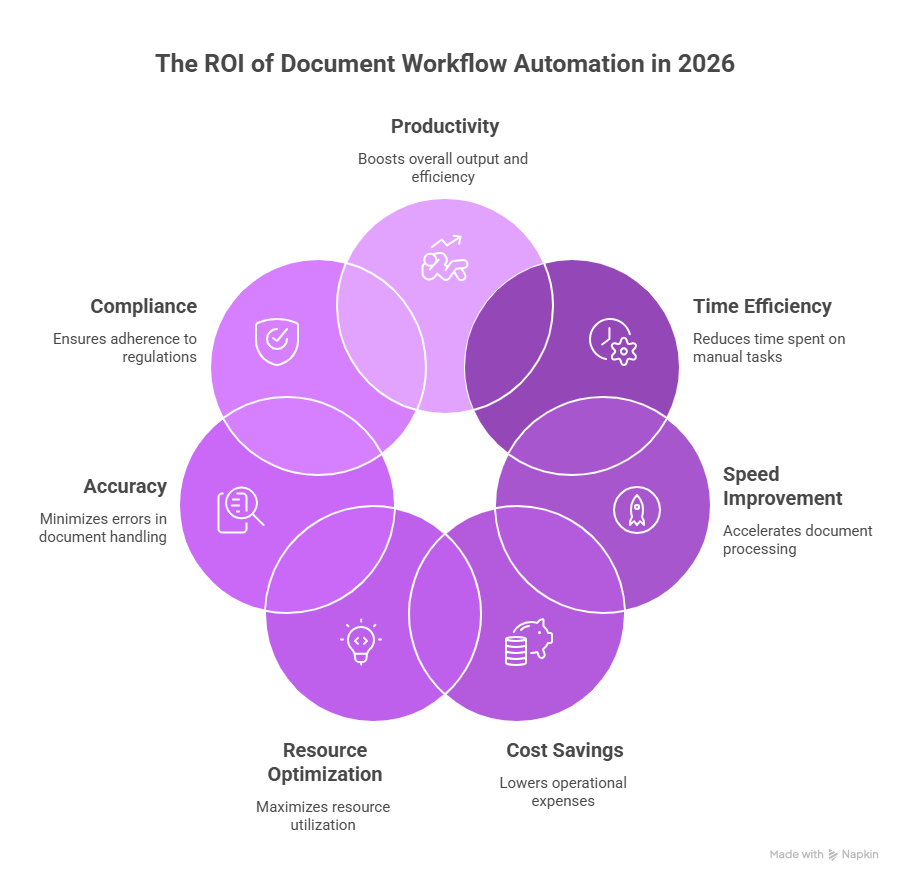
As economic pressures intensify and operational expectations rise, organizations can no longer afford to treat document management as a back-office afterthought. In 2026, the ability to demonstrate measurable returns on technology investments has become a strategic imperative. Document workflow automation stands out as one of the highest-yield investments available, delivering quantifiable gains across time, cost, accuracy, and workforce productivity.
Time Efficiency
Time is business money, and document workflow automation has a direct impact on reducing processing times. By speeding up document handling, automation reduces the turnaround time for important tasks, such as loan approvals in mortgages or claim processing in insurance. In fact, McKinsey reports that 60% of employees could save up to 30% of their time with automation, significantly boosting productivity and contributing to overall ROI.
Speed Improvement
One of the most immediate and visible ways automation delivers ROI is through dramatic improvements in processing speed. Tasks that previously required hours or even days can now be completed in a matter of minutes. Businesses that have implemented document workflow automation report up to an 80% reduction in processing time, enabling faster client service, shorter decision cycles, and more responsive operations overall. In competitive industries such as mortgage lending and insurance, this speed advantage is not just operational; it is a differentiator.
Cost Savings and Resource Optimization
Automation significantly reduces dependence on manual labor for routine tasks such as data entry, document sorting, and compliance checks. As a result, organizations realize meaningful savings on payroll, onboarding, and staff training costs.
Beyond labor, automation also reduces the frequency of costly errors that require rework or remediation. Document workflow automation consistently drives down processing costs, providing businesses with sustainable, long-term financial benefits that only compound as document volumes grow.
Accuracy and Data Integrity
Automation helps in reducing human error, a common problem in manual document handling. Errors in financial data, claims, or engineering specs can lead to compliance issues or costly mistakes. By using automation, businesses can ensure data is captured and stored accurately, improving compliance and reducing risk. When every document is processed in the same way, accuracy is no longer a guessing game.
Scaling Without Scaling Headcount
As businesses grow, they often face the dilemma of having to increase their headcount to manage more work. With document workflow automation, this is no longer necessary. Companies can process more documents without adding more employees. This scalability ensures that businesses can expand operations without the corresponding increase in overhead costs.
Compliance Adherence
Regulatory compliance is a non-negotiable requirement across the mortgage, insurance, and engineering sectors. The cost of non-compliance, in fines, legal exposure, and reputational damage, can be substantial.
Document workflow automation embeds compliance checks directly into the process, ensuring that every document is reviewed and processed in accordance with the applicable regulatory standards. Whether validating mortgage documents against federal lending guidelines or confirming that insurance claims meet state-mandated requirements, automation eliminates the compliance gaps that manual processes inevitably leave open.
Enhanced Productivity
Automation empowers employees to focus on tasks that require creativity, judgment, and critical thinking, rather than time-consuming manual work. When administrative work is automated, employees can work on higher-value activities, like customer service, analysis, or strategy. This results in a higher output from each employee, contributing to the company's bottom line.
Document Workflow Automation ROI vs Traditional Document Processing ROI
Understanding ROI in document operations is not just about cost savings, it’s about how efficiently work moves through your system. Traditional processing and automated workflows deliver fundamentally different outcomes when you look at time, accuracy, scalability, and long-term value.
ROI Calculation: Where Savings Show Up
Understanding where automation delivers its greatest returns requires looking beyond surface-level efficiency gains. The most meaningful ROI from document workflow automation surfaces across three interconnected areas: financial performance, operational accuracy, and processing throughput. Together, these dimensions provide a comprehensive picture of the value automation generates over time.
Financial ROI
Document workflow automation produces tangible financial returns that materialize across multiple areas of the business simultaneously. By reducing the volume of manual, repetitive tasks, organizations require fewer staff hours to process the same workload, resulting in direct and measurable labor cost savings. Improved accuracy further contributes to financial performance by minimizing the errors that typically lead to expensive rework, compliance remediation, or client disputes.
At the same time, faster processing speeds increase operational capacity, allowing businesses to handle greater document volumes within the same timeframe and, in turn, generate more revenue without a proportional increase in costs. Businesses typically see a return on investment of 200–300% within the first 12 months of deploying automation solutions, making it one of the most financially compelling technology investments available.
Measuring Accuracy and Throughput
Financial metrics alone do not capture the full ROI story. Accuracy rates and throughput speed are equally critical indicators of automation's impact and should be tracked consistently from the moment a solution goes live. When error rates decline, and documents move through workflows faster, the downstream benefits are significant: fewer corrections, shorter processing cycles, and more predictable operational outcomes.
Monitoring these metrics over time also allows organizations to identify bottlenecks, refine automated processes, and build a data-driven case for expanding automation across additional workflows.
Implementation Checklist: Steps to Get Started
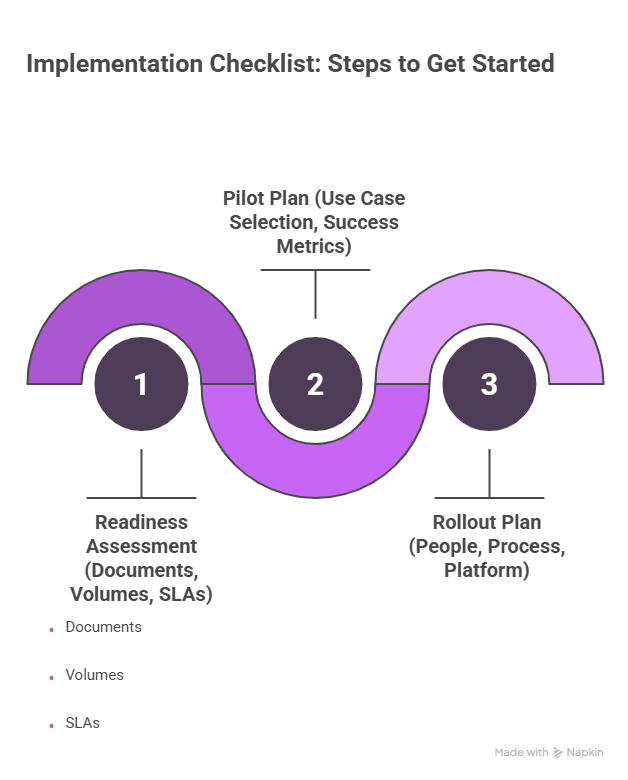
Deploying document workflow automation successfully requires deliberate planning across three distinct phases. Organizations that approach implementation with a structured framework are far more likely to achieve their target outcomes, avoid costly disruptions, and build internal confidence in the technology from the outset.
Readiness Assessment (Documents, Volumes, SLAs)
The first step toward automation is an honest evaluation of where the organization currently stands. This means taking stock of the types of documents being processed, the volumes handled on a daily and monthly basis, and the service level agreements that govern turnaround expectations. A thorough readiness assessment surfaces the workflows most burdened by manual effort, highlights the operational gaps that automation is best positioned to address, and provides the baseline data necessary to measure improvement once a solution is in place. Without this foundation, even well-designed automation implementations risk misalignment with actual business needs.
Pilot Plan (Use Case Selection, Success Metrics)
Rather than attempting a broad, organization-wide deployment from the start, businesses benefit significantly from launching a focused pilot program. Selecting a single, well-defined use case, such as automating mortgage loan document intake or insurance claim verification, allows teams to test the solution in a controlled environment, identify unforeseen challenges early, and refine the workflow before scaling.
Equally important is establishing clear, measurable success metrics at the outset, whether that means tracking processing time reduction, error rate improvement, or SLA compliance.
A well-executed pilot builds the internal evidence and stakeholder confidence needed to support a full-scale rollout.
Rollout Plan (People, Process, Platform)
A successful full-scale deployment depends on aligning three critical elements: people, process, and platform.
On the people side, staff must be adequately trained not just to use the new system, but to understand how their roles evolve within an automated workflow environment. On the process side, existing workflows must be carefully mapped and restructured to take full advantage of automation capabilities, rather than simply digitizing inefficient manual steps. On the platform side, the automation solution must integrate seamlessly with existing systems, including CRMs, ERPs, and document management platforms, to ensure continuity and avoid operational disruption.
When these three elements are aligned from the start, the transition from manual to automated workflows proceeds with clarity, confidence, and minimal friction.
Infrrd’s Approach to Document Workflow Automation
Infrrd delivers a No-Touch automation solution that handles the entire document lifecycle without human intervention. By using advanced AI to understand context and extract data from complex files, the system removes traditional processing bottlenecks. For high-stakes industries, Infrrd utilizes a Maker-Checker validation feature. The AI (Maker) extracts data, while a human (Checker) reviews only low-confidence flags to ensure 100% accuracy.
In a live deployment with a global withholding tax recovery provider, Infrrd reduced processing time by 80% and achieved 39% straight-through processing. The system identified errors early and limited manual review to only low-confidence cases, allowing teams to focus on higher-value work and improving overall efficiency and accuracy.
To calculate the potential savings and efficiency boost Infrrd’s IDP could provide, fill out a few details here: ROI Calculator
Conclusion
Document workflow automation is a strategic necessity for mortgage, insurance, and engineering firms. By eliminating manual bottlenecks, organizations strengthen their margins and accelerate growth. Beyond financial gains, automation ensures high data integrity and seamless compliance across every file. Transitioning to a No-Touch solution like Infrrd allows your team to focus on high-value strategy rather than repetitive data entry. Embracing this technology today secures a competitive edge and creates a scalable foundation for long-term operational success.
FAQs
Q1: What industries benefit most from document workflow automation?
Industries such as mortgage, insurance, and engineering, where documents are critical to operations, benefit the most from workflow automation.
Q2: How can automation improve audit and compliance readiness?
Automation ensures that every document is processed in compliance with industry regulations, reducing the risk of audit failures.
Q3: How does Infrrd ensure data accuracy in complex documents?
Infrrd uses advanced AI and machine learning, along with smart confidence scores, to accurately extract data from complex documents, ensuring reliable, high-quality results.
Q4: How long does it take to implement document workflow automation?
The time required to implement automation varies, but it typically takes anywhere from a few weeks to several months, depending on the complexity and implementation requirements, including planning, piloting, and full-scale deployment.
Q5: Can document workflow automation integrate with existing business systems like CRM and ERP?
Yes, Infrrd’s automation solutions are designed to integrate seamlessly with existing systems, enhancing productivity without disruption.
Q6: What are the common pitfalls when implementing document automation?
Common pitfalls include inadequate planning, lack of employee training, and poor integration with existing systems.
Q7: How do I calculate the ROI for my business?
ROI can be calculated by measuring time saved, cost reductions, and productivity improvements after implementing automation.
Q8: What steps should I take to prepare my team for document automation?
Prepare your team by providing training, setting clear expectations, and ensuring the automation solution integrates smoothly with existing workflows.
Q19: How does Infrrd’s automation handle multi-document workflows?
Infrrd’s solution can handle multi-document workflows by processing different types of documents simultaneously, ensuring fast and accurate data extraction across all documents.