- Infrrd's next-generation IDP connects information across documents to deliver evidence-backed findings that reviewers can verify confidently.
- AI identifies discrepancies, validation checks verify findings, and experts retain control over decisions and workflows.
- Traceable evidence, governed execution, and smarter processing help enterprises reduce manual effort and improve operational efficiency.
Two years ago, the most impressive thing you could ask an AI was, “Can you summarize this?” You fed it a long document, and it returned a much shorter one.
Then the ask got more specific: “Can you extract the gross pay from this pay stub?” Useful, but it was still one document at a time.
Today, the questions are much bigger. “Is this loan package complete?” “Does the income on the pay stub match the tax return?” “What checks out, what doesn't, and where is the supporting evidence?”
Answering these questions takes more than reading documents or connecting information across a case. Enterprises need to know whether an AI-generated finding is accurate, where the information came from, which checks were performed, and whether the result can be trusted. That's what pushed us to rethink our IDP pipeline.
Our next-generation approach brings together case-level understanding, evidence-backed findings, verification, human oversight, and governed execution. The goal isn't simply to help AI find an answer. It's to help enterprises verify that answer and understand how it was reached.
In this blog, we'll explore why we made this shift, what changed in our architecture, and how we're building document processing workflows that enterprises can trust.
Why We Needed to Change
Document processing has come a long way. Businesses that once spent hours manually reviewing documents can now extract information in minutes. But as automation improved, customer expectations grew. Faster data extraction was no longer enough to solve the entire problem.
What Our Customers Kept Telling Us
Our customers were seeing real improvements in processing speed, operational costs, and manual effort. Yet their teams were still spending time on work that happened after extraction.
Extracted Data Was Never The Real Goal
Think about a mortgage lender processing a 1,000-page loan package.
Extracting income from paystubs, tax returns, and bank statements is valuable. But the lender isn't collecting those numbers just to put them into a system. They need to establish whether the borrower's income is consistent, whether the required documents are present, and whether the loan meets specific conditions.
The real goal was never just to extract data or generate a finding. It was to give reviewers the reliable information, supporting evidence, and verification they need to make a confident decision.
The Decision Still Sat With A Person
Even with accurate data available, someone often had to connect the dots.
A reviewer would compare information across documents, identify discrepancies, check guidelines, and determine what needed attention. Automation reduced the time spent entering and reading data, but much of the reasoning still depended on people.
That raised a new question for us: Could document processing do more of the investigation and verification while giving people the evidence and control they need to make the final decision?
Where The Industry Is Heading
Businesses are increasingly evaluating complete cases rather than individual documents. A mortgage loan is assessed as a package. An insurance claim involves multiple forms, reports, and supporting records. A financial review may require information from several statements before concluding.
Our existing IDP technology was already processing large document packages and delivering meaningful returns. Customers could handle higher volumes, reduce manual work, and improve turnaround times. But success doesn't mean the technology has reached its limit.
We saw an opportunity to move beyond faster processing and build a system that understands how documents relate, identifies what matters, and helps teams reach decisions with supporting evidence.
That became the foundation of our next-generation IDP pipeline.
How Document Processing Worked Before and What Was Missing
Previous IDP pipelines were built to classify documents, extract information, validate fields, and deliver structured data to downstream systems. They made document processing significantly faster, including for large, complex document packages.
But extracting the right data didn't eliminate all the work required to review a complete case.
Reviewers still had to connect information across documents, investigate discrepancies, determine whether evidence was missing, and verify findings before making decisions.
Consider three common situations:
- Mortgage: Income figures differ between a paystub and a W-2.
- Insurance: The accident date on a claim form doesn't match the police report.
- Accounts payable: The quantity on an invoice differs from the goods received.
Extracting the values is only the beginning. The next step is understanding the discrepancy, checking the supporting evidence, and determining whether it needs human attention.
This revealed an opportunity: move beyond extracting and comparing information toward producing findings that are verifiable, traceable, and governed.
What We Do Now: From Case Understanding to Trusted Answers
Our next-generation IDP architecture doesn't stop at understanding how documents relate within a case. It brings that information into a controlled workflow where findings can be verified, traced to supporting evidence, and reviewed before decisions are made.
Case-level understanding makes this possible. But the differentiator lies in what happens next: how the system verifies findings, governs execution, records decisions, and involves human experts when judgment is required.
From Documents To Cases
A case is a collection of related documents working toward one outcome. For a mortgage lender, that could mean an entire loan package. For an insurer, it could mean a claim containing application forms, supporting records, and reports.
The pipeline brings these documents together, identifies their relationships, and evaluates them against the case's requirements.
Relate: One Map Of The Whole Case
At the center of this approach is Relate, our case relation engine. It builds a connected view of the people, organizations, facts, and evidence appearing across documents.
- Recognizing The Same Person Or Company Across Documents
A borrower might appear as "John Smith" on a paystub and "John A. Smith" on a tax return. Similarly, a claimant may appear across an insurance claim form and a police report, or a vendor may be referenced differently on a purchase order and an invoice.
Relate connects these identities when the evidence supports a match, rather than treating every name variation as a separate entity.
- Spotting Where Documents Disagree
A pay stub may report a different income figure from a W-2. An insurance claim form may list an accident date that differs from the police report. An invoice may show quantities that don't match the goods receipt.
Relate helps connect these facts across documents, identify inconsistencies, and preserve supporting evidence so investigators can review and verify it.
- Making Missing Evidence Explicit
If a mortgage loan requires two months of bank statements but includes only one, the missing month becomes a recorded evidence gap. Similarly, an insurance claim may be missing a required repair estimate, or an invoice may lack its corresponding purchase order.
Relate helps make these evidence gaps explicit, allowing teams to identify incomplete cases earlier instead of discovering missing documents later in the review process.
- Giving AI a Cited, Right-Sized View Of The Case
Not every task requires reviewing an entire document package. Checking borrower income, verifying an insurance claim date, or matching an invoice against a purchase order may require only specific documents, pages, and fields.
Relate is designed to provide AI with a focused, cited view of the relevant information while preserving access to the supporting evidence. This approach aims to reduce unnecessary processing and help reviewers trace findings back to their sources.
Case Planner: AI Plans, Experts Approve
The Case Planner uses case requirements and processing rules to draft the steps needed for a workflow. Rather than giving AI unrestricted freedom to execute tasks, the approach is designed around defined, approved processing paths.
Experts review and approve workflows before execution. AI operates within those approved boundaries, helping enterprises maintain control over how documents are processed, checked, and reviewed.
The result is a more governed approach to automation, where AI helps plan the work but doesn't independently decide the rules.
Evidence Graph: Every Conclusion Tied To Its Source
A finding is only as useful as the evidence behind it. The Evidence Graph connects findings to the information used to produce them. Reviewers can trace a result back to its source document, page, and line, rather than accepting an AI-generated response without knowing where it came from.
For example, if a mortgage income check identifies a discrepancy, the reviewer should be able to see which figures were compared, where those figures appeared, and what triggered the finding.
The same principle applies to a disputed accident date in an insurance claim or a mismatch between an invoice and a purchase order. This traceability helps reviewers verify findings without having to reconstruct the investigation from scratch.
That's why our next-generation architecture focuses on five principles.
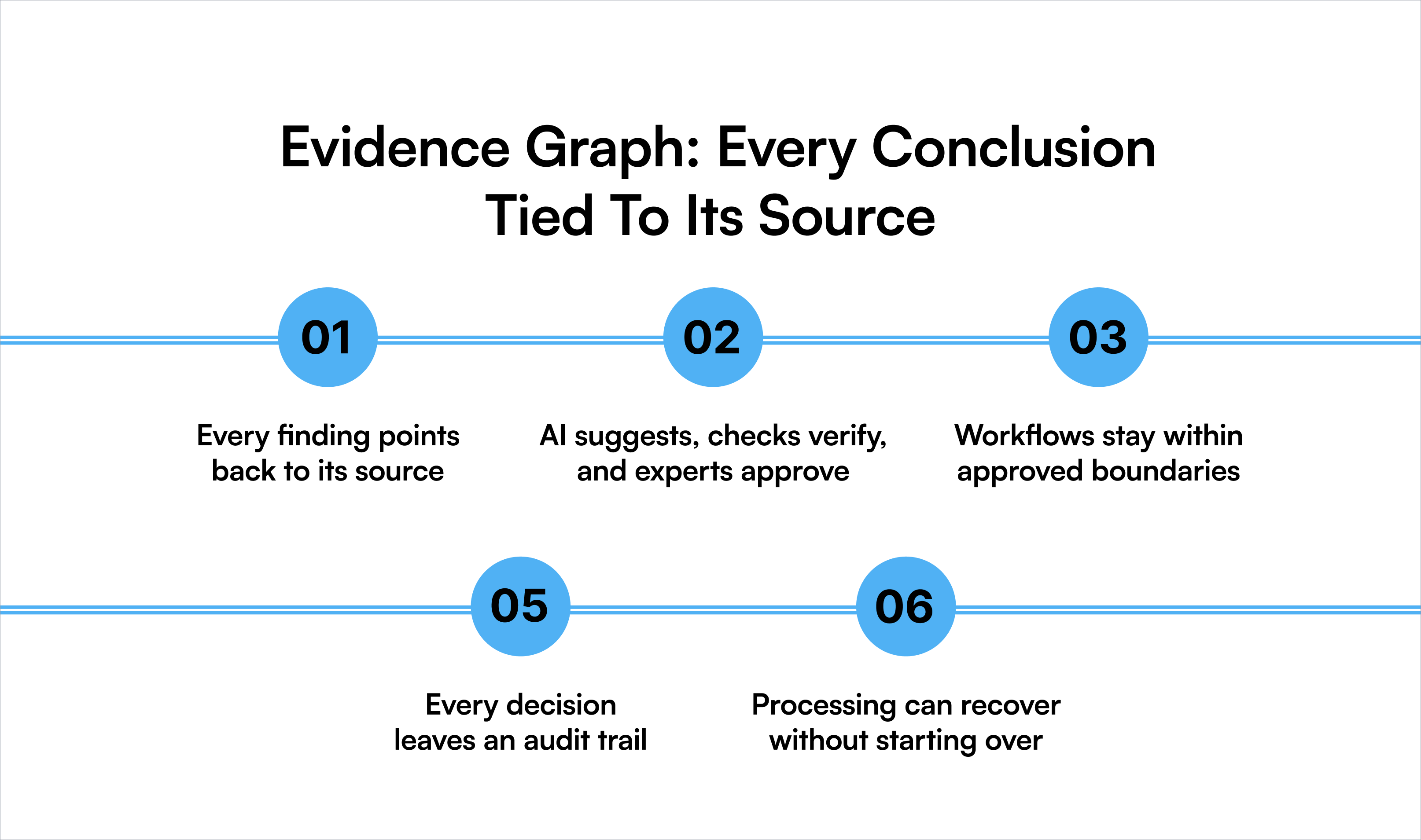
1. Every finding points back to its source
Findings are linked to supporting evidence, including the source document, page, and line. This allows reviewers to verify information directly instead of relying on an AI-generated answer alone.
2. AI suggests, checks verify, and experts approve
AI helps identify discrepancies, investigate information, and recommend next steps. Defined validation checks test the findings, while human experts retain responsibility for decisions that require their judgment.
3. Workflows stay within approved boundaries
AI doesn't have unrestricted freedom to execute workflows. Processing follows approved rules and paths, helping organizations maintain control over which actions the system can perform.
4. Every decision leaves an audit trail
The system records processing steps, findings, and decisions so teams can revisit what happened, understand the supporting evidence, and review how an outcome was reached.
5. Processing can recover without starting over
If a workflow is interrupted, the execution layer is designed to resume from a saved checkpoint instead of repeating completed work. This helps avoid duplicate processing and billing while keeping the workflow consistent.
Together, these capabilities are designed to make document processing more than automated. They make it verifiable, governed, and accountable.
Smarter Extraction: Only What The Decision Needs
Not every decision requires processing every page and every field in a document package.
The next-generation architecture is designed to identify relevant rules, fields, and supporting pages so processing can focus on the information needed for a particular task. By prioritizing relevant evidence, this approach aims to reduce unnecessary processing while keeping the information needed for verification accessible.
How This Benefits Enterprises
The goal of our next-generation pipeline isn't simply to introduce more AI into document processing. It's to reduce the work customers still have to do after extraction. Here's what these capabilities are designed to change.
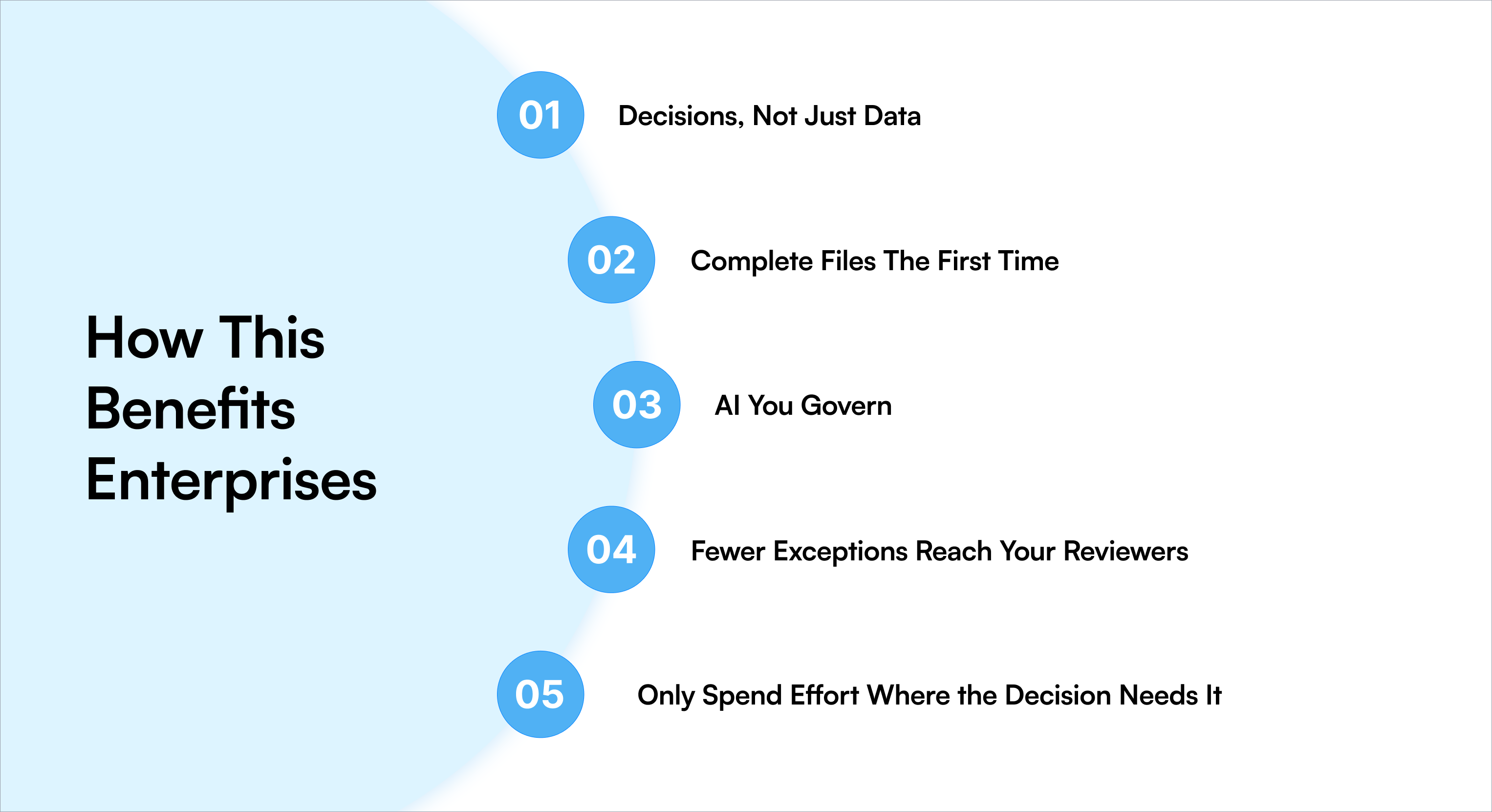
Decisions, Not Just Data
Instead of receiving extracted fields and figuring out what they mean, teams can receive case-level findings. Instead of receiving extracted fields alone, teams can receive findings that show which checks passed, which identified discrepancies, and which require additional evidence. Each finding can be connected to its source, helping reviewers verify the results before making the final decision.
Complete Files The First Time
Missing documents and incomplete evidence can be identified earlier. Rather than discovering a missing tax return days into processing, teams can request it during intake and continue once the required information arrives.
AI You Govern
The Case Planner drafts workflows, but people remain in control. Experts approve the rules and processing paths before execution. Planned Locked and Guided modes would allow organizations to choose between fixed workflows and controlled agent decisions.
Fewer Exceptions Reach Your Reviewers
Not every processing issue requires human intervention.
The architecture is designed to handle routine problems through retries, additional checks, and evidence-based investigation. Cases that require judgment or further clarification can then be routed to reviewers.
The goal is to reduce unnecessary review work so people can focus on the exceptions that genuinely need their expertise.
Only Spend Effort Where the Decision Needs It
A 300-page loan package doesn't necessarily require the same level of processing on every page.
The architecture is designed to identify relevant documents, pages, and fields for a particular task, helping prioritize the work that matters most.
This targeted approach aims to reduce unnecessary processing effort without compromising access to the evidence needed for verification.
What this means across industries: Mortgage teams can evaluate complete loan packages. Insurers can connect evidence across claims. Financial services teams can review information across statements and records. Logistics teams can investigate discrepancies between shipping documents.
Each industry has different requirements, but the opportunity is the same: less manual investigation and more reliable, evidence-backed outcomes.
The Next Chapter of Intelligent Document Processing
The future of IDP isn't simply about extracting more data, processing more pages, or understanding more documents at once.
It's about giving enterprises answers they can verify and workflows they can control.
That means connecting every finding to its source, validating AI-generated results, keeping people responsible for critical decisions, and maintaining a record of how each outcome was reached.
At Infrrd, we're building toward that future by combining case-level intelligence with governed execution, traceable evidence, and human oversight.
Because the real measure of intelligent document processing isn't just how quickly it produces an answer.
It's how confidently that answer can be trusted.