- Agentic AI transforms insurance document processing by autonomously reading, understanding, and acting on files, eliminating manual workflows.
- Agentic AI transforms insurance document processing by breaking it down into a series of intelligent, automated steps that work together seamlessly
- the transition from manual entry to Agentic AI is no longer a luxury, it is a competitive necessity.
Insurance companies deal with thousands of documents every single day. Going through all of them manually takes a lot of time and often leads to mistakes. This is where Agentic AI in insurance document processing is making a real difference. Instead of waiting for humans to sort and review every file, AI systems can now read, understand, and act on documents on their own.
The results speak for themselves. Smarter claim routing has improved accuracy by 30%, which has led to a 65% drop in customer complaints. AI has also cut down false claim rejections by 15%, meaning fewer valid claims are wrongly denied. On top of that, AI-powered underwriting tools have made pricing 20–30% more accurate, which has helped reduce financial losses and kept more customers from leaving.
This guide is written for insurance and financial teams who want to understand how agentic AI actually works in document processing — and how it can be applied in real, day-to-day operations. Whether you are new to the topic or looking to go deeper, this guide will walk you through everything in a clear and straightforward way.
What Is Agentic AI in Insurance Document Processing?
Agentic AI refers to the application of advanced AI systems that not only automate tasks but also make intelligent decisions based on document data. In insurance document processing, this AI takes charge of post data extraction tasks like validating, and cross-checking data. Unlike traditional AI systems, which require significant human intervention, agentic AI performs a majority of the work autonomously, ensuring faster and more accurate results.
Where It Fits in Document-Heavy Workflows?
Insurance companies deal with large volumes of documents daily. These documents range from claims, policies, underwriting applications, and more. Agentic AI fits into this workflow by automating validation, and processing of these documents. It reduces the need for this nlp friendly manual data entry and error-prone human checks, speeding up the workflow and improving accuracy.
Agentic AI enables insurers to eliminate document-heavy bottlenecks. By autonomously scanning forms, validating data, and cross-referencing systems, these intelligent agents process complex documentation faster and more accurately than manual workflows, significantly increasing operational efficiency.
Why Agentic AI in Insurance Document Processing Matters in 2026?
As insurance companies face growing document volumes and tightening regulatory demands, agentic AI has emerged as a critical tool for staying competitive. Its ability to autonomously process, validate, and route documents is reshaping how insurers operate at scale. Understanding why this technology matters today comes down to three core areas: speed and cost, accuracy, and compliance readiness.
Time, Cost, and Accuracy Impacts
In 2026, time is money in the insurance industry. With the sheer volume of paperwork insurers handle, the speed of processing can directly affect profitability. Agentic AI reduces the time spent on each document by automating repetitive tasks. This leads to faster claim processing and underwriting decisions.
Additionally, it helps save costs by minimizing the need for human intervention in routine tasks. Errors caused by manual entry are also reduced, lowering the risk of financial loss and compliance violations. A more accurate system means fewer claim denials or delays, which in turn improves customer satisfaction.
Compliance and Audit Readiness
Regulatory compliance is one of the most pressing concerns in the insurance sector. Agentic AI helps organizations stay ahead of this by ensuring that all data extracted from insurance documents aligns with industry regulations. During processing, the system automatically flags potential issues such as missing or incorrect information, keeping documents audit-ready at every stage. It also maintains a detailed, transparent log of every action taken, providing a reliable audit trail for future reviews or regulatory inquiries.
How Agentic AI Insurance Document Processing Works?
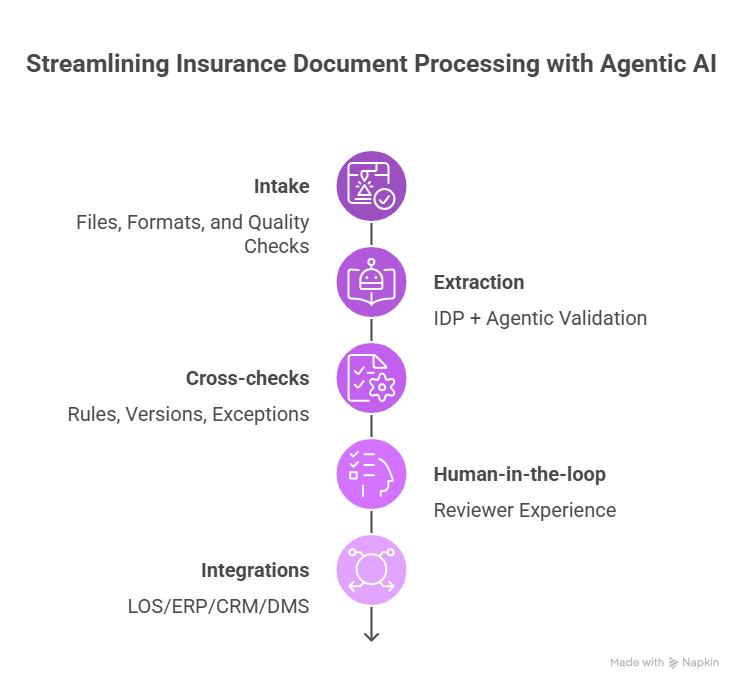
Agentic AI transforms insurance document processing by breaking it down into a series of intelligent, automated steps that work together seamlessly. Rather than relying on manual handoffs between teams, the system guides each document through a structured pipeline from intake to integration. Here is a closer look at how each stage operates.
Intake: Files, Formats, and Quality Checks
The process begins with the intake of documents. Agentic AI automatically identifies the format of the incoming files, whether they’re PDFs, scans, or images. It checks for quality, such as clarity, legibility, and completeness, before moving forward with data extraction.
Extraction: IDP + Agentic Validation
Once the documents are processed, the system uses Intelligent Document Processing (IDP) technology combined with agentic AI to extract relevant data. Whether it’s claim numbers, policy details, or customer information, the AI validates the extracted data against predefined rules to ensure accuracy.
Cross-checks: Rules, Versions, Exceptions
Agentic AI performs cross-checks to compare extracted data against various sources such as internal databases, external systems, or other documents. It verifies that the data is consistent and flags any discrepancies, exceptions, or version changes for review.
Human-in-the-loop: Reviewer Experience
Even though agentic AI handles most of the work, human involvement is still required for exceptional cases. The AI identifies edge cases or errors that require human validation, allowing the reviewer to focus only on critical issues while leaving routine tasks to the AI.
Integrations: LOS/ERP/CRM/DMS
Agentic AI integrates seamlessly with existing insurance management systems, including Loan Origination Systems (LOS), Enterprise Resource Planning (ERP) systems, Customer Relationship Management (CRM) platforms, and Document Management Systems (DMS). This allows data to flow effortlessly across systems, reducing the need for manual data entry and ensuring consistency.
Generative AI v/s AI Agents v/s Agentic AI
Not all AI works the same way. In insurance document processing, three distinct layers shape how work gets done, each with a different role, autonomy level, and purpose. Here is how they compare.
Key Challenges of Using Agentic AI in Insurance Document Processing
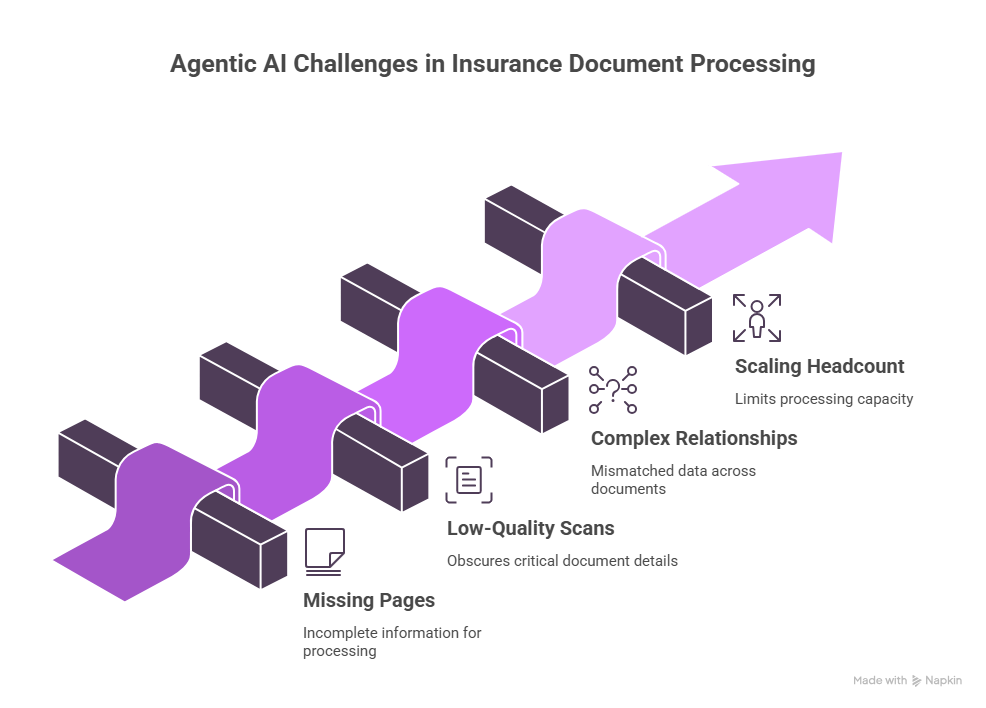
Implementing agentic AI in insurance document processing is not without its hurdles, as real-world documents rarely arrive in perfect condition. From incomplete files to complex multi-document relationships, these obstacles can slow down even the most well-designed workflows. Fortunately, agentic AI is built to anticipate and address these challenges head-on.
Missing Pages & Version Drift
One challenge in document processing is handling missing pages or version discrepancies. Agentic AI can identify incomplete documents and automatically request missing pages or versions, ensuring that the entire document is processed without human intervention.
Low-Quality Scans, Handwriting, Stamps
Low-quality scans or handwritten notes on documents can complicate data extraction. However, agentic AI, when combined with Optical Character Recognition (OCR), can improve the accuracy of data extraction even from poorly scanned or handwritten documents. It learns to recognize diverse fonts, writing styles, and stamps.
Complex Multi-Doc Relationships & Data Mismatches
In insurance, multiple documents often need to be linked together, such as claims, medical records, and policy documents. Agentic AI can automatically identify relationships between documents and cross-check data across these linked files. This helps resolve mismatches and ensures that all data is consistent.
Scaling Without Scaling Headcount
One of the most significant benefits of agentic AI is its ability to scale without increasing headcount. Insurers can process more documents faster without needing additional staff. This is particularly valuable during high-volume periods, such as after natural disasters or during policy renewal seasons.
Implementation Checklist for Agentic AI in Insurance Document Processing
Rolling out agentic AI in insurance document processing requires more than just deploying technology; it demands a structured approach at every stage. This checklist walks insurers through the key steps needed to move from initial evaluation to full-scale adoption with confidence. Following each phase in order helps minimize risk and sets the foundation for long-term success.
Readiness Assessment
Before any implementation begins, insurers need to take an honest look at where they currently stand. This means evaluating existing document workflows, auditing the current technology stack, and understanding the skill levels of the teams who will be working alongside the new system. A thorough readiness assessment helps identify gaps early and ensures that the infrastructure is well-positioned for a smooth integration with agentic AI.
Pilot Plan
With readiness established, the next step is designing a focused pilot plan. This involves selecting a representative sample of users and document types to test the system under real conditions. Running a controlled pilot allows insurers to surface edge cases, uncover unexpected friction points, and make informed adjustments before committing to a broader rollout.
Rollout Playbook
Once the pilot has been validated, the organization can move toward full-scale deployment. A well-structured rollout playbook serves as the operational guide for this phase, covering everything from system configuration and employee training to escalation protocols and ongoing support structures. Having this playbook in place ensures that every team transitions consistently and confidently, with minimal disruption to daily operations.
Infrrd’s Approach
Infrrd offers AI-driven document automation purpose-built for document-heavy industries like insurance. Its Intelligent Document Processing (IDP) platform classifies, extracts, and validates documents before routing them directly into operational systems to support underwriting and compliance workflows, enabling fully no-touch document processing.
Infrrd's flagship product, iTrackPro, is purpose-built to overcome the limitations of manual extraction and bridge the gaps left by traditional IDP solutions. With 60+ pre-configured extraction fields and industry-specific capabilities, it delivers fast, accurate, and reliable data tailored to insurance compliance demands.
Conclusion
In 2026, the transition from manual entry to Agentic AI is no longer a luxury, it is a competitive necessity. By moving beyond simple data extraction to autonomous decision-making and workflow orchestration, insurance teams are achieving unprecedented gains in accuracy and speed.
As demonstrated, the integration of tools like Infrrd’s iTrackPro allows firms to tackle complex document extraction without increasing headcount.
By automating the "managerial" layer of document processing, insurers can finally eliminate operational bottlenecks, reduce customer friction, and ensure every claim or policy is audit-ready. Embracing this intelligent autonomy today sets the foundation for a more resilient, scalable, and data-driven future in the financial sector.
FAQs
What is agentic AI in insurance?
Agentic AI is a form of artificial intelligence that automates document processing tasks like data extraction, validation, and cross-checking. It handles most of the work autonomously, requiring minimal human intervention.
How does agentic AI improve insurance claims processing?
By automating the review of claims documents, agentic AI speeds up the process, reduces errors, and ensures compliance. This leads to faster decisions and improved customer satisfaction.
What are the benefits of agentic AI for insurers?
Agentic AI improves operational efficiency, reduces costs, increases accuracy, and supports compliance and audit readiness.
What are common use cases of agentic AI in insurance?
Common use cases include claims processing, underwriting, policy issuance, and document verification.
How is agentic AI different from traditional AI or RPA in insurance?
Unlike traditional AI or Robotic Process Automation (RPA), agentic AI makes decisions based on data, automating more complex tasks with minimal human oversight.
What is intelligent document processing (IDP) in insurance?
IDP is the technology used by agentic AI to extract, validate, and classify data from unstructured documents like claims forms and policy applications.
How do agentic AI systems handle low-quality or handwritten insurance documents?
Agentic AI systems, when combined with OCR, can read and extract data from low-quality scans or handwritten documents, ensuring accuracy even with imperfect input.
What are common challenges when implementing agentic AI in insurance?
Challenges include handling low-quality documents, version drift, and the complexity of multi-document relationships. These can be mitigated through proper system training and integration.
How does agentic AI support compliance and auditing in insurance?
Agentic AI tracks every action taken during document processing, providing a transparent audit trail for compliance purposes. It also ensures that all documents meet regulatory standards.
What metrics indicate the ROI of agentic AI in insurance?
Metrics such as increased throughput, higher accuracy rates, reduced processing time, and improved customer satisfaction indicate strong ROI from agentic AI adoption.